

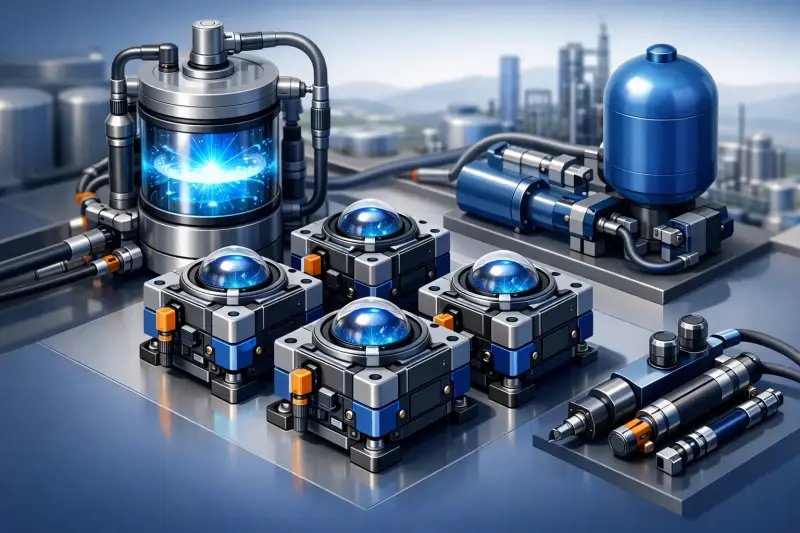
Industrial sites rarely need electricity alone; they require high-torque drive, power, cooling, pressure, and heat. Conventional generation converts thermal energy into rotating power via crankshafts or turbines before reaching a load. Each step introduces friction, control complexity, and maintenance exposure. Industrial hydraulic generation changes this path by treating pressurized fluid as the principal medium to transfer power, store energy, and match demand directly.
At its core, a thermal, electrical, or chemical source produces hydraulic pressure and flow as primary output. The governing principle is simple: power equals pressure multiplied by flow. Pressure dictates torque, while flow controls speed, separating the energy core from variable load demands. A robust system relies on four layers: energy conversion, a hydraulic circuit, energy conditioning/storage (accumulators, heat exchangers, filtration), and the final work interface.
Direct hydraulic coupling eliminates intermediate electrical conversions for pumping, gas compression, or driving high-inertia loads. Electricity remains for controls, lighting, and computing, but isn't mandatory for every kilowatt of work. Furthermore, accumulators absorb pressure surges and supply peak flow during load steps, letting the energy core operate smoothly near its ideal steady-state.
This principle is central to pulse-based isolated combustion. Managing combustion separately from the hydraulic working circuit removes crankshaft constraints, lowering parasitic losses and insulating the energy core from load variation.
Topologies vary by demand:
- Steady demand: Continuously operated cores paired with hydraulic motor-generators and CHP (heat recovery for steam, drying, or desalination).
- Variable loads: Accumulator-backed storage supplying short bursts while maintaining stable core operation.
- Future fuels: Hydrogen and ammonia adoption require material compatibility and tailored combustion, preserving the downstream hydraulic architecture.
Designing a performant system requires backward modeling from driven equipment. High pressure reduces pipe sizes but demands precise sealing and contamination control. Fluid cleanliness is critical; continuous filtration and monitoring prevent premature failure. Similarly, thermal management determines whether waste heat is rejected or recovered as a valuable CHP asset.
Economics excel when multiple energy services overlap—like power, high-pressure pumping, and cooling in desalination, data centers, or greenhouses. The financial case rests on total site energy costs, displaced boiler fuel, avoided electrical conversions, and modular deployment.
Hydro Puls Systems addresses this through the HPDD concept: a direct-drive, pulse-based architecture functioning as an Autonomous Energy Heart. It separates combustion from load dynamics, making hydraulic power a primary industrial output. The strongest projects start by targeting conversion losses and unstable loads where conventional architecture fails, delivering an energy system built precisely around what the plant needs to produce, move, heat, and cool.