

🛢️ Rethinking Well Drilling:
Why Underbalanced Drilling (UBD) is a Game-Changer.
In conventional drilling, maintaining overbalanced fluid pressure is the standard safety net to prevent reservoir fluids from entering the wellbore.
But what if maintaining lower pressure is actually the key to unlocking maximum production and efficiency?
Enter Underbalanced Drilling (UBD).
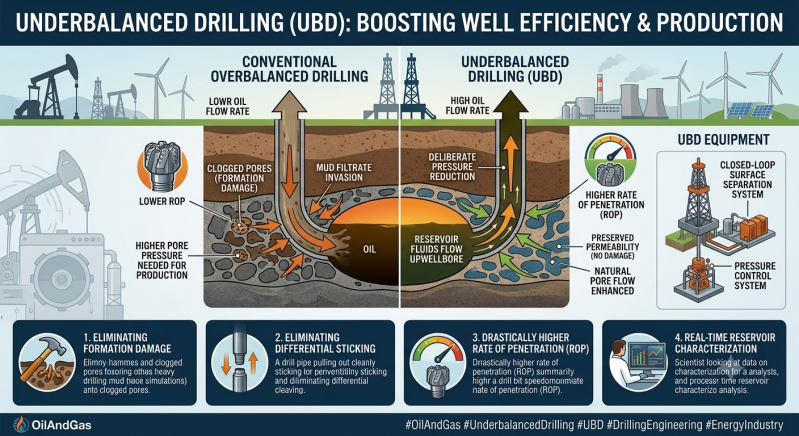
By keeping the hydrostatic pressure of the drilling fluid deliberately lower than the formation pore pressure, UBD allows reservoir fluids to flow into the wellbore while drilling.
Here is why this technique is reshaping modern drilling economics:
1. Eliminating Formation Damage
Traditional overbalanced drilling forces drilling mud and solids into the formation rock pores, causing permanent skin damage and clogging fluid pathways. UBD prevents mud filtrate invasion entirely, preserving the natural permeability of the reservoir and maximizing initial flow rates.
2. Eliminating Differential Sticking
When wellbore pressure exceeds formation pressure, the drill string can easily get sucked into the filter cake against the wall. UBD eliminates the differential pressure gradient toward the formation, virtually removing the risk of costly stuck pipe incidents.
3. Drastically Higher Rate of Penetration (ROP)
Without the heavy column of mud holding back the rock at the bit face ("chip hold-down effect"), bits cut through formation rock significantly faster. Higher ROP means fewer rig hours, reduced bit wear, and faster time to total depth (TD).
4. Real-Time Reservoir Characterization
Because formation fluids flow to the surface during drilling, UBD acts as a continuous well test. Engineers get immediate, real-time data on produced fluids, flow rates, and reservoir boundaries, before even running completion tools.
⚙️ The Operational Catch? Precision Control
UBD isn't a silver bullet for every field. It requires:
Closed-loop surface separation systems to safely handle hydrocarbons at the surface.
Continuous pressure management (MPD/UBD equipment) to maintain the delicate pressure envelope.
Specialized downhole tools (like deployment valves) to trip pipe safely under pressure.
The Bottom Line
Where target zones are highly depleted, fractured, or susceptible to heavy formation damage, Underbalanced Drilling delivers lower total cost per barrel produced, turning challenging reservoirs into highly lucrative assets.
💡 Have you implemented UBD in depleted or fractured formations? What were your biggest surface-equipment or pressure-management challenges?
#OilAndGas #DrillingEngineering #UnderbalancedDrilling #UBD #Upstream #PetroleumEngineering #EnergyIndustry #WellIntervention