

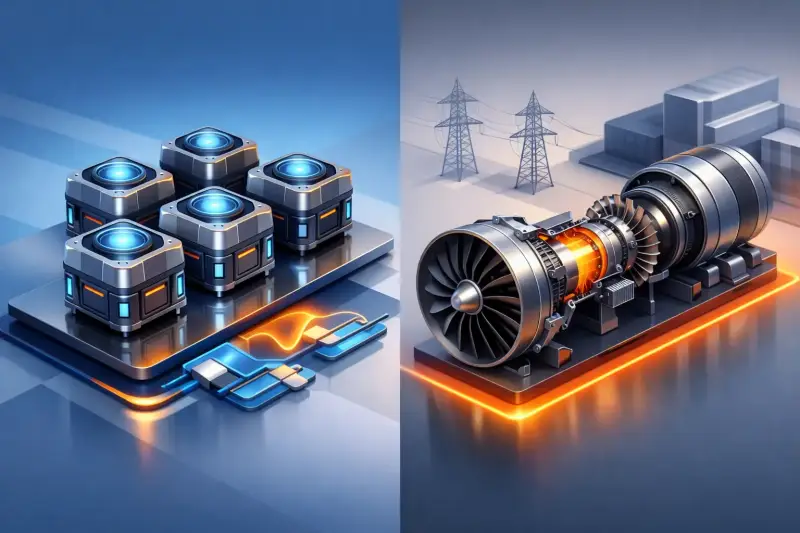
A compressor train that needs stable shaft power, a data center that needs electricity plus cooling and water, and a cement plant that needs process heat are not buying the same energy system. Yet many projects begin with the same default assumption: install a gas turbine and engineer the balance of plant around it. The direct drive vs gas turbine decision is more fundamental than a comparison of rated electrical output. It determines where losses occur, how the system responds to changing loads, what equipment sits between fuel and useful work, and whether the plant can evolve with new fuels.
Direct Drive vs Gas Turbine Starts With Architecture
A gas turbine is a continuous-flow Brayton-cycle machine. Air is compressed, fuel is combusted at approximately constant pressure, and hot gas expands through turbine stages. Part of the turbine's work drives the compressor; the remainder becomes shaft power for a generator, pump, compressor, propeller, or other load. Its strengths are well understood: high power density, mature supply chains, fast package deployment, and strong output at scale.
Direct drive is not one universal machine type. In industrial energy discussions, it describes an architecture that transfers generated force to useful work without the conventional chain of crankshaft, rotating machinery, mechanical transmission, and repeatedly accelerated reciprocating masses. In a pulse-based hydraulic direct-drive architecture, combustion pressure is converted into hydraulic energy and then delivered directly to pumps, motors, generators, actuators, or energy-storage elements.
That distinction changes the engineering question. A gas turbine is optimized around high-speed rotating airflow and expansion machinery. A direct-drive energy core can be optimized around controlled pressure transfer, hydraulic coupling, and operation at a stable internal setpoint even when the external load fluctuates.
Where Gas Turbines Carry Their Losses
Gas turbines are not inherently inefficient. Large combined-cycle plants can achieve excellent electrical efficiency because their exhaust heat is recovered in a steam cycle. In the right duty cycle, with sustained high utilization and access to a heat-recovery steam generator, this remains a formidable solution.
The limitation is that a simple-cycle turbine spends a material share of its generated work compressing its own intake air. Compressor work is internal parasitic demand. Turbine performance also changes with ambient temperature, elevation, inlet losses, fuel quality, and part-load operation. When load falls, firing temperature, pressure ratio, airflow, and component efficiency do not remain at their design point.
For facilities that need thermal output, cooling, water treatment, or mechanical drive alongside electricity, the turbine package is only part of the system. Gearboxes, variable-frequency drives, pumps, cooling loops, exhaust treatment, heat recovery equipment, and electrical conversion stages can add cost and consume useful output. Those components may be justified, but they should not disappear from the efficiency calculation.
Direct Drive Moves Energy Closer to Useful Work
The principal case for direct drive is not simply that it replaces a turbine. It is that it reduces the distance between pressure generation and industrial work. Hydraulic power is especially relevant where the final duty is already pressure- or torque-based: pumping, compression, lifting, marine propulsion, process equipment, water production, and heavy mobile systems.
Instead of generating electricity first and converting it back into motion through motors and drives, a direct-drive system can couple its hydraulic output to the working equipment. Electricity can remain an output where it is valuable, but it no longer has to be the mandatory intermediate form of energy.
This architecture can also separate the combustion process from the load profile. A conventional prime mover usually follows the load, and its efficiency moves with it. A pressure-buffered hydraulic system can allow the core to remain near its preferred operating condition while accumulators, hydraulic networks, and control hardware absorb shorter-duration changes in demand. That does not eliminate all part-load penalties. It changes where they are managed and creates an opportunity to avoid forcing the thermal core through constant transients.
The Value of Isolated Combustion
For Hydro Puls Systems, this principle is developed through the Hydro Puls Direct Drive, or HPDD: a pulse-based isolated combustion and hydraulic energy-transfer system. The stated objective is an Autonomous Energy Heart that operates under controlled conditions while supplying multiple energy streams to the site.
The engineering relevance is clear. If combustion can be isolated from the mechanical load, designers can target a repeatable pressure and temperature regime rather than continuously compromising the thermal process to follow a generator, wheel, propeller, or pump curve. The resulting system must still prove its efficiency, durability, controls performance, and safety case at the required scale. But the architecture attacks loss mechanisms that conventional rotating systems accept as inherent.
Part-Load Behavior Is Often the Decisive Factor
Nameplate efficiency is an incomplete procurement metric. Industrial assets spend much of their lives below nameplate because production schedules change, renewable generation varies, equipment cycles, and seasonal loads move. A data center may see rapidly shifting IT demand. A greenhouse may require very different heat, CO2, power, and cooling ratios across seasons. A desalination system can be constrained by water storage and intake windows rather than electrical demand alone.
Gas turbines can be effective when operated close to design load, particularly in large, steady applications. Their economics become less attractive when a project requires frequent starts, deep turndown, or repeated cycling without an effective strategy for heat recovery and storage.
Direct-drive systems are attractive where a plant needs controlled, dispatchable energy but cannot guarantee steady electrical load. Hydraulic buffering and modular energy cores can create a different operational model: maintain the thermal converter at a preferred point, then allocate energy to generation, mechanical work, heat, cooling, and storage according to site demand. The actual benefit depends on accumulator sizing, response requirements, duty cycle, and the efficiency of each downstream hydraulic component.
Integration Matters More Than the Prime Mover Alone
A gas turbine naturally produces a high-speed rotating shaft and a high-temperature exhaust stream. That is ideal for a generator, a compressor train, or a heat-recovery plant designed around steam. It is less direct when the facility needs high-pressure fluid movement, low-temperature cooling, fresh water, or multiple independent mechanical loads.
A direct-drive hydraulic architecture has a different integration advantage. It can distribute power through hydraulic lines to pumps, fans, compressors, winches, propulsion systems, or hydraulic generators. The same core can be configured as a multi-output energy system rather than an electricity-only machine with auxiliary equipment attached afterward.
This is particularly relevant for energy-intensive infrastructure. Water facilities need pressure. Cement plants need dependable process energy and may need carbon capture loads served without destabilizing production. Data centers need prime power, heat rejection, cooling, and water resilience. Shipping needs compact propulsion packages that can accommodate future fuel transitions. In these cases, the best system is the one that reduces the number of conversion steps across the whole plant, not the one with the most favorable isolated generator figure.
Fuel Transition: Neither Path Is Automatic
Both gas turbines and direct-drive combustion systems can be designed for lower-carbon fuels, including hydrogen, ammonia, synthetic fuels, or gas blends. However, fuel flexibility is an engineering program, not a brochure claim. Combustion kinetics, ignition behavior, material compatibility, NOx formation, fuel handling, safety zoning, and exhaust treatment all change with the fuel.
Gas turbine OEMs have substantial experience with fuel qualification, but hydrogen blending can introduce combustion stability and emissions challenges. Direct-drive systems offer a separate route: the isolated combustion environment can potentially give engineers more control over pulse conditions and energy transfer. That potential must be verified across fuels, load cases, starts, stops, and long-duration service intervals.
For buyers planning a phased transition, the question is whether the energy core can operate economically on available fuels now while avoiding a stranded asset when hydrogen or ammonia supply becomes viable.
CAPEX, OPEX, and Deployment Trade-Offs
The mature gas turbine market benefits from established vendors, operating history, service networks, and financing familiarity. For a large utility-scale combined-cycle project with predictable fuel supply and high annual run hours, those advantages can outweigh architectural alternatives.
Direct drive can shift the economics where modularity, multi-output use, avoided balance-of-plant equipment, and lower parasitic losses have real site value. It may also reduce the need to oversize electrical infrastructure when major loads can be served mechanically. But first-of-a-kind or early-commercial technology carries its own diligence requirements: independent performance validation, maintainability assessment, spare-parts strategy, controls integration, warranty structure, and bankability evidence.
The most credible comparison uses a site-specific model. It should include annual load duration, ambient conditions, fuel pathway, useful heat and cooling demand, mechanical loads, water requirements, emissions controls, grid interconnection cost, maintenance windows, and the value of avoided downtime. Comparing only installed dollars per kilowatt invites the wrong answer.
Choose the Architecture That Fits the Plant
A gas turbine remains a rational choice when high-speed shaft power, mature equipment availability, and sustained near-full-load operation dominate the project case. It is especially compelling when a combined-cycle configuration can monetize exhaust heat at scale.
Direct drive becomes strategically stronger when the facility needs several useful outputs, experiences variable loads, relies heavily on pumps or pressure-driven processes, or requires a compact modular path from current fuels to hydrogen and ammonia. The decisive measure is not whether one machine is universally superior. It is whether the architecture turns more of each unit of fuel into the work the site actually needs.
Before selecting either path, require the energy model to follow every conversion step from fuel input to productive output. That discipline is where a conventional prime-mover decision becomes an infrastructure advantage.