

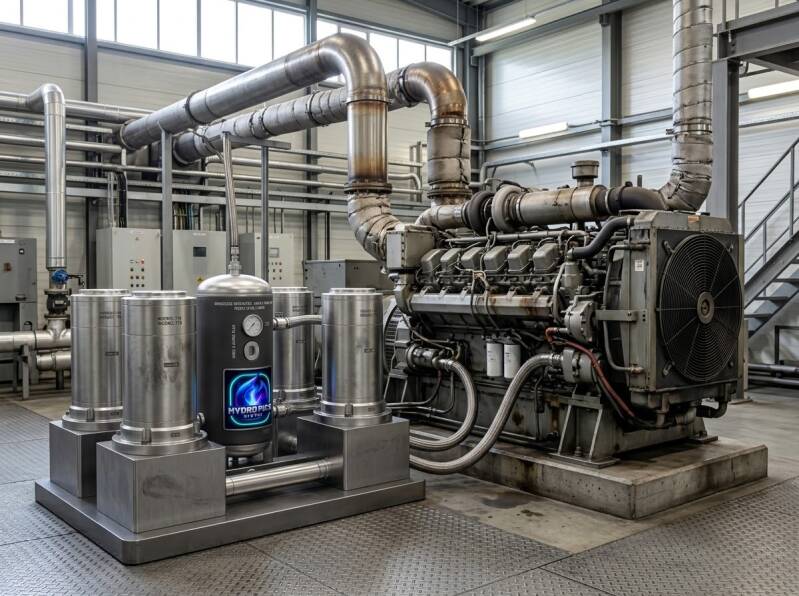
Industrial thermo-hydraulics is typically associated with heavy, vibrating machinery.
Failing dynamic seals, and massive pistons pounding across large strokes.
The reality of Hydro Puls Direct-Drive (HPDD) is the exact opposite: an exquisitely controlled, whisper-quiet micro-dynamic architecture.
Zooming into the mechanical core reveals precise fluid physics rather than brute mechanical force:
* 1.2 mm stroke length: The piston does not cycle through long, sluggish strokes; it oscillates across a minute displacement of just 1.2 millimeters.
* 75-micron bellows deflection: The isolation bellows flexes merely 75 micrometers, thinner than a human hair, virtually eliminating cyclic strain and material fatigue.
* A delta-P of just 5 bar: The internal operating pressure differential is only 5 bar.
Instead of brutal pressure spikes overloading components, the system maintains a stable, continuously balanced pressure regime.
* Only 2 moving parts: No complex crankshafts, cams, connecting rods, or mechanical valve trains. The functional core relies on exactly two moving elements.
* Zero mechanical friction: Operating on a hydrostatic water-bearing film, surfaces glide completely contact-free. Where there is no metal-on-metal contact, mechanical wear is effectively eliminated.
* Vibration-free balance: Minimal displacement combined with symmetric alignment prevents harmonic resonance and structural vibration across the skid.
Even the phase separation between nitrogen and water requires no forced, energy-intensive interventions, it occurs as a natural interfacial phenomenon governed purely by thermodynamic phase equilibria.
True thermodynamic efficiency does not come from muscling heavy reciprocating mass; it comes from minimizing displacement.
Mechanical serenity translates directly into multi-year runtimes, minimal maintenance OPEX, and maximum process reliability.