

DAY 6 / 10: MARITIME REVOLUTION SERIES
Decentralized Pods & Shaftless Maneuverability
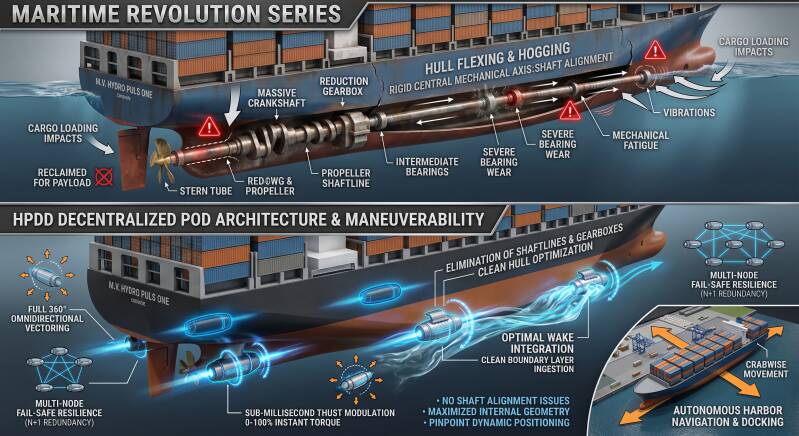
For well over a century, marine propulsion has relied on a rigid mechanical axis: massive crankshafts driving long propeller shaftlines through intermediate bearings, reduction gearboxes, and stern tubes. As heavy container ships load, discharge, and flex across heavy seas, dynamic hull hogging and sagging continuously threaten shaft alignment, inducing severe bearing wear, vibrations, and mechanical fatigue.
Day 6 explores how the Hydro Puls Direct-Drive (HPDD) platform eliminates the shaftline entirely, transitioning vessels to a decentralized, shaftless pod propulsion architecture.
Eradicating Mechanical Shaftline Vulnerabilities
By replacing central rotating drivetrains with distributed hydraulic drive vectors, HPDD removes the most rigid and vulnerable mechanical components onboard:
* Complete Elimination of Shaftlines & Gearboxes: Eliminates long propeller shafts, bulky reduction gearboxes, thrust blocks, intermediate bearings, and complex lubrication loops.
* Immunity to Cargo Hull Flexing: Hull deflection under multi-thousand-ton cargo loading and severe wave action no longer creates shaft misalignment or stern tube bearing overheating.
* Maximized Internal Hull Geometry: With no rigid center shaftline bisecting the aft section, prime lower-aft hull space is entirely reclaimed for payload or ballast optimization.
Sub-Millisecond Thrust Modulation & Vectoring
Distributing compact, direct-drive hydraulic pods along the hull introduces dynamic agility that conventional mechanical drivetrains cannot match:
* Instant 0–100% Thrust in Milliseconds: Direct hydraulic pulse modulation delivers instantaneous torque and thrust control with zero spool-up lag or gearbox inertia.
* Full Omnidirectional Vectoring: 360-degree independent thrust vectoring across decentralized pods enables pinpoint dynamic positioning and crabwise movement in restricted waterways.
* Autonomous Harbor Navigation & Docking: Extreme low-speed maneuverability eliminates the need for external tugboat assistance, streamlining autonomous docking maneuvers and slashing turnaround times in tight ports.
Redundancy, Efficiency & Total Control
* Multi-Node Fail-Safe Resilience: Decentralizing thrust across multiple autonomous hull pods provides true N+1 redundancy. An offline unit does not compromise navigational safety.
* Clean Boundary Layer Ingestion: Distributing pods along strategic hull positions allows optimal hydrodynamic wake integration, reducing hull drag and improving net propulsive efficiency.
Decoupling the power plant from rigid mechanical shafts transforms the cargo vessel from a sluggish giant into a hyper-responsive, self-docking marine platform.
Stay tuned for Day 7: "Extreme Thermal Resilience & Cold-Pinch Integration in Marine Environments."
#MaritimeTech #OceanShipping #NavalArchitecture #HydroPuls #HPDD #PodPropulsion #Maneuverability #ShipDesign #CleanShipping #MarineEngineering #DeepTech