

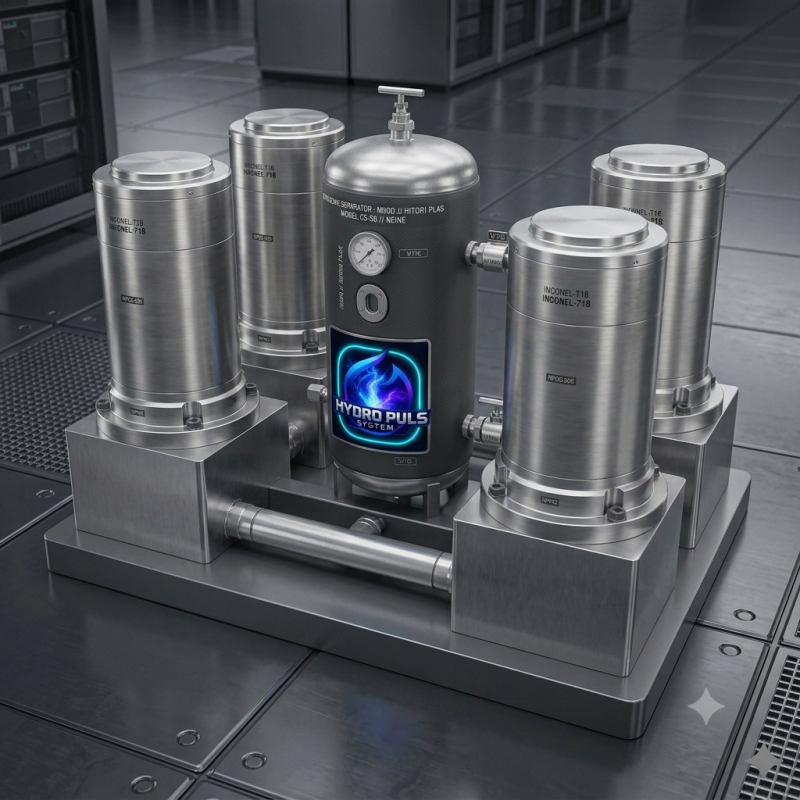
Why the performance of Hydro Puls Direct-Drive feels like a "miracle" to some, and why it is simply pure thermodynamics.
When engineers first review the operational data of the Hydro Puls Direct-Drive (HPDD) platform, the reaction is often disbelief:
"Zero mechanical friction losses?"
"No massive steam condensers or reduction gearboxes?"
"Graphitization in microseconds instead of weeks?"
"Drying delicate dairy proteins in 1.5 seconds with zero wall fouling?"
To those trained exclusively in 19th-century crankshaft mechanics, conventional Rankine steam turbines, and multi-day furnace cycles, these performance leaps can seem physically impossible. But HPDD does not violate the laws of physics; it simply eliminates the massive conversion and parasitic losses that industry has accepted as "unavoidable" for decades.
The real engineering principles behind the platform rest on four pillars:
1. Direct Kinetic Transfer: Instead of converting thermal energy into rotating shaft motion, then into electricity, and finally back into fluid pressure via motors and pumps, HPDD generates controlled fluid and pulse power directly at +600 bar. Eliminating redundant intermediate conversion steps directly preserves primary exergy.
2. Frictionless Linear Dynamics: Replacing rotating turbine shafts and heavy drivetrains with balanced opposed-piston pairs floating on hydrodynamic gas- and fluid-bearing matrices cuts mechanical friction, wear, and thermal fatigue down to near-zero baselines.
3. Software-Defined Gas Kinetics Over Brute Heat: Whether shattering ash aggregates, micronizing fragile whey proteins, or mechanochemically aligning carbon lattices, HPDD relies on supersonic decompression (> Mach 2.5) and shockwave kinetics inside an inert carrier loop. What once required weeks of high-temperature thermal soaking now occurs via localized kinetic shear in microseconds.
4. Closed-Loop Multi-Vector Integration: Rather than venting waste heat or losing carbon to oxidation (locking a ledger of ΔMass = 0.000 kg), sub-zero cryogenic cooling, high-grade process enthalpy, and high-purity inert gas streams are captured and utilized simultaneously within a unified closed thermodynamic circuit.
What looks like magic is simply thermodynamic discipline: matching the prime energy carrier directly to the work the industrial process actually requires, without compromise.
#HydroPuls #DirectDrive #DeepTech #Thermodynamics #ProcessEngineering #CleanTech #Innovation #IndustrialArchitecture