

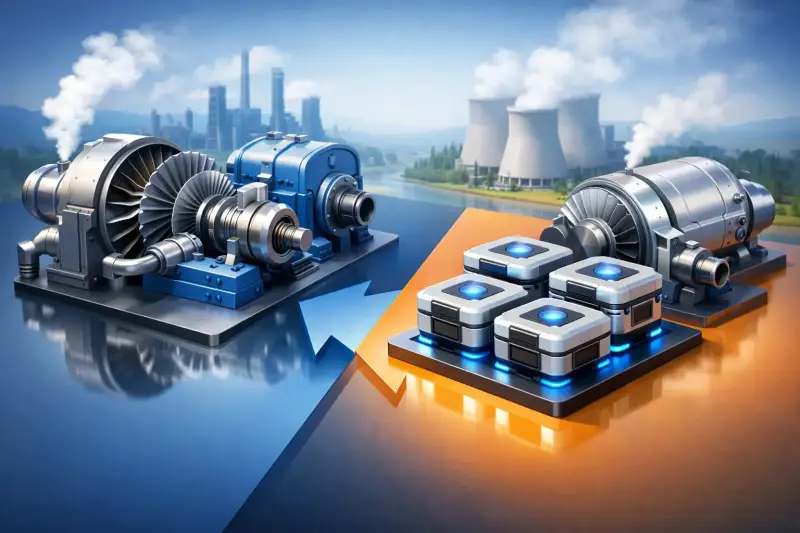
A steam turbine replacement comparison is no longer limited to choosing between a larger turbine, a smaller turbine, or a routine overhaul. Industrial operators are now comparing fundamentally different energy architectures. The real question is whether a conventional steam cycle remains the best way to convert fuel into the power, heat, cooling, water, and mechanical work a site actually needs.
For a refinery, cement plant, data center, greenhouse complex, desalination facility, or isolated industrial campus, that distinction determines far more than electrical output. It determines startup behavior, part-load economics, cooling demand, water treatment requirements, fuel flexibility, maintenance exposure, and the capital tied up in balance-of-plant equipment.
Steam Turbine Replacement Comparison Starts With the Load
Steam turbines remain proven machines. They are particularly effective where a facility already has a stable, high-pressure steam supply and a long-established boiler, condenser, feedwater, and steam-distribution system. In large utility and process applications, their operating history, known maintenance practices, and installed-base support are legitimate advantages.
But replacement decisions should not begin with the turbine nameplate. They should begin with the site's load profile. A turbine designed around a continuous thermal cycle performs best when steam conditions and electrical demand remain near their design point. Many industrial sites do not operate that way. They cycle compressors, pumps, mills, chillers, extraction systems, electric furnaces, and production lines. Their demand changes by shift, season, product mix, grid event, and maintenance condition.
At partial load, a conventional steam system can carry substantial parasitic demand. Boilers, feedwater pumps, condensate systems, cooling towers, vacuum equipment, water treatment, and steam conditioning equipment still consume energy and require supervision. The turbine may be only one component in a much larger thermal infrastructure.
A credible replacement comparison must therefore measure net useful output at the operating points the plant actually sees, not only at full-load design conditions. This includes electrical power, shaft power, usable heat, cooling duty, water recovery potential, and the energy consumed by supporting systems.
Compare Architectures, Not Just Prime Movers
A steam turbine converts the enthalpy of high-pressure steam into rotational work through expanding stages. It is an indirect path: fuel or another heat source creates steam, steam moves through the turbine, and the turbine drives a generator or process load. The architecture can be highly effective at scale, but it requires pressure vessels, thermal inertia, water management, and extensive heat-transfer equipment.
A direct-drive thermal system takes a different path. Hydro Puls Systems' HPDD-NEXUS is designed as an Autonomous Energy Heart using pulse-based isolated combustion and hydraulic energy transfer. Rather than relying on a conventional crankshaft-driven engine or a large steam expansion train, it converts thermal energy into hydraulic power that can be coupled directly to generators, pumps, fans, compressors, and other industrial work.
That distinction matters because hydraulic architecture can decouple the energy core from the load. A conventional turbine-generator arrangement must manage speed, steam conditions, and generator requirements as a connected system. A hydraulic energy-transfer platform can maintain its energy core in a preferred operating zone while delivering controlled power to different loads. For facilities with variable mechanical demand, that can reduce the penalty of constant cycling and throttling.
The decision is not that one architecture automatically replaces every steam turbine. It depends on the duty. A site with abundant, unavoidable steam and a stable baseload may retain a turbine as the rational choice. A site that needs modular deployment, rapid installation, direct mechanical coupling, multi-output energy, or a transition away from water-intensive steam infrastructure should evaluate a different architecture on its own technical merits.
The Variables That Change the Investment Case
Net efficiency at real operating conditions
Gross efficiency figures are incomplete. The relevant figure is net site efficiency after auxiliary loads. In a steam system, this means accounting for boiler fans, water pumps, cooling equipment, condensate handling, treatment chemicals, blowdown losses, and heat rejected at the condenser. For a replacement platform, it means accounting for fuel conditioning, controls, cooling, hydraulic losses, electrical conversion, and any downstream equipment.
The comparison should also distinguish between electricity-only efficiency and total useful-energy efficiency. If a facility can use heat, cooling, process water, or direct hydraulic work at the point of generation, the value of the energy system changes materially. A plant that purchases electricity for motors, gas for heat, and separate refrigeration capacity should not evaluate a replacement solely as a generator.
Part-load operation and response speed
Steam cycles are governed by thermal mass. That mass provides stability, but it also limits how quickly the system can start, stop, and follow load without introducing operational stress. Warm-up, steam chemistry control, pressure stabilization, and thermal expansion are not minor details. They affect availability and staffing.
A modular direct-drive platform is attractive when a facility needs staged capacity. Instead of building one large block sized for a peak that occurs only occasionally, operators can add energy modules as demand grows. This can improve capital discipline and preserve expansion options. It also supports resilience: maintenance on one module need not eliminate the entire site's power capability.
Water, cooling, and siting constraints
Steam systems require water as their working medium and often require significant heat rejection infrastructure. In water-constrained regions, this can become a strategic constraint rather than a utility cost. Treatment, chemistry, blowdown, cooling-water availability, and plume limitations all belong in the replacement model.
This is especially relevant for data centers, cooling facilities, remote industrial sites, and water-production projects. A system that produces useful thermal streams, supports desalination or atmospheric water extraction, and reduces dependence on a large steam loop can create value outside the electrical meter. The economic case becomes stronger when those outputs displace infrastructure the site would otherwise build and operate separately.
Fuel transition and emissions pathway
A new steam turbine can operate with steam produced by many fuels, including nuclear heat, biomass, waste heat, natural gas, hydrogen, and ammonia-derived energy pathways. That flexibility is real, but the boiler and combustion system determine much of the practical fuel transition challenge.
Replacement analysis should ask whether the proposed system can begin with available fuels while preserving a credible transition to hydrogen and ammonia. It should also assess carbon capture integration at the energy-core level. Capturing carbon from a diffuse exhaust stream is different from designing a plant where combustion, exhaust conditioning, heat recovery, and capture duty are considered as one architecture.
For industrial buyers, the key question is not whether a technology has a future-fuel claim. It is whether the fuel pathway, safety case, storage design, emissions controls, and permitting requirements can be engineered for the specific site.
CAPEX Must Include the Equipment You Avoid
Steam turbine replacement projects are often underestimated because the turbine price becomes the headline number. The complete capital picture includes the steam generator, piping, valves, pressure-control stations, condenser, cooling system, water treatment, civil works, electrical interconnection, and installation downtime.
Likewise, a direct-drive alternative must be evaluated with equal discipline. Include module count, fuel infrastructure, hydraulic distribution, generators, heat-recovery equipment, controls, redundancy, construction interfaces, and operator training. Then subtract the balance-of-plant systems that are no longer required.
This is where modularity can alter project economics. A facility may avoid oversizing capacity years before it is needed. It may deploy power closer to the load, reducing losses and electrical infrastructure. It may also replace battery energy storage for certain reliability and load-management duties by using dispatchable local generation. These benefits are site-specific, but they should be quantified rather than treated as general claims.
A Practical Evaluation Sequence
The strongest projects use a design-basis comparison rather than a vendor-specification comparison. First, map hourly electrical, thermal, cooling, water, and mechanical loads for a representative year. Second, establish the existing system's net fuel use, availability, maintenance cost, emissions profile, and water consumption. Third, model each candidate architecture at design load, normal load, minimum load, startup, and outage conditions.
The final model should test fuel price volatility, carbon cost, water cost, grid interruption risk, and future capacity growth. It should also assign value to avoided downtime. For a data center or continuous-process plant, a brief power interruption can be worth more than a marginal efficiency difference. For a greenhouse or desalination plant, dependable heat and water can be as valuable as electricity.
Technical due diligence should request heat-and-mass balances, parasitic-load schedules, maintenance assumptions, controls philosophy, emissions data, module redundancy logic, and commissioning plans. If a proposal cannot show how it behaves away from nameplate conditions, its advertised performance is not yet an investment-grade basis for replacement.
Where a Hybrid Solution Makes More Sense
The choice does not always have to be turbine versus replacement. Existing turbines can remain valuable where steam is already available, while a direct-drive energy core supplies variable loads, new expansion capacity, black-start capability, or local mechanical work. This hybrid approach can extend the useful life of installed assets while reducing exposure to boiler cycling and grid instability.
It is particularly compelling for facilities planning phased decarbonization. The first phase can address the most expensive or least reliable energy loads. Later phases can expand into CHP, cooling, water production, carbon capture support, or fuel conversion as economics and regulations change.
The best replacement decision is the one that treats energy as an industrial system, not a single rotating machine. Start with the loads that constrain production, calculate net outputs under real conditions, and select the architecture that gives the site more control over its next decade of energy risk.