

HPDD for buildings
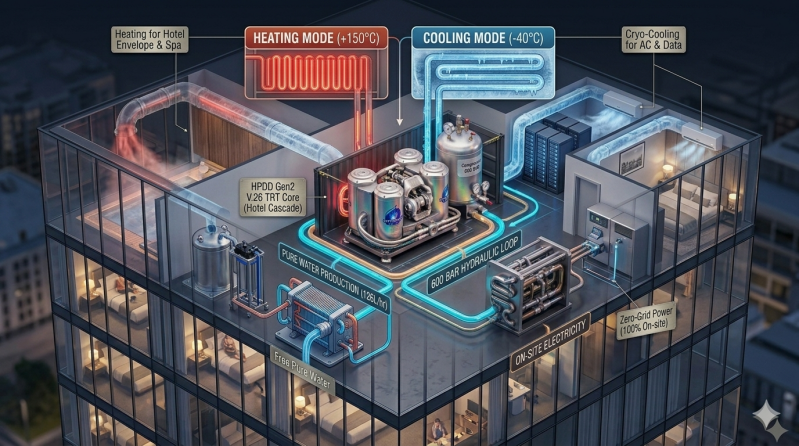
GRID-INDEPENDENT BUILDING ARCHITECTURE: THE HPDD QUAD-GENERATION REVOLUTION
The current approach to sustainability in the real estate sector is hitting a massive wall. Traditional buildings rely entirely on congested, overloaded electrical grids. Standard heating systems and heat pumps heavily strain the network during peak hours, while regional water scarcity and rising utility tariffs actively squeeze operational margins.
The Hydro Puls Direct-Drive (HPDD) platform from Hydro Puls Systems completely redefines the thermodynamic relationship of buildings. By integrating the crankshaft-free HPDD core, we transform residential blocks, commercial facilities, and industrial sites into completely autonomous, highly efficient resource loops.
By directly converting clean fuel molecules on-site into four vital utility streams, we achieve an unparalleled combined system efficiency of more than 85%.

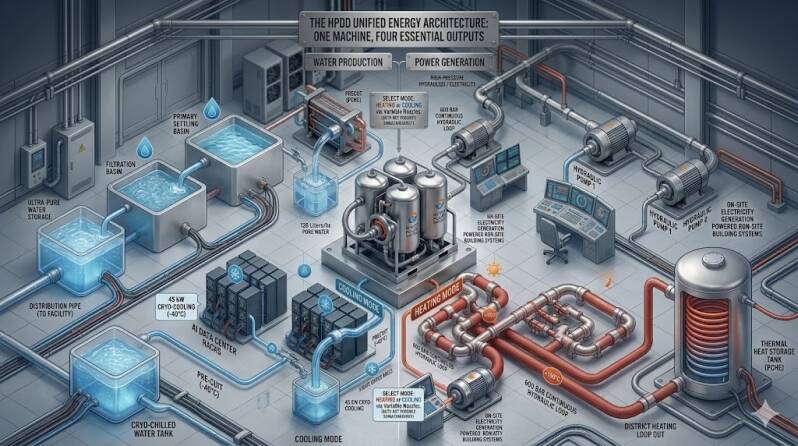
One Core, Four Critical Utility Streams
Where traditional combined heat and power (CHP) systems stop at electricity and heat, the HPDD building architecture simultaneously and independently delivers four critical utility streams:
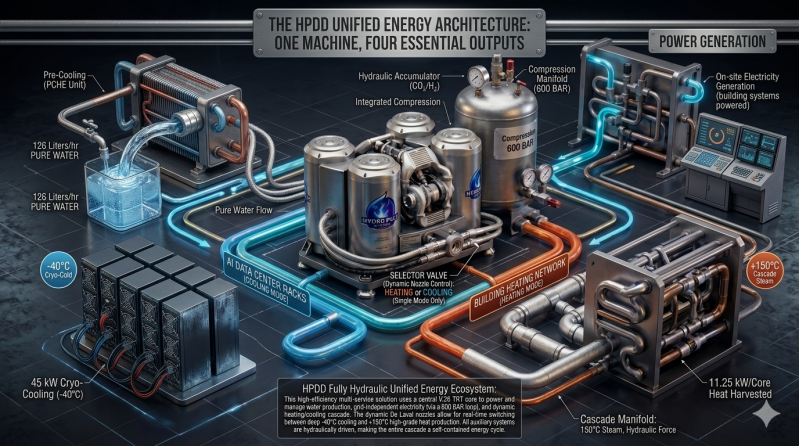
Stream I: Continuous Electricity (Power)
- The Mechanism: The crankshaft-free, linear pistons of the HPDD drive a high-density permanent magnet generator via direct shaft power.
- The Output: 250 kW to 1,000 kW of stable, continuous on-site electricity. This guarantees 100% grid autonomy and easily handles high peak demands from electric vehicle (EV) charging stations and building HVAC systems without requiring a costly grid connection.
Stream II: High-Enthalpy Heating (Heat)
- The Mechanism: High-temperature thermal energy is captured directly from the engine core using a closed-loop, unpressurized siloxane heat transfer circuit.
- The Output: A constant supply of 120°C to 150°C thermal fluid. This high-grade heat directly feeds the building’s hydronic space heating, domestic hot water (DHW) loops, and thermal storage tanks.
Stream III: Tri-Generation Cooling (Cooling)
- The Mechanism: Instead of using massive amounts of electricity to run mechanical compressors, a portion of the high-grade siloxane thermal energy is directed to a thermodynamic absorption chiller.
- The Output: Continuous production of chilled water at a stable 7°C for central air handling units, cooling coils, and climatic radiant ceilings. This cooling cycle is completely free from chemical refrigerants.
Stream IV: Local Drinking Water (Water)
- The Mechanism: The system couples the cooling capacity of the absorption chiller with an optimized Atmospheric Water Generation (AWG) condensation loop.
- The Output: Up to 5,000 Liters of crystal-clear, filtered, and mineralized drinking water per day per Megawatt (MW) of electrical capacity, extracted directly from the ambient air intake.
Key Strategic Benefits for Real Estate Operators
1. Complete Grid Congestion Bypass
By generating reliable base and peak electrical loads directly on-site, development projects completely bypass regional substation connection backlogs, allowing fast-tracked building permits and commissioning.
2. Frictionless Design and High Reliability
Traditional generator engines suffer intense side-wear and mechanical friction from lateral crankshaft stresses. The HPDD has no crankshaft. Its opposing linear pistons hover on a microscopic gas cushion. This results in a virtually frictionless core with an exceptionally long operational lifespan and minimal maintenance costs (OPEX).
3. 100% Clean Fuel Flexibility
The system is built to operate seamlessly on the zero-emission fuels of tomorrow:
- Green Ammonia (NH3): Cracked directly inside the core using reclaimed process heat, releasing harmless nitrogen (N2) while feeding hydrogen into the combustion chamber.
- Pure Hydrogen (H2): Direct fuel injection for an entirely emission-free physical cycle, where pure water vapor is the only primary exhaust.
Technical Performance Specifications
Below is the verified performance data for a modular, containerized HPDD building integration unit:
- Electrical Capacity: 250 kW to 1,000 kW (Fully scalable via modular Swarm configurations)
- Thermal Capacity (Heating): Up to 120% of electrical output (via closed-loop siloxane recovery)
- Cooling Capacity (Cooling): Up to 70% of extracted thermal energy (via Absorption loop producing 7°C water)
- Water Production (AWG): Approximately 5,000 Liters per day per Megawatt of electrical capacity
- Combined System Efficiency: Over 85% combined efficiency (by completely bypassing grid and boiler conversion losses)
- Noise and Vibrations: Negligible and structure-borne vibration-free due to perfectly balanced opposing linear pistons
Ready for Absolute Infrastructure Autonomy?
Future-proof your commercial, residential, or industrial real estate portfolio against grid shortages, rising energy rates, and water scarcity.
Contact our technical engineering department today to model your custom site load balances and calculate your system yields.
Grid-Independent Building Architecture
Simultaneous conversion of green fuels into Power, Heating, Cooling, and Localized Water.
Primary Mover
Crankshaft-Free HPDD Core
Core Load & Sizing Simulator
Adjust the slider below to scale the electrical output of the crankshaft-free HPDD Core. The simulator automatically calculates the optimized thermal recovery loops, absorption cooling yields, and atmospheric water extraction outputs.
Stream I: Power
250 kW
Continuous Electricity Output
Direct-drive PM generator provides 100% grid autonomy.
Stream II: Heating
300 kWt
Thermal Fluid Recovery
Closed-loop siloxane transfer (+120°C to +150°C) for space/DHW heating.
Stream III: Cooling
210 kWc
HVAC Chilled Water (+7°C)
Absorption chiller driven by waste heat. Zero chemical refrigerants.
Stream IV: Water
1,250 L/d
Atmospheric Pure Water
Local moisture extraction and exhaust condensation combined.
The Four-Stream Integration Architecture
Operational mechanisms, temperatures, and physical execution for each of the independent utility streams.
| Utility Stream | Primary Mechanical Mechanism | Operating Temperature Profile | Final Infrastructure Output |
|---|---|---|---|
| Stream I: Power | Direct-drive permanent magnet generator driven via linear pistons. | Ambient (Engine air-cooled casing) | 100 kW to >1 MW Continuous Electrical Output |
| Stream II: Heating | Closed-loop unpressurized siloxane fluid heat exchanger on exhaust jacket. | +120°C to +150°C Thermal Fluid | Hydronic Space Heating & Domestic Hot Water (DHW) |
| Stream III: Cooling | Heat-driven vaporization within a specialized Absorption Chiller loop. | +7°C Chilled Water Flow | Central HVAC Coils, Klimaatplafonds & Climatic Controls |
| Stream IV: Water | Bespoke condensation loop fed by chiller water and engine air-flow logic. | +4°C to +8°C Condensation Surface | Filtered, Mineralized Local Drinking Water (AWG) |
Thermodynamic Input Flexibility
- • Green Ammonia (NH3): Cracked directly inside the core utilizing reclaimed process heat. This releases harmless nitrogen (N2) while feeding pure hydrogen (H2) directly into the combustion chamber.
- • Pure Hydrogen (H2): Direct feed mechanics allow for immediate 100% emission-free operation, generating water vapor as the sole primary combustion exhaust.
Overall Combined System Efficiency
- • Erasing Parasitic Losses: By skipping electricity-to-heat conversion and using thermal energy directly from the unpressurized siloxane loop for heating and absorption chiller operations, overall system efficiency jumps above 85%.
- • Self-Sufficiency Equation: Unlike a split grid system (vulnerable to blackouts and high fuel prices), an integrated HPDD building operates autonomously, completely bypassing electrical transmission losses.
© 2026 Hydro Puls Systems. All rights reserved. The HPDD platform and its building integrations are protected by international patents.