Technical specs.


HPDD Master-Dossier v26 TRT: High-Availability Standard & Asset Integrity
Core Vision: The HPDD system functions as a High-Availability (99.999%) Infrastructure for uninterrupted power supply. Its true commercial value is rooted in Zero-Friction Solid-State Dynamics, operating significantly below technical limits to ensure absolute residual value and operational guarantees.
1. Compliance & Certification
- ISO 13849 Compliance: Safety of control systems (software-driven transduction sequences).
- DNV Maritime Standard: Engineered for critical maritime and offshore reliability.
2. Strategic Design Margins (Reliability vs. Capacity)
We maintain massive safety buffers to guarantee Asset Integrity:
System Pressure: 600 bar (Technical Ceiling: 1,000 bar) – 40% Integrity Margin.
Transduction Frequency: 100 Hz (Technical Ceiling: 200 Hz) – 50% of technical ceiling.
Bellows Displacement: 0.07 mm (Ceiling: 1.00 mm) – Certified for Infinite Fatigue Life.
Thermal Damping: 230°C at 1 bar – Active Thermal Damping Reservoir prevents cavitation.
3. Ultra-Long Life & Zero-Friction Geometry
- Plunger Geometry: "Ultra-Long" ratio with integrated cooling fins and Gas-Bearing Nitrogen Flow.
- Surface Integrity: Mirror finish (Ra < 0.1 µm) with advanced tribological coatings.
- System Purity: Sub-micron nitrogen filtration for the labyrinth interface.
4. Advanced Thermal Management & Turbo-Architecture
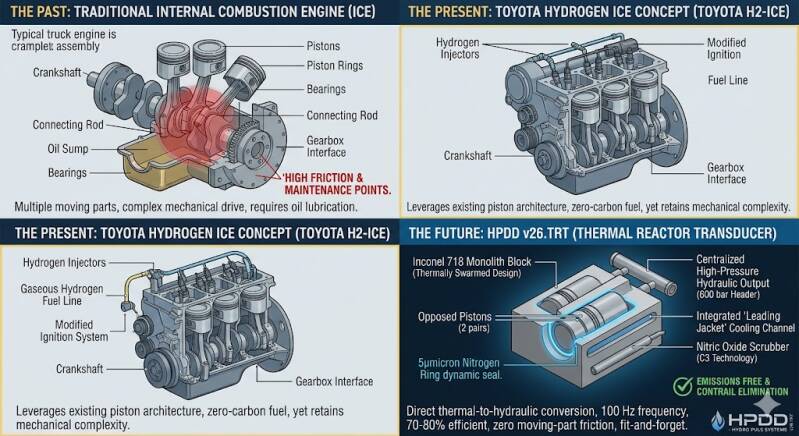
- Twin-Turbo High-Availability: Two active gas-bearing turbos for load reduction and full redundancy.
- ITS (Integrated Thermal Stabilization): Integral recovery of thermal energy for maximum system efficiency and wall stabilization.
- Thermal Insulation (Min-K® Microporous): Aerospace-grade insulation for heat retention and total elimination of atmospheric influences.
- Heat Exchange: Helix-based discharge to the ITS unit via active loop with electric bypass pump.
5. Operational & Digital Integrity
- Software-Controlled Start-Stop: Structured protocols to prevent thermal shock.
- Digital Twin Readiness: Every module is prepared for full operational data traceability for performance proofing to financiers.
6. Advanced Analytics & Projections
- Thermal Balance Mapping: Continuous analysis of active heat harvesting vs. cooling needs.
- Residual Value Benchmarking: 10-year asset value projection demonstrating superior resale value compared to conventional systems.
- Availability Modeling (Swarm Uptime): Statistical proof of 99.999% availability through 56-module redundancy.
7. Financial Architecture: Power-as-a-Service (PaaS)
- Asset-Backed Lease: Extremely high residual value due to conservative loading, ideal for institutional investors.
- Uptime as a Product: The commercial driver is the Operational Guarantee of performance.
8. System Redundancy (Swarm Intelligence)
- Fail-Safe Architecture: 56 independent modules per unit; continuity via software-driven swarm control in the event of individual module failure.
🛠️ Technical Appendix: HPDD v26 TRT Structural Integrity
Subsystem focus: Plunger-to-Bellows Pressure Distribution & Fatigue Mitigation
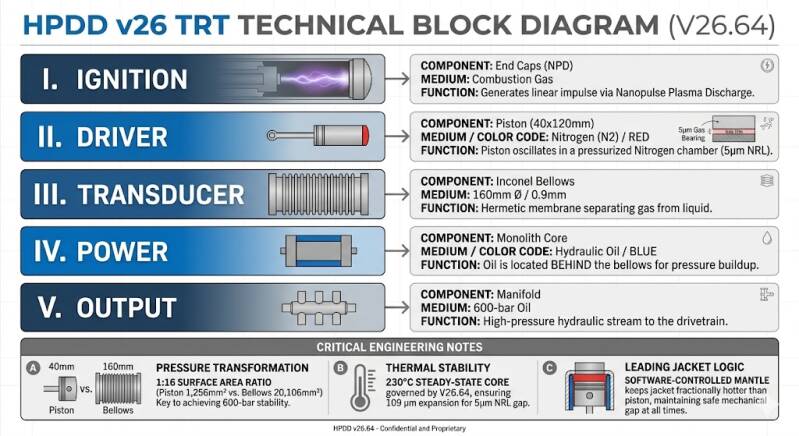
1. Pulse-Amplitude vs. Diameter Ratio (The 1:4 Rule)
The core innovation of the HPDD v26 TRT is the decoupling of high-pressure transduction from hydraulic displacement via a calculated surface area expansion.
- Plunger Diameter: 40 mm (High-pressure zone / Reaction chamber)
- Bellows Diameter: 160 mm (Low-displacement zone / Hydraulics)
- Surface Area Factor: 1:16 (1,256mm^2 vs. 20,106mm^2)
2. Fatigue Mitigation (The 75-Micron Principle)
Conventional metal bellows fail due to mechanical stress caused by excessive stroke (deflection). By utilizing the 1:16 surface area ratio, we minimize the physical movement of the bellows:
- Plunger Pulse-Amplitude: 1.2 mm (Nominal transduction amplitude)
- Bellows Displacement: 0.075 mm (75 microns)
- Result: By restricting the bellows displacement to under 100 microns, the Inconel 718 material remains well within its elastic limit. Mechanical stress is distributed across the full 160 mm diameter, eliminating metal fatigue and resulting in an Infinite Fatigue Life (billions of cycles).
3. Frictionless Operation & Materials
- Nitrogen-Referenced Loading (NRL): The 40 mm plunger "floats" on a nitrogen gas cushion (25-micron gap). This eliminates metal-on-metal friction and minimizes heat transfer to the fluid column.
- Tribological Coatings:
- Plunger: Ta-C (Tetrahedral Amorphous Carbon / Diamond-Like).
- Chamber Wall: CrN (Chromium Nitride) Ceramics.
- Hermetic Separation: The 160 mm Inconel bellows forms a 100% leak-proof barrier between the energetic reactant and the hydraulic Siloxane oil.
4. Thermal Management (ITS Integration)
- Integrated ITS (Integrated Thermal Stabilization): Every module cluster utilizes the ITS unit to capture heat from the exhaust monolith.
- System Advantage: Exhaust gases are deep-cooled before exiting the system. This enables the Water Recovery Cycle (WRC), where pure distilled water is harvested as a valuable byproduct.
5. Distributed Hub Safety (Redundancy)
- Manifold Integration: All transduction modules are linked via a high-pressure hydraulic ring-bus (Common Rail).
- Isolation: Individual "Bypass Safety Valves" activate at Delta P > 10 bar, immediately isolating a malfunctioning module without affecting system pressure.
- Control: 100 Hz FPGA monitoring ensures that the pressure differential across the Inconel bellows never exceeds the 5-bar safety margin (Delta P-5 Stabilization Logic).