

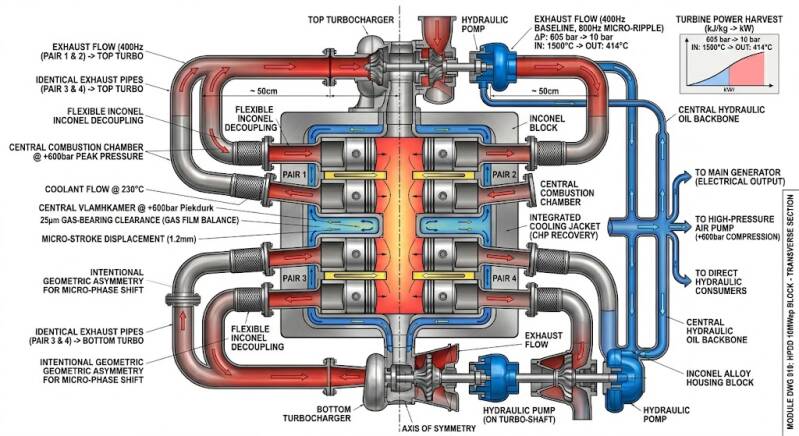
Hydro Puls Direct-Drive (HPDD): Twin-Turbo Energy Harvesting Architecture
Conventional engines treat turbocharging as a minor auxiliary system designed to force air into cylinders. The Hydro Puls Direct-Drive (HPDD) platform completely reinvents this logic. By separating the energy conversion core from legacy crankshaft mechanics, the HPDD transforms the extreme pressure drop of its pulse combustion into a highly efficient, centralized power recovery hub.
The Engineering Logic: Transforming 605 Bar into Fluid Power
The HPDD module operates on a strict Constant Volume Combustion (CVC) principle. Within the central Inconel alloy core, four piston pairs in opposition generate sharp combustion pulses hitting a peak working pressure of +605 bar at a stable core temperature of 230°C.
Instead of a conventional, efficiency-robbing exhaust stroke, the HPDD utilizes an ultra-fast 1.2 mm micro-stroke to bleed out high-frequency micro-pulses under immense pressure.
-
The Thermodynamic Drop: Zipping through the exhaust ports, the gas undergoes rapid adiabatic expansion, dropping from 605 bar down to an optimized terminal target of 5 bar. This massive expansion acts as a natural cooling mechanism. Real-world peak flame temperatures exceeding 2200°C drop adiabatically by more than 1650°C, entering the turbine housing at a highly manageable .
-
Commercial-off-the-Shelf (COTS) Integrity: Lowering the turbine inlet temperature to allows the platform to utilize standard, highly reliable industrial turbocharger alloys rather than requiring expensive, exotic ceramics.
-
Choked Flow Mitigation: To safeguard the delicate gas-bearing clearance from sudden, destructive pressure differentials, the manifold is engineered as a cooled, thermo-mechanically decoupled expansion nozzle. Integrated Flexible Inconel Decoupling segments absorb local temperature gradients, keeping the cylinder boring completely stress-free and perfectly symmetrical.
Twin Parallel Centrally Positioned Turbochargers
To process the massive volumetric expansion generated by a factor-121 pressure drop, the HPDD utilizes two identical, high-performance turbochargers centrally integrated within the quad-core cluster to achieve the shortest possible pipe routing.
-
Symmetrical 400 Hz Baseline: The quad-core assembly is split symmetrically into two distinct vertical zones. The upper core segments discharge directly into the Top Turbocharger, while the lower segments feed the Bottom Turbocharger. Each turbine receives a highly predictable, consecutive 400 Hz pulse stream.
-
Identical Pipe Matrix: All exhaust ducts are geometrically identical. This ensures that every single cylinder pair experiences the exact same dynamic backpressure, keeping piston synchronization flawlessly balanced based on pure physical symmetry.
-
The 800 Hz Micro-Ripple: Intentional layout asymmetries right at the turbine inlets introduce micro-phase shifts, converting the 400 Hz baseline into an ultra-high frequency 800 Hz ripple effect. This effectively flattens out destructive backpressure spikes at the core and creates a continuous scavenging pull directly behind the exhaust ports.
Centralized Hydraulic Oil Backbone: "All Power to the Oil"
The true architectural genius lies in what happens on the turbo-shaft. Instead of mounting complex, high-RPM electrical generators directly to the high-speed turbines, both turbochargers directly drive high-pressure hydraulic displacement pumps. This eliminates net-synchronization issues, mechanical friction losses, and complex power electronics on the turbocharging side. Every single kilowatt of harvested kinetic and expansion energy is pumped directly into a unified Central Hydraulic Oil Backbone.
This centralized high-pressure oil rail acts as the single, fluid energy source for the entire platform, feeding:
-
The Main Generator: Delivering smooth, stable electrical output to the grid or industrial asset.
-
The High-Pressure Air Pump: Utilizing recovered exhaust energy to directly compress incoming combustion air back up to , allowing the platform to prime itself for the next cycle with zero parasitic electrical grid losses.
-
Direct Hydraulic Consumers: Supplying mechanical or hydraulic work straight to site boundaries without conversion penalties.
By capturing the brute force of a 605 bar explosion and smoothly bundling it into a central oil backbone, the HPDD turns an extreme thermodynamic expansion challenge into a massive efficiency advantage. This is not just a repackaged engine, it is a streamlined, high-frequency energy platform built for the infrastructure of tomorrow.