De HPDD Direct-Drive: The New Standard for Hydrogen Logistics
Efficient 700-Bar Compression: Eliminating the "Electric Detour"
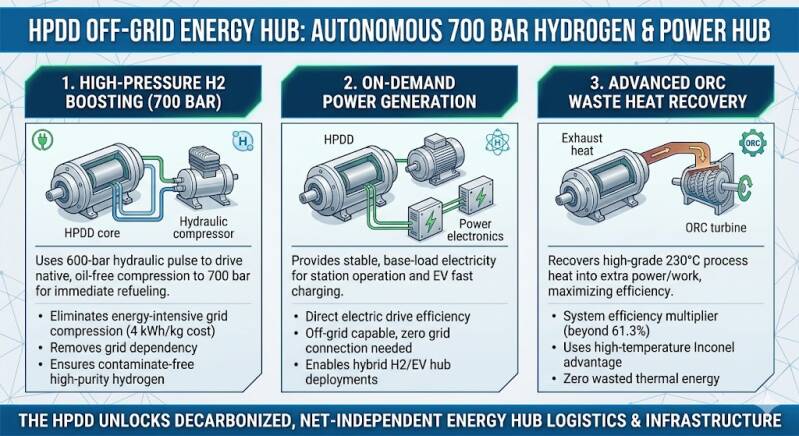
The transition to hydrogen mobility demands a radical rethink of gas compression and storage. The current industrial standard for refueling stations relies on complex, multi-stage electric compressors that consume up to 3 kWh per kg of Hydrogen. The HPDD v26 (Hydro Puls Direct-Drive) shatters this inefficiency by compressing hydrogen directly from the source to the required 700 bar.
⚡ Why the HPDD is the Gamechanger for Refueling Stations:
-
Direct-Drive Power: Unlike traditional systems that convert electricity into mechanical movement, the HPDD module delivers 600 to 700 bar hydraulic pressure directly from the combustion process. This eliminates losses from the power grid, transformers, and heavy electric motors.
-
300% More Efficient: Thanks to our unique fluid-piston technology and integrated Organic Rankine Cycle (ORC), the HPDD reduces the energy consumption for compression from the industry average of 3 kWh/kg to just ~1.0 kWh/kg.
-
Energy Autonomy (Off-Grid Capability): An HPDD module uses a tiny fraction of the processed hydrogen (~1.2% of throughput) to pressurize the rest. This enables fully off-grid refueling stations; you no longer need heavy-duty grid connections to refuel trucks or buses.
-
Thermal Synergy: Waste heat is never wasted. The HPDD provides high-grade process heat for local heating or industrial applications at the station site, pushing total system efficiency above 90%.
From 40 to 700 Bar in a Single Step
Where conventional systems require three or four compression stages—each introducing friction and heat—the HPDD delivers the required pressure in one fluid motion.
This results in:
-
Lower Maintenance Costs: Fewer moving parts and a piston speed 20x slower than standard engines.
-
Compact Footprint: A "swarm" of HPDD modules replaces an entire machine room full of traditional compressors.
-
Scalability: Easily expand your station’s capacity by adding modules to the cluster as demand grows.
Strategic "Trigger" for Infrastructure Investors:
"We don't just compress hydrogen; we make it profitable. By cutting compression energy costs by 66%, the HPDD v26 turns a logistical hurdle into a competitive advantage."

Why the HPDD is 300% More Efficient:
-
Eliminating the "Electric Detour": We convert chemical energy directly into hydraulic pressure. By skipping the transformation steps—from combustion to generator, to grid, to electric motor, and finally to piston—we eliminate the massive cumulative energy losses inherent in traditional systems.
-
Internal Energy Recycling (ORC): We don't just vent combustion heat; we harvest it. Our integrated Organic Rankine Cycle feeds captured thermal energy back into the system as additional mechanical power, maximizing every joule of fuel.
-
Isothermal Efficiency: By utilizing fluid-piston technology, we manage compression heat far more effectively than traditional methods. This results in a process that requires significantly less physical work than standard "dry" compression.
-
Single-Stage Power: The HPDD delivers 700 bar in one fluid motion. This eliminates the friction and heat-build-up losses typically found in multi-stage intermediate compression stations.
Frequently Asked Questions: 700 Bar High-Pressure
How does the HPDD technology achieve 700 bar without external compressors?
Traditional electrolyzers produce hydrogen at low pressure (30–50 bar), requiring massive, unreliable mechanical compressors to reach storage pressures. The HPDD utilizes its high-frequency pulse architecture and Inconel-bellows to generate pressure natively. By performing the electrochemical split within a high-pressure environment, we deliver 700-bar Hydrogen (H2) directly at the source, saving up to 15-20% of the total system energy.
What are the efficiency advantages of "In-Situ" compression?
Compression is typically the "Achilles' heel" of the hydrogen economy. By eliminating the need for standalone multi-stage compressors, the HPDD-based system reduces mechanical losses and thermal waste. The energy usually spent on external pumps is instead utilized within the transducer core, resulting in a significantly higher "Well-to-Tank" efficiency.
How does the system handle the corrosive nature of high-pressure Hydrogen?
Hydrogen embrittlement is a major concern at 700 bar. This is why we use aerospace-grade Inconel for all critical pressure-bearing components. Unlike steel, Inconel remains stable and ductile under extreme pressure and temperature (230°C}), ensuring a safe and reliable operation throughout the system's 20,000+ hour lifespan.
What is the maintenance requirement for a 700-bar stationary system?
Standard high-pressure compressors require intensive maintenance every 2,000 to 4,000 hours due to seal wear and valve fatigue. The HPDD operates on a frictionless 5-micron gap principle with no rotating crankshafts or traditional mechanical seals. This enables a 20,000+ hour maintenance-free interval, even when operating continuously at peak pressure.
Can this system help stabilize the electrical grid?
Absolutely. Because the HPDD is a software-defined transducer, it can ramp its electrolysis production up or down in milliseconds. This makes it the perfect "Flexible Load" for grid operators. It can instantly absorb excess renewable energy from wind or solar and store it as ready-to-use 700-bar fuel, effectively acting as a high-speed energy buffer.