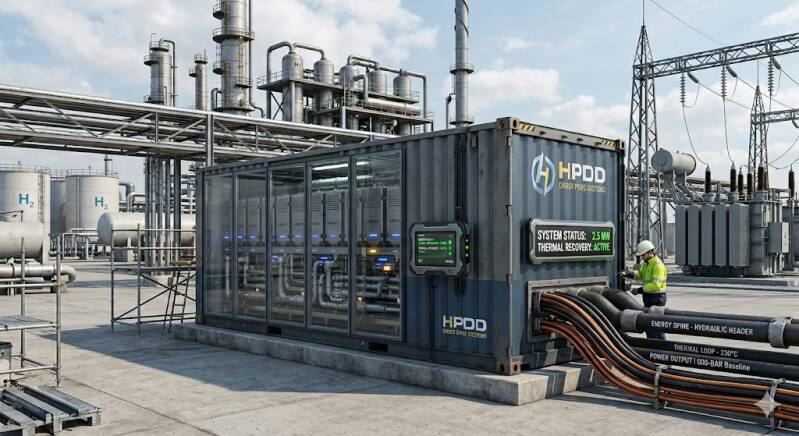
Industry: HPDD V26
Synergy of 600 Bar & Process Heat

HPDD Direct-Drive: A Revolution in Industrial High-Pressure (600+ bar)
Power Without the Electrical Constraints
In modern industry, the demand for high pressure (600 bar and above) is higher than ever, yet the path to achieving it remains inefficient. Conventional systems rely on multi-stage electric compression—a process plagued by massive energy losses, complex mechanical transmissions, and a heavy burden on your electrical infrastructure.
The HPDD v26 offers a radical alternative: Direct-Drive Hydraulics.
⚡ Why the HPDD Optimizes Your Industrial Process:
-
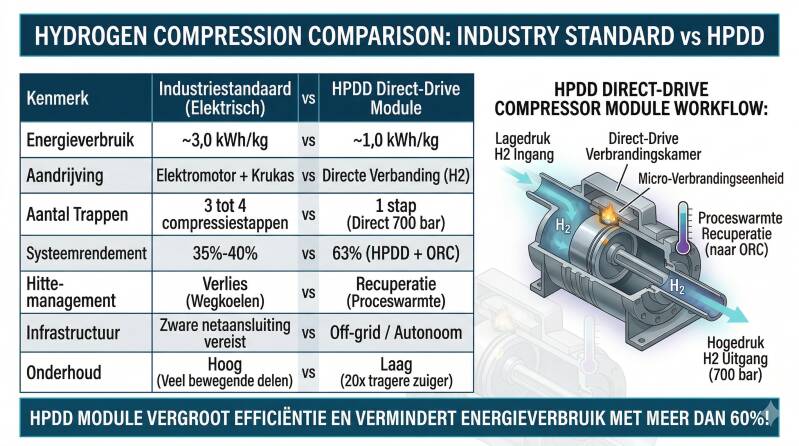
Eliminating the "Electric Detour": Why convert chemical energy into electricity only to struggle with generating 600 bar pressure? The HPDD delivers this pressure directly from combustion. This not only slashes your energy bill but eliminates the need for expensive, high-capacity grid connections.
-
Superior Operational Reliability (20x Less Wear): Traditional high-pressure pumps operate at high RPMs, leading to rapid wear of seals and valves. The HPDD plunger moves at a speed of only 0.48 m/s up to 20 times slower than conventional systems. This translates directly into lower maintenance costs and unprecedented uptime.
-
Integrated Heat Management (ORC & Process Heat): The HPDD is more than a pump; it is a thermal power station. Thanks to the internal Organic Rankine Cycle (ORC), waste heat is recycled into additional mechanical power (62% BTE). The remaining high-grade heat can be utilized directly for industrial drying or heating processes.
-
Compact & Modular: Replace bulky machine rooms with a "swarm" of compact HPDD modules. This modular design guarantees redundancy: if one module requires maintenance, your process continues at full capacity.
Applications:
-
High-Pressure Presses & Forging: Direct feed for hydraulic presses without conversion losses.
-
Waterjet Cutting: Efficient control of intensifiers for industrial cutting tables.
-
Hydrogen Hubs: On-site compression to 700 bar for local storage and distribution.
-
Chemical Reactors: Reliable fluid displacement under extreme pressure and temperature.
Strategic "Industrial Trigger" :
"In a factory, energy efficiency is profit. By removing the generator, the grid, and the electric motor from the high-pressure chain, the HPDD v26 delivers 600 bar at a fraction of the traditional energy cost. We don't just provide pressure; we provide industrial autonomy."
HPDD v26: Transforming Industrial Energy Standards
Simultaneous High-Pressure Mechanical Power and Thermal Energy Delivery
The HPDD v26 redefines industrial efficiency by providing a dual-stream energy solution: high-pressure hydraulic force coupled with high-grade thermal output. It is the ultimate utility for the modern, decarbonized factory.
The Solution for the Modern Factory:
-
Direct-Drive Power: Delivering 600-bar hydraulic pressure for presses, cutting machines, or hydrogen compression. By bypassing the "electric detour," we eliminate the energy losses inherent in traditional motor-pump chains.
-
High-Grade Cogeneration (CHP): The 230°C operating temperature within the HPDD core is perfectly suited for generating industrial steam, powering drying processes, and driving chemical reactors.
-
Energetic Independence: Reduce your reliance on an overloaded electrical grid. By utilizing local (hydrogen) fuel streams, the HPDD ensures operational continuity regardless of grid stability.
The Economic Edge:
While traditional systems treat heat as a waste product to be cooled away, the HPDD harvests this energy source to push total system efficiency beyond 90%. This drastically lowers Operational Excellence (OPEX) and accelerates the ROI on sustainability projects.
Frequently Asked Questions: High-Pressure Industrial Systems
Why shift from the industry-standard 210 bar to HPDD’s 600 bar?
In industrial manufacturing, pressure equals power density. By increasing the operating pressure to 350-600 bar, we can deliver the same force using components that are significantly smaller and lighter. This allows for more compact machine designs, faster cycle times, and a reduction in the total volume of hydraulic fluid required, leading to a smaller factory footprint and lower costs.
How does the HPDD reduce energy consumption in factories?
Traditional industrial hydraulic power units (HPU) use massive electric motors that often run continuously, even when the machine is idle. The HPDD is a demand-driven transducer. It only pulses when pressure is required. This "Power-on-Demand" approach, combined with the core's 61,30% efficiency, can reduce a factory's hydraulic energy consumption by up to 50-70%.
Is the system compatible with existing industrial automation?
Yes. The HPDD is software-defined. It can be integrated into any modern PLC (Programmable Logic Controller) or SCADA system. The pressure and flow are controlled digitally via the HPDD’s high-frequency pulse rate, allowing for "Surgical Precision" in clamping, pressing, and forging applications without the need for complex proportional valves.
How does the HPDD handle 24/7 continuous industrial cycles?
Industrial environments demand extreme reliability. The HPDD core is hermetically sealed and operates on a frictionless 5-micron gap principle. With a 20,000+ hour maintenance-free interval, it eliminates the frequent seal replacements and oil filtrations required by traditional piston pumps. This ensures maximum uptime for critical production lines.
Can the HPDD operate at the high temperatures of heavy industry?
Absolutely. Many industrial processes, such as metal forging or plastic injection molding, generate significant heat. The HPDD is designed to operate at an optimized internal temperature of 230°C using Inconel components. It doesn't require the massive, water-hungry cooling towers that traditional hydraulic systems need to keep their oil stable.
What are the advantages of "Decentralized Hydraulics" in a plant?
Instead of one massive, central hydraulic room with kilometers of leaking pipes, the HPDD enables Point-of-Use Hydraulics. Because the modules are compact (60x45x45 cm), you can place the power source directly on the machine. This eliminates pressure drops, reduces the risk of large-scale oil leaks, and allows for independent maintenance of individual production cells.