

The New Benchmark for Concrete Logistics: HPDD v26
Maximum Payload. Zero Emission. Unprecedented Efficiency.

The HPDD v26: Breaking the Payload Barrier in the Concrete Sector
In the transition to sustainable transport, the concrete sector is hitting a physical wall. Battery-electric vehicles (BEV) lose up to 4 tons of payload due to heavy battery packs. In an industry where every kilogram counts, this translates to less concrete per trip and an unsustainable business case.
The Hydro Puls Direct-Drive (HPDD) v26 shatters this barrier.
Why the HPDD v26 is the Superior Choice for Concrete Mixers:
-
Preservation of Full Payload: Thanks to the exceptionally low system weight of HPDD units, you never have to compromise on your cargo. Transport your maximum volume of concrete, every single trip. No "dead ballast" from batteries—just pure revenue.
-
The 500-Liter Powerhouse: Our configuration includes a 500-liter accumulator that acts as an energetic buffer. This provides the massive peak torque required to start a full drum or maneuver on unpaved construction sites, without additional fuel consumption or delay.
-
Silent Operations in Urban Zones: Concrete pouring often occurs in dense urban areas or early morning hours. The HPDD v26 is significantly quieter than traditional diesel engines, providing constant power to the drum (PTO) without the loud, monotonous drone of a conventional combustion engine.
-
62% System Efficiency (LHV): While traditional engines and turbines waste precious energy, the HPDD v26 converts fuel (Hydrogen or HVO) into work with unprecedented efficiency. This drastically lowers your operational costs per cubic meter poured.
-
700-Bar Direct Compression: Our technology is purpose-built for the hydrogen economy. The HPDD can compress hydrogen directly to 700 bar, making you independent of expensive external compression infrastructure at the batching plant.
Technical Specifications for the Concrete Sector:
-
Configuration: 1 or 2 HPDD units (4 to 8 cores).
-
Power Output: 300 to 500 hp (205 - 410 kW) – ideal for heavy-duty four-axle trucks.
-
Energy Buffer: 500-liter accumulator for on-demand torque.
-
Fuel Agnostic: Fully Hydrogen-ready, yet compatible with existing (bio)fuels to ensure energy security during the transition.
Upgrade to the technology that respects your payload. The HPDD v26 is lighter, stronger, and more efficient. We are breaking the hegemony of inefficient legacy tech and making zero-emission concrete transport profitable at last.
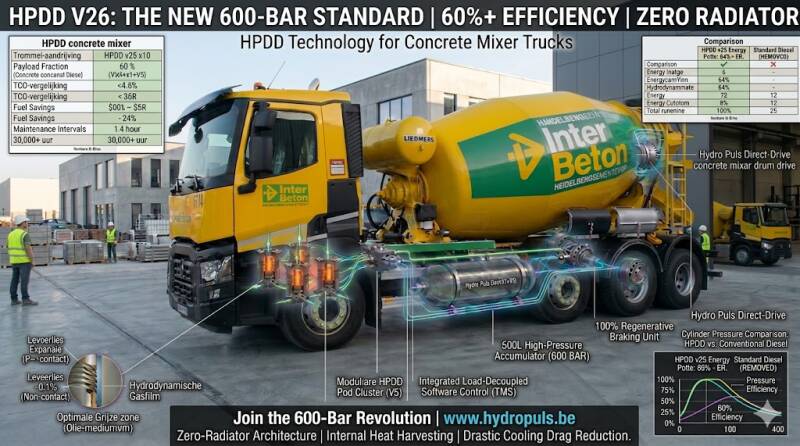
Financial Returns: The Business Case for HPDD v26
In a market where margins are under pressure from rising energy costs and mileage levies, the HPDD v26 offers an immediate improvement to your bottom line:
-
Increased Revenue per Trip (+12% per m³): A battery-electric concrete mixer (BEV) loses approximately 1 m³ of payload per trip due to battery weight. The HPDD v26 maintains full capacity. With an average of 5 trips per day, this translates to 5 m³ of additional concrete delivery per truck, per day, without additional personnel or vehicle costs.
-
Drastic Reduction in Fuel Costs: Thanks to a system efficiency of 62% LHV, the HPDD v26 consumes significantly less fuel (Hydrogen or Biofuel) than a conventional diesel engine or turbine. These OPEX savings are felt immediately from day one.
-
Zero Investment in Heavy Charging Infrastructure: Transitioning to BEV mixers requires millions in investments for charging stations and grid upgrades at your batching plants. The HPDD v26 utilizes existing refueling logistics and lowers the cost of hydrogen infrastructure through its built-in 700-bar Direct-Compression.
-
Lower Maintenance Costs (TCO): The simplicity of the Direct-Drive architecture eliminates complex transmissions and the wear-prone components of traditional drivetrains. This results in higher uptime and lower workshop invoices over the entire lifespan of the vehicle.
-
Future-Proof Resale Value: While diesel vehicles face accelerated depreciation due to emission zones, the HPDD v26 retains its value as a zero-emission solution that meets the strictest ESG standards of your clients.
The Financial Verdict:
-
HPDD: More concrete per trip + Lower fuel consumption + No charging infrastructure investment = Immediate Profit.
-
BEV: Less concrete per trip + Massive infrastructure investment + Payload penalty = Operational Loss.
Frequently Asked Questions: Concrete Mixers & Construction
How does the HPDD handle the constant power demand of a mixer drum?
Unlike traditional diesel engines that must idle at high RPMs to keep the drum rotating, the HPDD provides independent hydraulic power. Our high-pressure 600-bar system can drive the mixer drum with maximum torque at 0 RPM, ensuring a perfect mix without wasting fuel or creating unnecessary engine wear.
Is the system resistant to the dust and debris of a construction site?
Yes. The HPDD is a Solid-State inspired platform with no external moving parts like belts or fans. The core is hermetically sealed using aerospace-grade Inconel bellows. This means cement dust, grit, and water cannot penetrate the drive system, making it the most durable power source for harsh construction environments.
Can the HPDD reduce noise pollution on urban construction sites?
Significantly. Traditional mixers are notoriously loud due to high-revving diesel engines. The HPDD operates with a high-frequency pulse that is nearly silent to the human ear. This allows for extended working hours in residential areas and night-time deliveries without violating noise ordinances.
Does the system provide weight advantages for maximum payload?
Weight is money in the concrete business. By eliminating the heavy internal combustion engine, complex transmission, and massive battery packs, the HPDD system is up to 30% lighter. This weight saving translates directly into a higher legal payload of concrete per trip.
What happens if the truck is stuck in traffic or on-site for hours?
Zero waste. The HPDD only consumes fuel when energy is actually needed. Because there is no mechanical idling, you can keep the drum rotating for hours with minimal energy consumption. Furthermore, the system produces zero localized emissions, protecting the health of workers on-site.
How does the "Maintenance-Free" claim work in such a heavy industry?
Construction machinery usually requires frequent oil and filter changes due to contamination. The HPDD operates on a frictionless 5-micron gap principle. With no oil-burning combustion and no metal-on-metal contact in the core, the system reaches a lifespan of 20,000+ hours without any scheduled engine maintenance.