HPDD v26: The Powerhouse for Mobile Maritime Energy Containers
Transform any vessel into an emission-free powerhouse. Modular energy driven by Green Ammonia and Hydrogen.
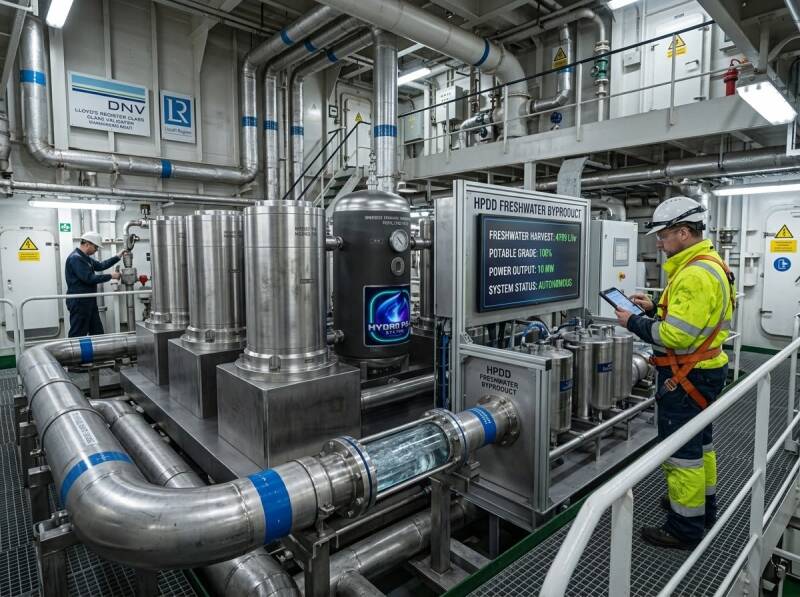
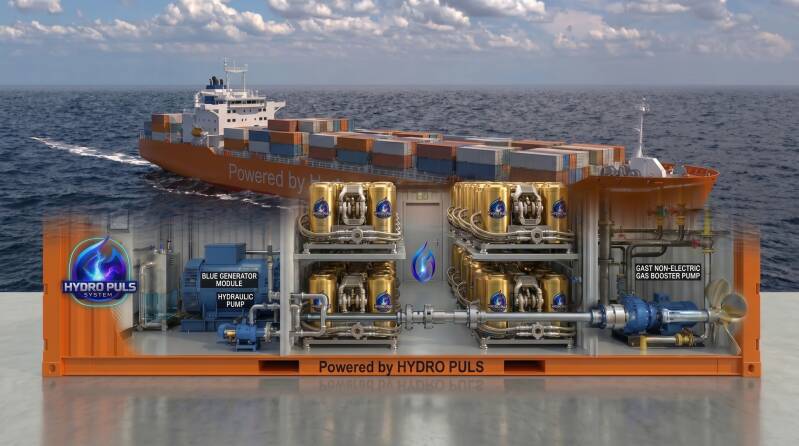
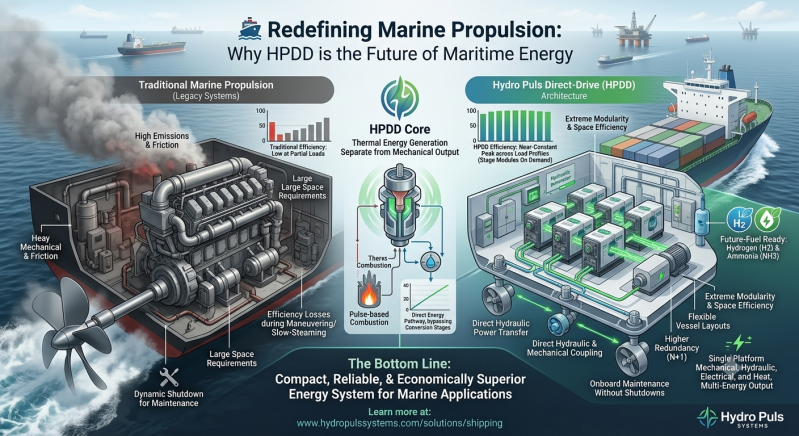
The shipping industry faces a massive logistical challenge: how to integrate new fuels without rebuilding the entire engine room? The answer lies in the Energy Container. The Hydro Puls Direct-Drive (HPDD) is the first high-frequency transducer specifically engineered to fit as a compact, safe, and ultra-efficient module within a standard 20ft or 40ft container.
🚢 Why the HPDD v26 is Rewriting the Container Standard:
- Unrivaled Power Density per m³: With our roadmap targeting 200 Hz (410 kW per module) and a working pressure of 1,000 bar, the HPDD delivers more power per cubic meter than any traditional marine engine. This leaves more room for fuel storage or battery capacity within the same container footprint.
- 100% Hermetic Safety (Inconel Bellows): Safety at sea is paramount. While Ammonia is toxic, our patented Inconel Bellows guarantee a physical, leak-proof seal. Even in the confined space of a container, there is 0% risk of ammonia slip into the environment.
- Plug-and-Play Hydraulics & Electricity: The HPDD delivers direct high-pressure fluid power (Direct-Drive), eliminating heavy mechanical transmissions. The container connects directly to the ship’s grid or hydraulic systems for cranes, winches, or propulsion.
- Maintenance-Free at Sea: Marine maintenance is difficult and expensive. The HPDD has no crankshaft, no piston rings, and no lubricating oil in the reaction chamber. The plunger floats on a 620-bar nitrogen shield, creating a "black box" energy source capable of thousands of hours of autonomous operation.
⚓ The "Clean Port" Solution
The HPDD Energy Container is the ideal solution for Cold Ironing and maneuvering in zero-emission zones:
- Pure Ammonia Power: Utilize the vast range of liquid ammonia without the need for a diesel pilot (Pure Mono-Fuel).
- Silent Power: High-frequency operation (100–200 Hz) ensures a low-vibration system that does not stress the ship’s structure or the container.
- 62% Net Efficiency: Maximize every drop of green fuel. The HPDD is the most efficient converter of chemical energy into usable power in the maritime sector.
Modular Scalability
Whether it’s a single 20ft unit for auxiliary power or a stack of 40ft containers for primary propulsion, the HPDD v26 scales effortlessly with the energy demands of the modern fleet.
Future-proof your fleet with the HPDD Energy Container. [Request our Maritime Integration Guide]
🛡️ Strategic Shipping Arguments (Deduction):
-
"Ammonia Slip": This is the industry's biggest nightmare. By mentioning 0% risk, you position yourself miles ahead of MAN or Wärtsilä, who are struggling with this in traditional combustion engines.
-
"1,000 Bar Pressure": In a container, space is money. Higher pressure means smaller components and more power in the same box.
-
"Nitrogen Shield": This clarifies the "frictionless" claim for maritime engineers who are used to heavy oil-lubricated liners.
-
"Cold Ironing": The technical term for ships using shore power or external containers to turn off their main engines in port.

Headline: Why are we still using Diesel to burn Ammonia? 🚢💨
The maritime industry is betting big on Ammonia ($NH_3$), but there is a "dirty" secret: most current ammonia engines are Dual-Fuel. They require a constant injection of pilot-diesel to ignite the slow-burning ammonia.
This means we are still carrying carbon-based fuels, producing $NO_x$, and dealing with complex dual-fuel logistics.
The HPDD v26-63 changes the game.
We have engineered the world’s first Pure Mono-Fuel Ammonia system operating at 100 Hz. Here is how we break the dependency on diesel:
⚡ Plasma Activation: Instead of a diesel pilot, we use high-frequency corona discharge to "crack" the $NH_3$ molecules directly in the chamber, milliseconds before ignition.
🔥 Turbo-Helix Pre-heating: We harvest waste heat to raise ammonia's reactivity to the level of hydrogen.
🛡️ Zero Ammonia Slip: Our patented Hermetic Inconel Bellows provides a physical barrier, permanently solving the toxic leakage problem that plagues traditional piston designs.
The result? 64% net efficiency on pure green ammonia. No pilot. No carbon. No compromise.
We are not just transitioning to green shipping; we are engineering the "Energy Spine" that makes it work.
Join the Pioneer Series. Let's move beyond the pilot.
#Ammonia #ZeroEmission #MaritimeInnovation #HPDD #GreenShipping #HydrogenEconomy #DeepTech #FutureOfTransport

Executive Summary: HPDD v25 "The Clean Core"
The Ammonia Breakthrough: Pure Mono-Fuel at 100 Hz
The Challenge: Current ammonia-powered shipping relies on Dual-Fuel engines. This requires a constant injection of "pilot diesel" to ignite the slow-burning ammonia. This is not 100% emission-free, produces $NO_x$ (nitrous oxide), and limits operating frequencies to approximately 15 Hz.
The HPDD Solution: The Hydro Puls Direct-Drive is the world's first Mono-Fuel ammonia machine operating at 100 Hz.
-
Plasma Activation: High-frequency corona discharge breaks the NH_3 molecules open prior to flame-front propagation. This eliminates the need for a diesel "pilot lighter" entirely.
-
Pre-Heated Injection: Waste heat harvesting via the Turbo-Helix raises the reactivity of ammonia to the level of hydrogen.
-
Hermetic Inconel Bellows: A physical barrier with only 0.07 mm of elastic deformation. This permanently solves the toxic leakage (slip) problem that currently plagues the sector.
-
1000-Bar Roadmap: A 2/3 reduction in oil volume within hydraulic drivetrains by stepping up from the industry-standard 350 bar to a 1000-bar backbone.
Conclusion: While the market attempts to go "green" using diesel support, the HPDD delivers 62% net efficiency on pure ammonia. We are not just a competitor in shipping; we are the technical enabler that makes zero-emission maritime transport a reality.
Frequently Asked Questions: Maritime & Shipping
How does the HPDD facilitate the transition to Green Ammonia (NH3)?
The shipping industry has identified Ammonia as the primary future fuel due to its high energy density and ease of storage compared to Hydrogen. The HPDD is native to Ammonia. Our high-frequency transducer system is specifically designed to handle the combustion characteristics of NH3, allowing large vessels to achieve zero-carbon propulsion without the massive efficiency losses of traditional converted diesel engines.
Can the system replace large-scale marine diesel engines?
Yes, but with a revolutionary shift in architecture. Instead of one massive, vulnerable engine, the HPDD uses a Distributed Power Grid. By placing multiple HPDD modules throughout the vessel, we provide redundant, fail-safe power. If one module requires attention, the ship continues its journey at full operational capacity.
What are the maintenance advantages during long-haul voyages?
Traditional marine engines require constant onboard maintenance and carry literal tons of spare parts. The HPDD is hermetically sealed and frictionless, with a lifespan of 20,000+ hours. For a ship, this means years of operation without a single engine overhaul, significantly reducing the size of the engineering crew and maintenance costs.
How does the HPDD impact the ship’s cargo capacity?
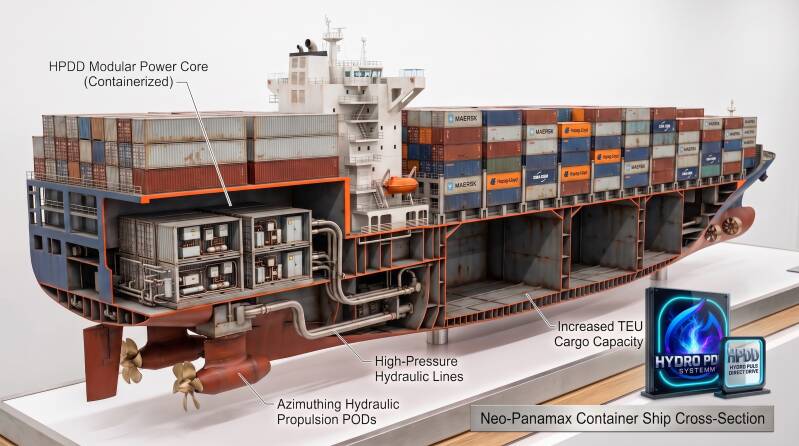
Weight and volume efficiency are critical. The HPDD system, including its hydraulic drive interface, is up to 40% lighter and 50% more compact than traditional low-speed two-stroke engines and their heavy drive shafts. This reclaimed space and weight can be directly converted into additional TEU (containers) or liquid cargo capacity.
Does the system eliminate the need for heavy gearboxes and drive shafts?
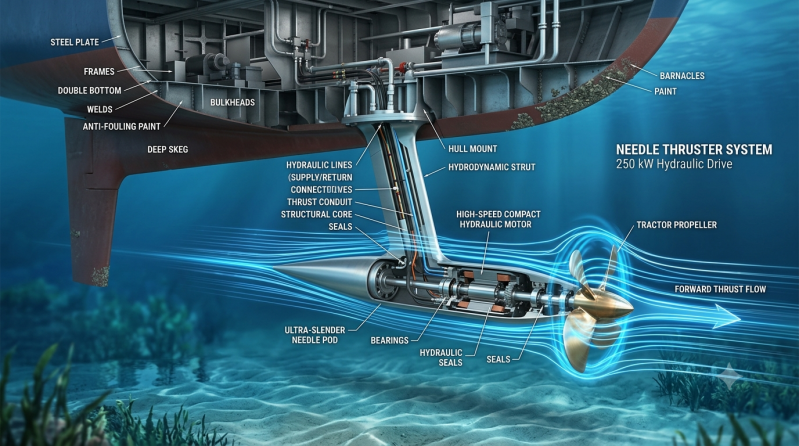
Precisely. The HPDD converts fuel directly into high-pressure hydraulic energy (600 bar). This energy is transported through flexible, high-strength conduits to hydraulic motors at the propellers (Pods). This eliminates the alignment issues, vibrations, and mechanical losses associated with massive steel drive shafts and complex gearboxes.
How does the HPDD contribute to "Quiet Shipping" and marine life protection?
Underwater noise pollution is a growing regulatory concern. Because the HPDD operates without the heavy "thumping" of massive pistons and mechanical gears, the acoustic signature is dramatically reduced. This makes HPDD-powered vessels compliant with the strictest future environmental regulations regarding marine noise.