Molecular Cleansing for Used Lube Oil
HPDD Atomic Eraser: Molecular Cleansing for Used Lube Oil Re-Refining
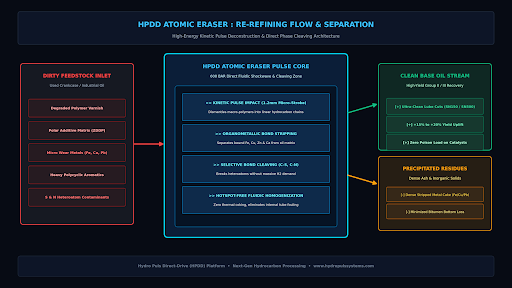
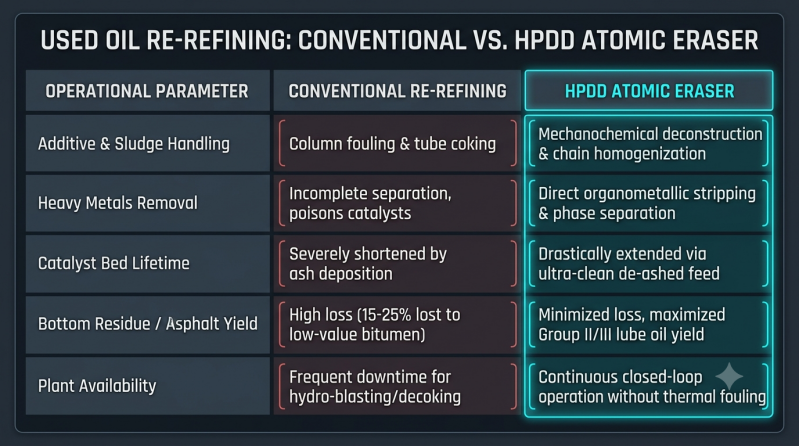
Traditional re-refining methods—vacuum distillation, thin-film evaporation, and severe hydro-finishing—treat used lubricating oil merely as a mixture to be thermally separated. This approach faces constant operational obstacles: degraded polymer additives create dense tars, organometallic residues poison hydro-treatment catalysts, and local thermal hotspots cause severe coking and fouling on heat exchanger surfaces.
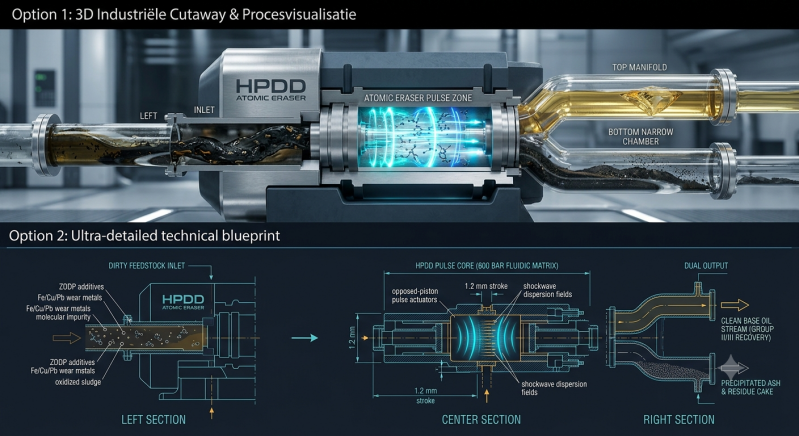
The HPDD Atomic Eraser alters the re-refining paradigm. By applying localized, extreme kinetic-energy pulses and controlled thermochemical gradients directly to the hydrocarbon feed, it dismantles stubborn contaminants at the molecular level before they can foul downstream systems.
The Molecular Mechanism: Dismantling Sludge, Polymers, and Contaminants
Instead of allowing heavy, degraded compounds to bake onto hot metal surfaces, the Atomic Eraser targets the chemical bonds that degrade used oil:
- Deconstruction of Degraded Polymer Additives: Viscosity index improvers and polar additive packages (such as ZDDP) degrade into long-chain varnishes and oxidized sludge. The Atomic Eraser mechanochemically breaks down these macro-polymers, homogenizing heavy fractions into stable, low-viscosity hydrocarbon chains.
- Stripping Organometallics & Catalyst Poisons: Micro-abrasive wear metals (Fe, Cu, Pb) and detergent salts (Ca, Mg, Zn) are chemically bound inside the sludge matrix. Focused pulse mechanics strip these organometallic bonds, allowing inorganic ash precursors to precipitate out cleanly in a dedicated separation phase.
- Targeted De-Sulfurization & De-Aromatization: High-intensity fluidic pulse gradients selectively break weaker heteroatom bonds (C\text{–}S, C\text{–}N), transforming harmful polycyclic aromatic hydrocarbons (PAHs) into readily extractable volatile or insoluble fractions with minimal hydrogen consumption.
- Coking-Free Thermal Processing: Because the process relies on direct fluidic energy transfer rather than open-flame heating tubes, skin-temperature hotspots are eliminated, completely preventing coking and tube plugging.
Process Comparison: Conventional Re-Refining vs. HPDD Atomic Eraser
Unlocking Higher Yields of Group II and Group III Base Oils
Integrating the HPDD Atomic Eraser upstream of distillation or hydro-finishing turns a low-margin, high-fouling re-refinery into an advanced hydrocarbon recovery asset:
Maximized Base Oil Yield: Converting problematic heavy polymers into usable fractions instead of burning them into cokes directly increases the yield of high-margin base stocks.
Reduced Hydro-Finishing Severity: Cleaner feedstocks entering finishing units mean lower hydrogen pressures, reduced catalyst changeout frequency, and drastically lower OPEX.
Self-Contained Energy Footprint: When paired with the broader Hydro Puls Direct-Drive architecture, the entire refining line can be powered and heated using the co-generated 600-bar hydraulic and high-grade thermal vectors of the platform.