

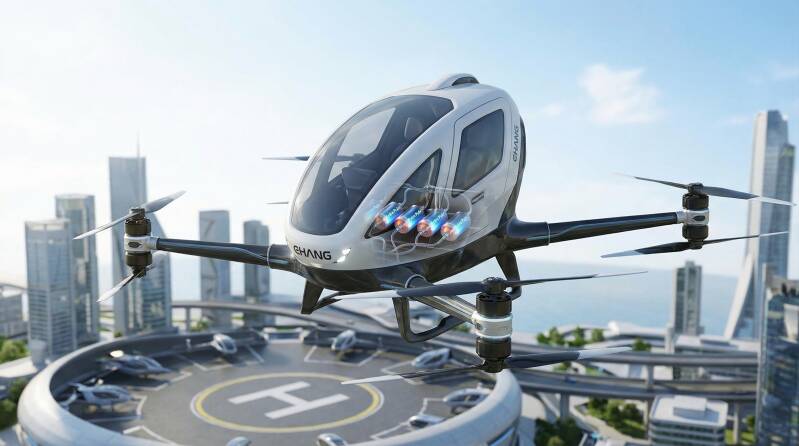
The New Lungs of the Drone Industry
Why Fly on Batteries When You Can Reign on Hydrogen and Ammonia?
The drone sector is at a crossroads. To make the leap to heavy transport, offshore inspections, and humanitarian missions, current battery technology is simply too heavy and too limited. The HPDD v26 provides the answer: a feather-light, high-frequency power source that converts ammonia or hydrogen directly into hydraulic or electrical energy.
⚡ Unstoppable Advantages for UAV & Heavy Lift:
-
Extreme Energy Density: While batteries add kilograms for every extra minute of flight time, the HPDD leverages the massive energy density of (green) ammonia. This translates to flight times 5 to 10 times longer than the current industry standard.
-
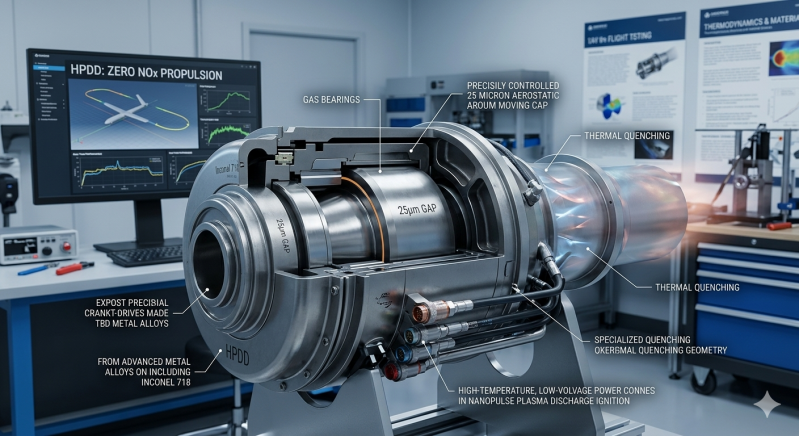
Frictionless Precision (5-Micron Gap): Thanks to our patented gas-bearing technology, the piston floats within the cylinder. Zero mechanical friction means minimal heat, no need for heavy lubrication systems, and an unprecedented operational lifespan.
-
Vibration-Free at 100-200 Hz: Traditional internal combustion engines destroy sensitive sensors and cameras with low-frequency vibrations. The HPDD operates at such high frequencies that vibrations fall outside the critical range of drone electronics.
-
Hermetic Safety (The Inconel Bellows): Safety is paramount in the sky. Our 100% leak-proof bellows technology guarantees that no fuel slip or toxic fumes are ever released, even under the most extreme flight conditions.
🛸 From "Battery Drone" to "Powerhouse"
The HPDD v26 acts as the ultimate Range Extender. The drone takes off and lands electrically (for maximum control), while the HPDD constantly recharges the batteries or drives the motors directly via an ultra-compact 1000-bar hydraulic system.
The Results:
-
Heavy Lift: Transport heavy payloads over distances previously deemed impossible.
-
Instant Refuel: No more hours spent at the charger. Refuel with hydrogen or ammonia and be airborne again within minutes.
-
Zero Emission: Fly 100% climate-neutral on green ammonia or hydrogen.
The Future is Direct-Drive
With a roadmap targeting 200 Hz and 410 kW, and a 2/3 weight reduction of the drivetrain thanks to our high-pressure technology, the HPDD v26 is the engine that pushes the boundaries of the sky.
Ready to elevate your drone platform to a strategic new level? [Contact us for a technical deep-dive]
"The Integration of a Modulable Hydraulic Energy Buffer for Transient Load Management."
In long-endurance loitering UAVs, the biggest challenge for a hybrid system is managing the massive gap between the efficient "loitering" phase (low power) and sudden transient demands like climbing, dodging, or payload activation (high power).
If you use a traditional engine, it has to constantly change its RPM and throttle, destroying its fuel efficiency and increasing thermal wear.
You could introduce a framework where the thermal core is completely decoupled from the actual propeller drive.
The core thermal unit runs exclusively at its absolute aerodynamic and thermal sweet spot, feeding a hydraulic accumulator buffer.
This accumulator acts as a passive, high-density energy slot that handles all sudden transient load peaks instantly.
Because the thermal core never has to fight unpredictable power demands, it remains optimized for maximum LHV efficiency throughout the entire mission profile.
Furthermore, you could analyze a modular approach: for example, using a multi-core platform where you can scale down from maximum power to a fraction of that output by simply switching off individual high-frequency cells without losing any system efficiency.
Frequently Asked Questions: Drones & UAVs
How does the HPDD compare to battery-powered drones?
The biggest limitation of current drones is flight time. While high-end batteries offer 30 minutes of flight, the HPDD—powered by Hydrogen or Ammonia—enables flight times of 8 to 12 hours or more. This transforms drones from short-range sensors into long-range logistics and surveillance platforms.
Can the HPDD increase the maximum payload of a drone?
Yes. Batteries are extremely heavy for the energy they provide. By replacing a 50 kg battery pack with a compact HPDD module and a lightweight fuel tank, you significantly reduce the "empty weight" of the UAV. This weight saving can be directly converted into a higher payload for cargo, professional cameras, or specialized sensors.
Is the system responsive enough for the rapid maneuvers of a drone?
Absolutely. Drone stability requires near-instantaneous power adjustments. The HPDD’s high-frequency pulse technology allows for sub-millisecond control of the hydraulic pressure. When paired with high-speed hydraulic motors, the response time is equal to or faster than electronic speed controllers (ESC) on battery drones.
How does the HPDD perform in cold or high-altitude environments?
Lithium batteries fail rapidly in cold temperatures and high altitudes. The HPDD is thermally stable. Our Inconel-based core operates at an optimized $230°\text{C}$, meaning it is unaffected by freezing external temperatures. This makes it the ideal power source for high-altitude reconnaissance or Arctic delivery missions.
What about the noise signature for stealth or urban operations?
Standard internal combustion engines for drones are notoriously loud and high-pitched. The HPDD operates as a solid-state inspired transducer, eliminating the mechanical "clatter" of traditional pistons. The result is a much lower acoustic signature, making it suitable for discreet surveillance or night-time urban deliveries.
Is the system reliable enough for autonomous long-range missions?
Reliability is key when a drone is 500 km away from base. With a 20,000+ hour maintenance-free lifespan and no rotating crankshaft to fail, the HPDD offers a level of reliability that traditional small engines cannot match. This makes "Beyond Visual Line of Sight" (BVLOS) missions safer and more economically viable.