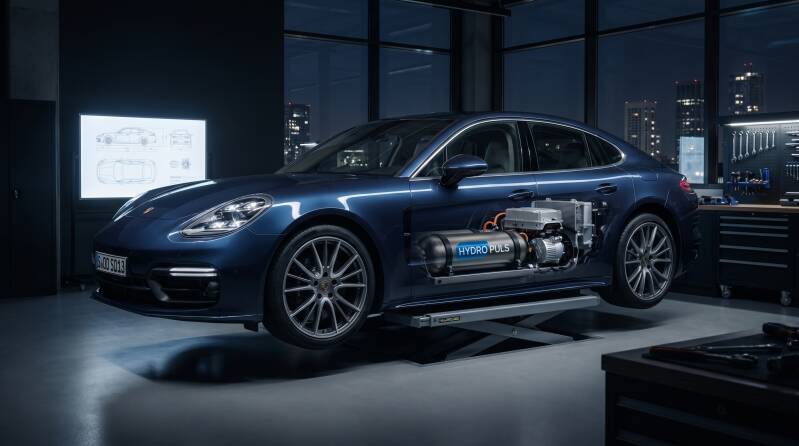
HPDD-v26-TRT: Range Extenders

Comprehensive Technical Description: Range Extender with HPDD Technology

The Hydro Puls Direct-Drive (HPDD) technology represents a paradigm shift in range extender (REX) design for electric vehicles. By moving away from the rotational inertia and mechanical complexity of traditional internal combustion engines, the HPDD system provides a linear, high-frequency energy conversion method that is exceptionally compact and efficient.


1. Architectural Philosophy: Opposed Piston Configuration

The core of the HPDD unit is built on a high-balance architecture designed to eliminate the NVH (Noise, Vibration, and Harshness) issues typically associated with small auxiliary engines.

  • Four-Piston Opposed Layout: The system utilizes two pairs of pistons in direct opposition. This ensures that the momentum of each stroke is perfectly countered by its opposite pair, resulting in a self-balancing unit that requires minimal heavy engine mounts.

  • Siloxane Integration: The system employs siloxane as a specialized medium. To ensure long-term reliability and reduce seal fatigue, the siloxane is maintained under zero pressure, functioning as a stable thermal and lubrication interface without the risks of high-pressure fluid leaks.


2. Extreme Thermal Engineering

The HPDD operates at a standardized high-performance threshold of 230°C. Engineering at this temperature requires precise material science to maintain mechanical integrity.

  • Material Choice: Both the cylinder boring and the pistons are constructed from Inconel, a high-strength nickel-chromium superalloy.

  • Controlled Thermal Expansion: At the operating temperature of 230°C, both the cylinder and the piston expand by exactly 109 µm. This synchronized expansion is critical to maintaining the functional clearance required for high-frequency operation without seizing or losing compression.

  • Precision Gap Management: The system is engineered with a 5-micron gap, a tolerance level that allows for a "gas cushion" effect, significantly reducing mechanical wear.


3. Fluid Dynamics and Performance Parameters

The efficiency of the Direct-Drive system is derived from its unique geometric ratios and pressure capabilities.

  • High-Pressure Operation: The unit is designed to handle pressures exceeding +600 bar, allowing for an incredible power density relative to its physical footprint.

  • Geometric Optimization: The design utilizes an 80/40 ratio combined with a specific spiral angle in the flow paths. This geometry optimizes the pulse-wave dynamics of the fluid, ensuring that energy transfer is maximized during every stroke.


4. Future Roadmap and Scalability

The HPDD platform is designed as a modular solution that can be scaled depending on the vehicle's requirements (from passenger cars to heavy-duty transport).

  • Performance Scaling: While current iterations focus on standard range extension, the technical roadmap includes a high-output version capable of 200 Hz operation, delivering up to 160 kW of power.

  • Direct-Drive Efficiency: By bypassing the need for a gearbox or traditional generator coupling, the "Direct-Drive" nature of the system ensures that the energy generated by the piston pulses is converted into usable power with minimal intermediary loss.


Summary of Technical Advantages

  • Friction Reduction: The linear motion and 5-micron tolerances eliminate the side-loading forces found in crankshaft engines.

  • Compact Integration: The lack of a cooling jacket (due to Inconel’s heat resistance) and the absence of a pressurized oiling system for the siloxane significantly reduce the total system volume.

  • Sustainability: Optimized for high-pressure cycles, the HPDD can achieve thermal efficiency levels that far exceed current small-displacement range extenders.

As the global industry shifts toward electric drivetrains, the low energy density of batteries remains the primary obstacle for heavy-duty transport and long-haul applications. The Hydro Puls Direct-Drive (HPDD) serves as the "missing link": an ultra-efficient range extender that converts Hydrogen or Ammonia directly into hydraulic or electrical power—without the mechanical limitations of a crankshaft.

Why the HPDD is the New Standard for Range Extension:

  • Unmatched Efficiency (62.0%): Utilizing a three-stage energy recovery cycle (Turbo-compounding and ORC), the HPDD extracts more energy from every kilogram of fuel than any traditional internal combustion engine.

  • Extreme Weight Reduction: With a dry weight of only 81 kg, the HPDD v26 delivers a power output that typically requires engines weighing over 300 kg. This effectively neutralizes the "weight penalty" of large battery packs.

  • Vibration-Free Operation: Thanks to our patented isostatic geometry and the absence of rotating masses, the unit operates with near-zero vibration. This is critical for the longevity of onboard electronics and structural chassis integrity.

  • Fuel Agnostic & Carbon-Free: Designed for the direct combustion of Green Hydrogen and Ammonia ($NH_3$), the HPDD allows vehicles to operate with 100% zero emissions while maintaining the fast-refueling advantages of liquid/gas fuels.

Key Applications:

  • Heavy-Duty Trucking: Eliminate "range anxiety" and the need for multi-hour charging stops.

  • Maritime Retrofits: The ideal power core for vessels transitioning to electric propulsion using Ammonia as an energy carrier.

  • Mobile Power Grids: Rapidly deployable, emission-free power generation for construction sites, disaster relief, and off-grid industrial hubs.

"HPDD Inside" means you no longer have to choose between the benefits of electric drive and the necessity of long-range performance. We provide the technology that enables both.