Bitcoin Mining
Why the AI Boom and Bitcoin Mining Face the Exact Same Wall
The ultimate bottleneck for Bitcoin mining today is no longer the availability of ASIC chips; it is access to stable, affordable power and the massive cooling infrastructure required to support it. Globally, miners are facing multi-year grid connection delays and intensifying regulatory scrutiny due to their massive carbon and water footprints.
By directly coupling a Bitcoin mining operation with the autonomous Hydro Puls Direct-Drive (HPDD v26) platform, a mining farm transitions from an energy-draining strain on the grid into a fully closed-loop, zero-emission, independent ecosystem.
Here is how Bitcoin miners can leverage the HPDD architecture to mine the most environmentally friendly, high-margin Bitcoins on the planet:
1. 100% Carbon-Free Power via Pure Ammonia
Traditional off-grid mining typically relies on heavy diesel generators or gas flaring. The HPDD platform utilizes pure ammonia () combustion. Thanks to software-controlled, ultra-fast expansion and a peak equilibrium core temperature of , the formation of harmful nitrogen oxides ( and ) is physically prevented. The exhaust consists purely of harmless atmospheric nitrogen () and clean water vapor. This allows for megawatt-scale mining with a net-zero and emissions footprint.
2. Free Cryogenic Cooling for ASICs (0.0 kW Parasitic Load)
Bitcoin miners generate massive thermal loads, often spending to of their total energy budget on forced-air or liquid-chiller cooling infrastructure. HPDD solves this without drawing a single watt from the primary energy busbar.
- The Mechanism: High-temperature exhaust gas is driven through a precision-engineered supersonic De Laval nozzle.
- The Cascade: The extreme, controlled expansion causes an instantaneous collapse in temperature, creating a stable, sub-zero stream down to .
- The Asset: This cryogenic energy is cascaded directly into an immersion cooling system for the ASIC mining rigs. The parasitic power cost for hardware cooling drops to exactly 0.0 kW, optimizing the facility's Power Usage Effectiveness (PUE) to unprecedented levels.
3. Absolute Grid Independence (Zero Utility Delays)
Instead of waiting on overextended central electricity grids, the HPDD operates as a modular, software-defined "swarm" network. A cluster of HPDD containers can be deployed completely off-grid anywhere in the world, adjacent to ammonia storage terminals, stranded energy assets, or remote regions. Mining facilities can scale and become operational within months rather than years.
4. High-Volume Water Generation as a Secondary Asset
Data centers and mining farms in arid regions frequently face heavy local pushback due to the water consumption of conventional cooling towers. The HPDD architecture reverses this environmental liability: by actively condensing the clean water vapor trapped in the exhaust stream, a standard 10 MW HPDD module natively harvests over 2,300 Liters of pure, technical utility water per hour. This water can be utilized for local agricultural irrigation, industrial use, or regional community infrastructure, leaving a net-positive ecological footprint.
The Bottom Line for Miners
Bitcoin mining via HPDD shifts the sector from an environmental liability into a textbook model for Ecosystem Engineering. By integrating power generation, sub-zero cryogenic cooling, and industrial water production into a single thermodynamic cascade, operators drastically slash their OpEx and mine Bitcoins that are verifiably green, grid-independent, and net-zero.
Baseline Comparison Table: 10 MW Mining Facility
Financial & Operational Breakdown (10 MW Model)
1. The Hashing Power Disadvantage of Traditional Systems
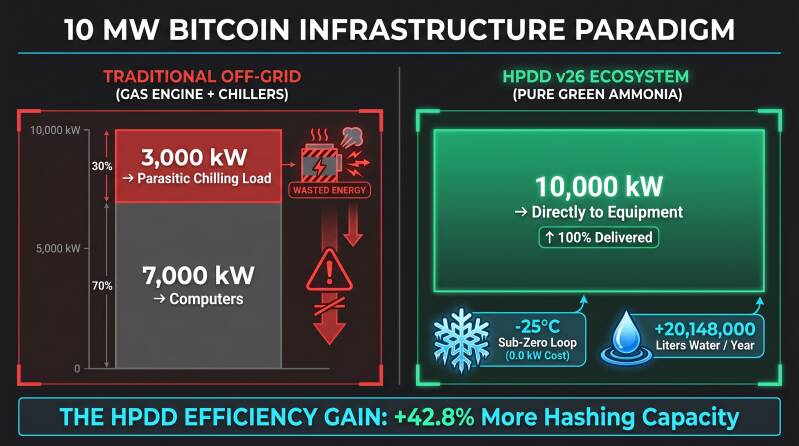
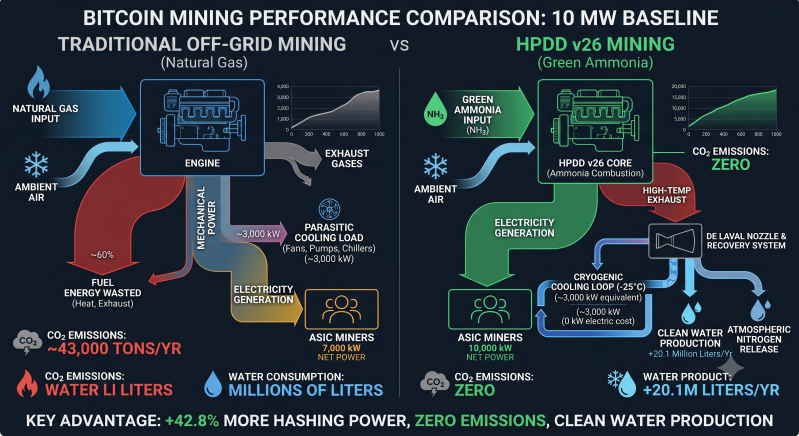
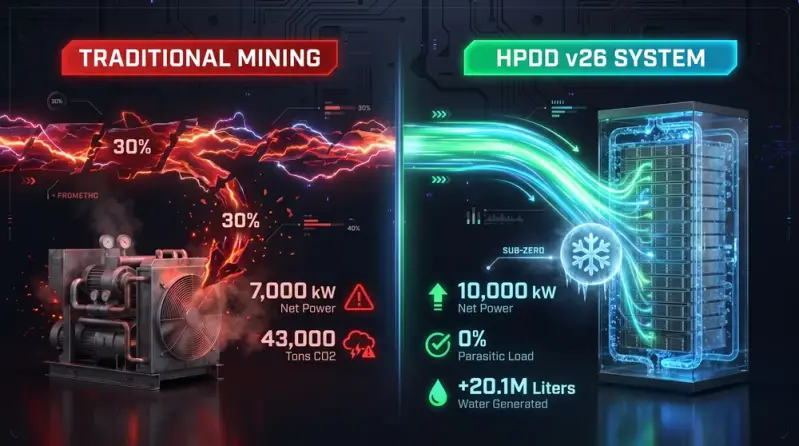
In a standard 10 MW off-grid setup, a massive chunk of electricity never reaches the Bitcoin mining rigs. Because ASICs generate extreme heat, roughly 3,000 kW of power must be constantly fed into mechanical chillers, pumps, and high-velocity fans. This leaves only 7,000 kW for actual hashing.
2. The HPDD Thermodynamic Advantage
The HPDD platform completely eliminates this parasitic cooling load. The exhaust gases are driven through a supersonic De Laval nozzle, causing an immediate expansion that drops temperatures down to .
This cryogenic stream is captured and cascaded directly into the facility's liquid immersion mining tanks.
- The result: The cooling cost drops to 0.0 kW.
- The outcome: The full 10,000 kW is delivered directly to the ASIC chips.
To match the hashing output of a 10 MW HPDD facility, a traditional mining operator would have to build, permit, and fuel a 14.28 MW conventional power plant. This represents a 42.8% boost in hashing efficiency for HPDD at identical gross power scales.
3. Turning an Environmental Expense into a Commodity
Conventional data centers and mining farms face immense regulatory scrutiny over their water footprint due to evaporation losses in cooling towers.
The HPDD architecture reverses this dynamic entirely. By capturing and shock-condensing the moisture-rich, clean exhaust of the ammonia combustion process, a 10 MW cluster continuously harvests 2,300 Liters of pure technical water per hour. Over a single operational year, this creates an unpressurized on-site asset of 20,148,000 Liters of water that can be sold locally, used for agriculture, or recycled into closed-loop cooling circuits.
The Bottom Line for Crypto Infrastructure Investors
By coupling mining hardware directly to an autonomous HPDD energy core, you do not just lower your utility bill; you engineer a multi-output infrastructure node. It maximizes raw computational capacity, eliminates utility grid-queuing completely, and produces verifiably green, net-zero Bitcoins that meet the highest environmental standards worldwide.