

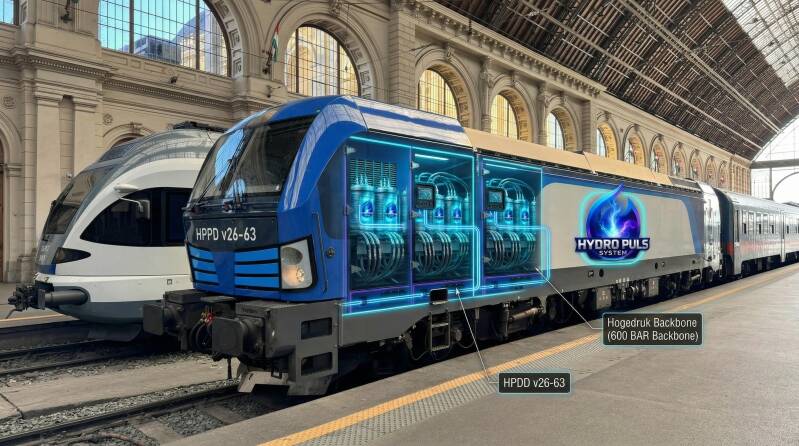
HPDD Railway Technology: The New Traction Standard for Heavy Haul
The Challenge: Decarbonization Beyond the Catenary
While passenger rail is often electrified, freight and regional transport on non-electrified tracks remain dependent on heavy diesel-electric locomotives. For these high-power requirements, batteries are too heavy, and fuel cells are too fragile and costly for the harsh railway environment.
The Hydro Puls Direct-Drive (HPDD) v26 provides the missing link: a carbon-free powertrain with the energy density of diesel and the efficiency of a modern electric system.
Why HPDD is the Future of Rail:
-
Direct-Drive Efficiency (62% LHV): Instead of converting hydrogen into electricity (suffering all associated conversion losses), the HPDD converts ammonia or hydrogen directly into hydraulic power. By eliminating heavy copper windings and complex cooling systems, we achieve groundbreaking net efficiency.
-
Unrivaled Tractive Effort: Rail transport is defined by low-speed torque. The hydraulic nature of the HPDD delivers maximum force from a standstill—ideal for heavy freight and steep gradients—without the overheating risks common in electric traction motors.
-
Mass Savings for Higher Payload: Utilizing Inconel 718 and reducing the part count by 85%, the HPDD unit is significantly lighter than a traditional diesel engine. This weight saving translates directly into extra cargo capacity or extended fuel range.
-
Zero-Vibration & Silent Operation: Thanks to first-order vibration cancellation (sum F = 0) and the absence of a mechanical crankshaft, the HPDD operates virtually vibration-free. This extends the lifespan of the locomotive chassis and reduces noise pollution in shunting yards and urban areas.
Technical Integration:
The HPDD is modular. For locomotives, this means multiple 205 kW cores can be arranged in parallel to create multi-megawatt systems.
-
Fuel Agnostic: Seamless use of liquid ammonia or compressed hydrogen.
-
Maintenance: No oil change intervals and a design life aimed at the infinite life regime (10^{11} cycles).
-
Repowering: Due to its compact dimensions, the HPDD is perfectly suited for retrofitting existing diesel locomotives with a zero-emission powertrain.
The future of rail is emission-free. With HPDD technology, we transform the locomotive from a polluter into an efficient, silent, and powerful ally in the global logistics chain.
Frequently Asked Questions: Locomotives & Rail
Can the HPDD replace traditional diesel-electric drivetrains?
Yes, and it simplifies the entire architecture. Traditional locomotives use a diesel engine to drive a massive generator, which then powers electric motors. The HPDD skips these energy conversion losses by converting fuel directly into 600-bar hydraulic energy. This provides more "tractive effort" at the wheels with a fraction of the system's total weight.
How does the HPDD perform with extremely heavy freight loads?
Rail transport requires massive starting torque. High-pressure hydraulics are inherently superior for this task. The HPDD delivers 100% torque from a standstill, allowing heavy freight trains to start on steep inclines without the overheating issues often found in electric traction motors during prolonged heavy climbs.
Is the system suitable for long-distance, cross-border rail corridors?
Absolutely. While battery-powered trains are limited to short branch lines, an HPDD locomotive has the energy density to travel thousands of kilometers. By utilizing Green Ammonia (NH3), railways can leverage existing liquid fuel infrastructure to create zero-emission freight corridors across continents.
What are the maintenance benefits for rail operators?
Locomotives are expected to stay in service for 30 to 40 years, requiring multiple expensive engine overhauls. The HPDD core is hermetically sealed and frictionless, reaching 20,000+ hours of operation without any mechanical wear-and-tear. This dramatically increases "uptime" and reduces the need for massive, specialized maintenance depots.
Does the HPDD help with the weight limitations of bridges and tracks?
Yes. By removing the heavy copper-wound generators and massive cooling systems of traditional locomotives, we can reduce the locomotive's weight by up to 25%. This allows for higher cargo loads on weight-restricted lines or reduces the wear and tear on the rail infrastructure itself.
How does the HPDD contribute to quieter rail operations in urban areas?
The "thumping" low-frequency noise of a large-bore diesel engine is a major complaint in urban rail yards. The HPDD operates as a high-frequency transducer, making it significantly quieter. This allows rail operators to meet strict noise regulations for night-time operations and urban transit zones.