

Cryogenic OTR Tyre Recycling

BUSINESS USE CASE: Cryogenic OTR Tyre Recycling
Ultra-Fast Rubber Embrittlement via the Hydro Puls Direct-Drive (HPDD) Closed-Loop Platform
Target Audience: OTR (Off-the-Road) Tyre Recycling Operators & Circular Economy Investors
Objective: Demonstrating a 75% reduction in processing time and radical energy savings during the structural verglazing (embrittlement) of 5-ton rubber tyres.
1. The Challenge: The Thermographic Bottleneck of Massive Rubber
To crush massive 5-ton OTR tyres into high-value fine granulate, the rubber must be brought entirely below its molecular glass transition temperature (Tg of approximately -60°C to -70°C). Once in this "glass phase," the elastic rubber loses all structural flexibility and shatters under minimal mechanical impact.
However, rubber is a notorious thermal insulator. Traditional cryogenic cooling methods using atmospheric gas streams (at 1 bar) require 4 to 6 hours per 5-ton tyre. The gas forms an isolating microfilm around the tread, severely limiting heat extraction and resulting in massive energy losses and high CAPEX.
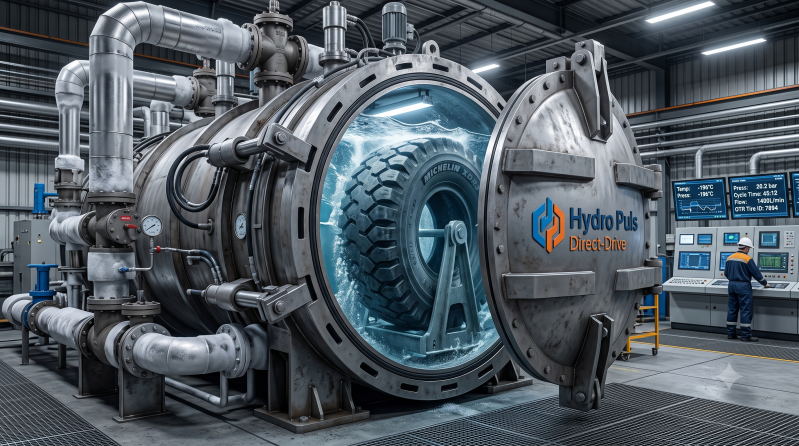
2. The HPDD Solution: Pressurized Fluidic Shock Integration
The Hydro Puls Direct-Drive (HPDD) platform re-engineers this process by deploying a proprietary, closed-loop liquid cooling system operating at a pressurized 30 bar sweet spot.
Instead of relying on inefficient gas expansion at the point of contact, the HPDD utilizes its deep cryo-turbine loop to chill a specialized, unpressurized siloxane environment or thermal fluid down to a stable -73°C. This sub-zero liquid is then injected under a controlled 30 bar hydraulic pressure into a closed cooling chamber, aggressively circulating across the 5-ton tyre structure.
Process Flow Configuration:
- HPDD Core Loop: Generates deep cryo-cold (-73°C) via a continuous closed-loop pumping configuration.
- 30 Bar Liquid Cooling Chamber: Maintains ultra-high turbulence flow to maximize convective heat transfer (reducing surface convection resistance to near zero) while constantly flushing away the warm microfilm boundary layer.
- Result: Rapid, uniform structural embrittlement of the entire 5-ton OTR tyre profile.
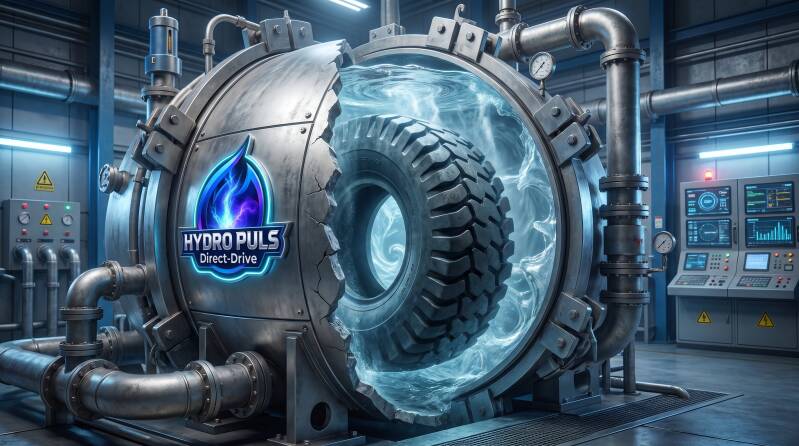
Cryogenic OTR Tire Recycling
Comparative analysis of structural embrittlement (verglazing) in massive rubber tires.
Developed by
Hydro Puls Direct-Drive
Interactive Performance Simulator
Adjust the OTR tire weight slider below to calculate and compare convective cooling performance, cycle duration, and efficiency gains of the HPDD pressurized system against atmospheric gas alternatives.
Traditional Gas (1 bar)
5.00 hours
Required cooling cycle duration
HPDD Fluidic Loop (30 bar)
1.25 hours
Required cooling cycle duration
Net Process Gain
75% Faster
Hours Saved: 3.75 hrs
Technical Process Matrix
Direct physical and operational comparison between atmospheric gas loops and the pressurized HPDD platform.
| Parameter / Specification | Traditional Gas Cooling (1 bar) | HPDD Pressurized Liquid (30 bar) |
|---|---|---|
| Core Processing Time (5-Ton OTR) | 4.0 to 6.0 Hours | 1.0 to 1.5 Hours (75% Time Reduction) |
| Convective Heat Transfer (h) | Baseline (Severely limited by insulating gas microfilm barrier) | 10x to 50x Increase (Aggressive, turbulent liquid-to-solid conduction) |
| Thermodynamic Phase Loss | High (Massive vaporization, boiling, and exhaust venting losses) | Zero Phase Loss (Closed-loop system keeps fluid in stable liquid state) |
| Parasitic Plant Load | Extremely High (Requires continuous, power-hungry refrigeration) | Absolute Minimum (Fluid recycled and recirculated with minor top-off chill) |
| Mechanical Tool & Blade Wear | Severe & Frequent (Heavy steel hieldraden and cords destroy shredder blades) | Zero Contact Wear (Fluid-cooling and non-contact shockwaves shatter rubber) |
Why Pressurized Liquid (30 bar) Succeeds
- • Microfilm Penetration: Under normal 1 bar gas cooling, a thin static boundary layer of warmed gas wraps around the tire tread, insulating it. The HPDD high-velocity liquid stream violently tears this microfilm away, unlocking extreme convective heat transfer.
- • Unpressurized Siloxane Medium: The system chills a specialized, unpressurized siloxane thermal fluid to a stable -73°C within the core, and then uses a closed, high-flow hydraulic loop at 30 bar to cycle it rapidly through the chamber. This balances peak speed with ultra-low thermal resistance.
Environmental & Circular Advantage
- • 100% Pure Raw Steel Reclamation: By bringing the rubber entirely below its glass transition temperature (Tg ≈ -70°C), the rubber instantly turns into a glass-like state. Minimal shock impulses shatter it entirely, separating 100% clean, unbent, premium steel cords from rubber powder.
- • Massive Carbon Reductions: With cooling times reduced by 75% and thermal conductivity multiplied up to 50x, the electrical operating energy per processed ton of OTR rubber falls by over 60%, drastically slashing carbon output.
© 2026 Hydro Puls Direct-Drive. All rights reserved. The HPDD platform is protected by international patents.

Key Architectural Benefits:
- 75% Reduction in Processing Time: By substituting gas with a pressurized liquid, the convective heat transfer coefficient at the rubber surface is multiplied exponentially. Continuously pulling the fluid away as it absorbs microscopic fractions of heat maintains the maximum temperature gradient (Delta T).
- Extreme Thermodynamic Efficiency: Because the fluid remains entirely in a liquid phase under 30 bar pressure, there are zero phase-change or evaporation losses. The liquid returned to the HPDD module requires only minimal top-off cooling.
- Optimized Mechanical Sweet Spot: Operating at 30 bar represents the absolute thermodynamic equilibrium. It delivers maximum turbulent flow velocity to eliminate surface thermal resistance without introducing unnecessary pump friction-induced heat or requiring cost-prohibitive heavy pressure-vessel casings.