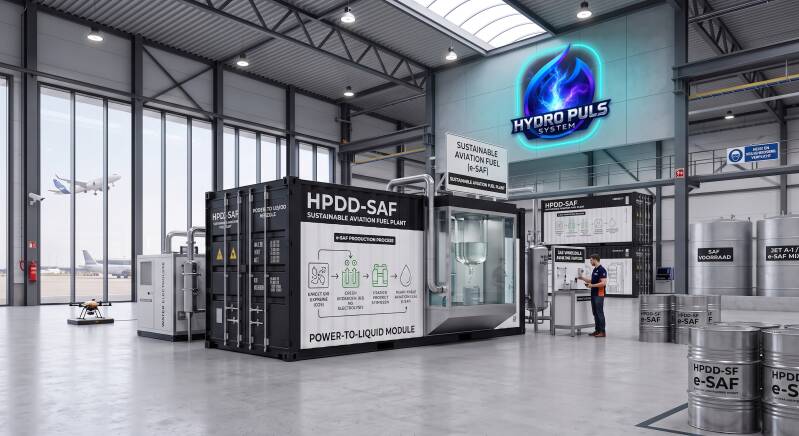
HPDD-SAF

Sustainable Aviation Fuel (SAF) Production via Hydro Puls Direct-Drive (HPDD)

1. Technical Architecture & Process Intensification
Conventional high-pressure triplex or diaphragm pumps introduce significant maintenance liabilities: mechanical crankshaft side-thrust causes uneven liner wear, dynamic wet-seals degrade rapidly under continuous shear, and lubricant migration risks deactivating expensive downstream catalyst beds.
The HPDD core is engineered around a non-crankshaft, direct linear drive platform optimized for process intensification:
- Dual Opposed-Piston Balance (4-Piston Dynamic Balancing):
The power head is built with two opposing pairs (4 pistons total). Working in direct opposition along a shared centerline, dynamic acceleration forces cancel out entirely. This eliminates radial side-loads on cylinder walls, radically attenuates mechanical vibration sent into plant pipe-racks, and provides smooth fluid-column pressurization far superior to angular crank drives. - Isothermal Micro-Gap Precision at 230°C:
SAF hydrotreating and hydrocracking routinely settle at process boundaries around 230°C. Conventional pumping mechanisms suffer clearance drift from mismatched thermal expansion coefficients, causing either fluid slip or catastrophic piston binding. Both the cylinder bore and the pistons in the HPDD core are manufactured from high-grade Inconel. At the 230°C design standard, both components expand identically by 109 µm, maintaining an uncompromised 25 µm micro-gap. This continuous tolerance delivers high volumetric efficiency without dynamic contact friction or mechanical ring wear. - Unpressurized Siloxane Fluid Barrier:
Cross-contamination between the hydraulic drive circuit and the biogenic feed/hydrogen stream is fully prevented using an inert siloxane barrier fluid. The siloxane buffer operates in an unpressurized state, eliminating hydraulic over-pressure on static and labyrinth seals. No hydrocarbon lubricating greases or engine oils enter the reaction path. - Kinetic Hydrogen Micro-Dispersal:
Rather than relying on massive, high-pressure hydrogen recycle gas loops and static mixers, HPDD utilizes high-frequency hydraulic shock pulses to induce extreme fluid-shear across the 25 µm clearance. Hydrogen gas is cleaved into micron and sub-micron bubbles directly inside the biogenic oil or intermediate wax stream. This dramatic expansion in interfacial surface area accelerates reaction kinetics inside hydrotreater and hydro-isomerization reactors, eliminating diffusion limitations at lower overall excess hydrogen ratios. - Future Platform Growth (High-Frequency Direct Drive):
The direct linear architecture scales beyond conventional mechanical stroke limits. The platform roadmap integrates continuous operations up to 100 Hz / 300 kW, allowing plants to adjust throughput velocity dynamically without changing skid geometry.
2. Technical Benchmark: HPDD vs. Legacy High-Pressure Pumping
3. Financial Architecture & Unit Economics
In current SAF production, Capex is heavily inflated by the balance-of-plant (BOP) required for multi-stage gas compression, multi-story hydrogen recycle loops, and high-frequency turnaround schedules for pump packings.
4. Certification & Regulatory Roadmap
For any alternative aviation fuel to enter airport hydrants, it must achieve drop-in qualification under global aviation specifications. Integrating HPDD into the processing loop requires adherence to strict quality protocols:
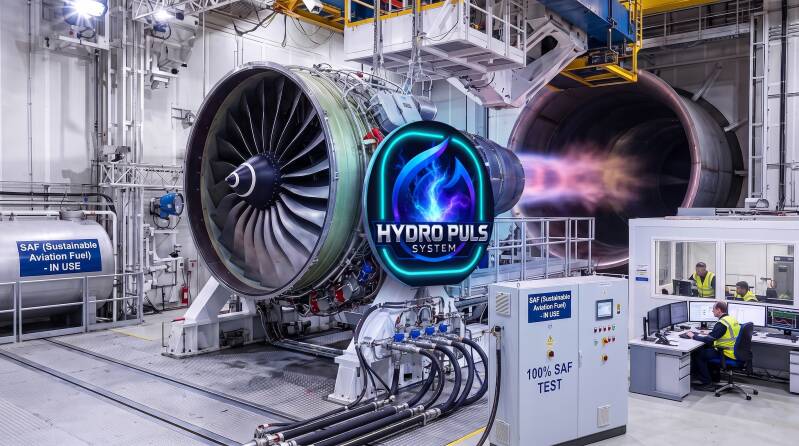
- ASTM D7566 Compliance: SAF produced using the HPDD reactor front-end must meet the exact parameters of its corresponding Annex within ASTM D7566 (e.g., Annex A2 for HEFA, Annex A5 for Alcohol-to-Jet). The process yields paraffinic kerosene identical in distillation curve, freeze point (below -40°C/-47°C), and flash point to traditional standards.
- Hydrocarbon Cleanness Verification (Zero Lubricant Trace): Critical to Tier 1 testing under ASTM D4054 is verifying that process intensifiers do not introduce unknown organic contaminants. The oil-free design ensures that total acid number (TAN), trace metals, and silicone/siloxane levels remain comfortably under analytical detection limits (<0.1 ppm).
- Sustainability & Carbon Accounting (CORSIA / EU RED III): The process skid must be certified under recognized voluntary schemes (such as ISCC PLUS or RSB). The high thermodynamic efficiency and reduced electrical parasitic load of the direct-drive platform cut Scope 1 and Scope 2 processing emissions, improving the life-cycle analysis (LCA) score required for EU ReFuelEU Aviation mandates and US IRA 45Z clean fuel production credits.
5. Site Integration & Modular Footprint
Traditional hydroprocessing units are capital-intensive, multi-story field erections that cannot be integrated into constrained industrial footprints. HPDD shifts SAF production into containerized, skid-mounted refinery infrastructure.
- Footprint Optimization: A complete 1 MW to 10 MW equivalent HPDD hydroprocessing skid fits within standard ISO container envelopes (20-foot or 40-foot skids). The lack of dynamic mechanical vibration eliminates the need for deep civil concrete pilings; the unit sits on standard reinforced industrial slabs.
- Plug-and-Play Feed Headers: The unit features direct connections for biogenic oils (used cooking oil, tallow, pyrolysis oils) and hydrogen headers, interfacing with existing refinery utility lines via standard high-pressure flanges.
- Distributed Regional Deployment: Instead of transporting raw, low-density biogenic feedstocks thousands of kilometers to centralized mega-refineries, modular HPDD skids can be sited directly at decentralized agricultural processing facilities, rendering plants, or regional biodiesel hubs.
- Dynamic Production Scalability: The direct-drive system can ramp its throughput up and down instantaneously via programmable stroke adjustments, responding directly to available green hydrogen or fluctuating off-grid renewable power inputs without stalling or risking pressure collapse in the catalytic zone.