CO₂-Negative Aviation: Transforming the Complete Airline Ecosystem
The aviation industry’s current roadmap to sustainability relies heavily on "carbon-neutral" targets, mostly achieved through alternative bio-fuels or offset certificates. However, carbon neutrality only addresses the flight itself. It completely ignores the massive footprint generated on the ground before a plane even takes off.
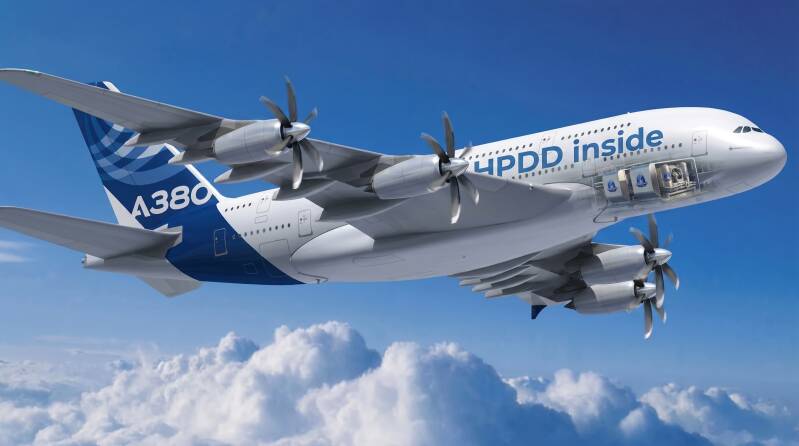
By combining the Hydro Puls Direct-Drive (HPDD) platform architecture with frontline Direct Air Capture (DAC) infrastructure, we introduce a paradigm shift: true CO₂-negative aviation. We don't just neutralize the propulsion; we erase the carbon footprint of the entire airline ecosystem.
The Two-Pronged HPDD Aviation Strategy:
1. In the Air: Clean Ammonia & Contrail Elimination
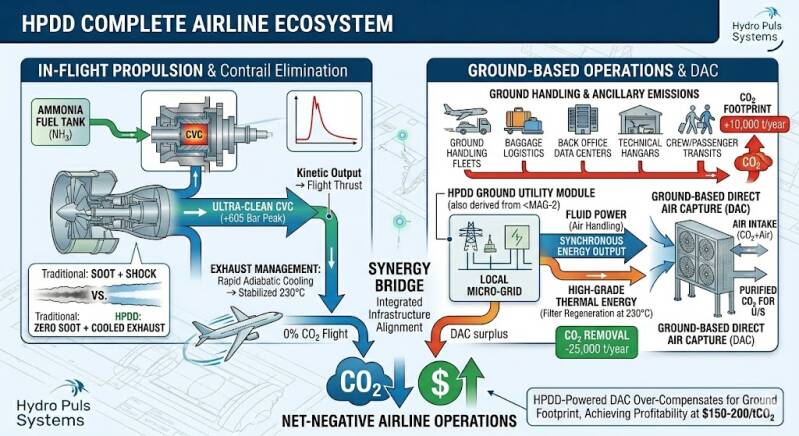
When an aircraft utilizes the HPDD platform fueled by green ammonia (), the flight itself is inherently 100% carbon-free. Because ammonia contains no carbon atoms, the exhaust profile contains zero .
Furthermore, the HPDD’s dual opposition piston layout exploits an extreme expansion ratio, causing rapid adiabatic expansion cooling within the core. The pressure drops instantly from its peak down to a stabilized exhaust management standard of 230°C. Combined with near-perfect chemical combustion that leaves zero soot or particulate matter, the physical triggers for high-altitude condensation trails (contrails) are entirely eliminated.
2. On the Ground: Over-Compensating via HPDD-Powered DAC
A truly sustainable flight cannot exist alongside a carbon-heavy ground operation. The non-flight activities of an airline carry a heavy energetic and environmental penalty:
- Ground Handling & Baggage Logistics: Heavy fleet towing, cargo loaders, and continuous runway transport.
- Corporate Back Office & Operations: High-load data centers, headquarters, and global booking systems.
- Technical Maintenance & Catering: High-energy maintenance hangars and ground support equipment.
- Crew & Passenger Transport: Commutes, airport shuttles, and internal airport transits.
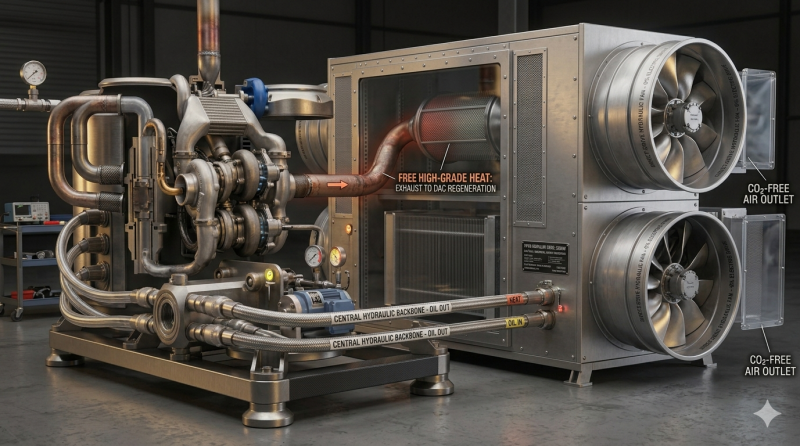
To absorb and over-compensate for these ancillary emissions, HPDD deploys stationary high-pressure utility modules directly at airport hubs to run localized micro-grids. These units drive Direct Air Capture (DAC) systems.
Because the HPDD simultaneously delivers brute fluid power for the DAC air-handling units and captures high-grade 230°C thermal energy for the chemical filters, it operates at a level of efficiency that legacy systems cannot match. This drives the levelized cost of carbon capture down to a highly profitable, subsidy-independent $150 to $200 per ton of .
The Math of Net-Negative Operations
For every single ton of fuel consumed in flight, the ground-based, HPDD-powered DAC infrastructure actively extracts a surplus volume of directly from the atmosphere.
By capturing more carbon on the ground than the entire operation emits across its back offices, ground handling fleets, and technical hangars, an airline achieves a validated net-negative status. The aircraft effectively becomes a catalyst for localized atmospheric scrubbing, turning every ticket sold into an active carbon-removal asset.
A Coherent Commercial Ecosystem
The future of aviation cannot be solved by treating planes as isolated components. By integrating thermodynamic propulsion with localized high-pressure fluid engineering, HPDD links flight physics and ground infrastructure into a single, highly profitable, and completely circular ecosystem.
We don't just protect the sky; we clean the earth beneath it.