

SHARING KNOWLEDGE OF:
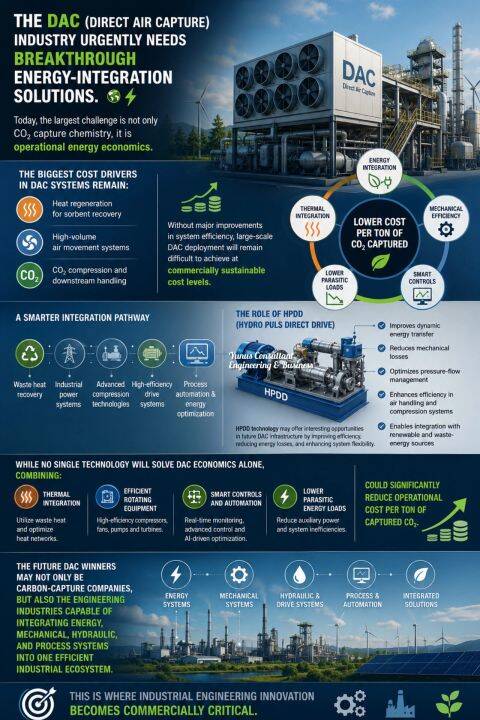
🌁 ♨️ The DAC (Direct Air Capture) industry urgently needs breakthrough energy-integration solutions, not only better CO₂ capture chemistry. 🌍⚡
Today, the biggest DAC cost drivers remain:
• Sorbent heat regeneration
• Large-scale air handling systems
• CO₂ compression & downstream processing
Without major efficiency improvements, scaling DAC to commercially sustainable levels will remain difficult.
Global projects already demonstrate the scale challenge:
• Orca (Iceland) → ~4,000 tCO₂/year
• Mammoth (Iceland) → ~36,000 tCO₂/year
• STRATOS (USA) → targeting ~500,000 tCO₂/year
Future DAC competitiveness will likely depend on deeper integration between:
✅ Waste heat recovery
✅ High-efficiency compression systems
✅ Smart automation & controls
✅ Advanced drive technologies
✅ Lower parasitic energy consumption
Technologies such as HPDD (Hydro Puls Direct Drive) may offer an interesting engineering pathway for improving dynamic energy transfer, reducing mechanical losses, and optimizing pressure-flow efficiency in future DAC infrastructure.
The future winners in DAC may not only be carbon-capture companies, but also industrial engineering innovators capable of integrating thermal, mechanical, hydraulic, and energy systems into one optimized industrial ecosystem. ⚙️🏭🌱
For deeper technical insight into HPDD technology: https://lnkd.in/gZJtWJDv
Contact: Gerd Van Driessche