

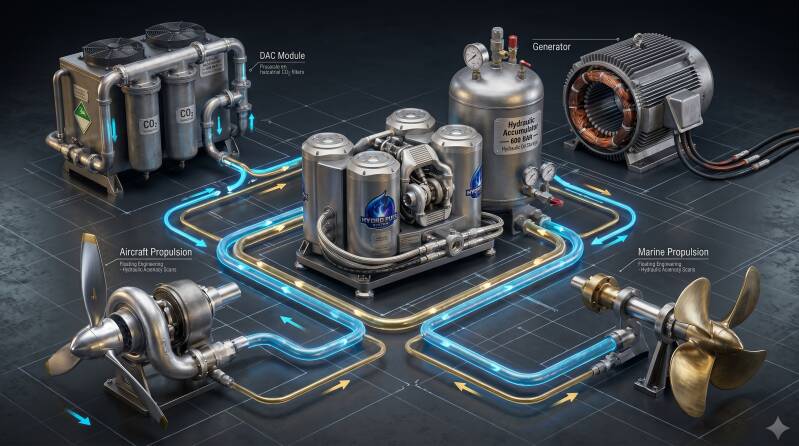
1. The Core Philosophy: Decoupling & Autonomous Rhythm
The greatest enemy of industrial efficiency is variable load. Traditional engines are "slaves" to their function; when demand changes, RPMs fluctuate, temperatures spike, and efficiency plummets.
The HPDD v26 TRT introduces the principle of the Master Metronome:
-
Intrinsic Rhythm: The machine is designed to pulse at one ideal, crystal-clear frequency (100 Hz). It operates unshakeably within its kinetic and thermal "sweet spot."
-
Functional Decoupling: The energy core is completely decoupled from the driven function (e.g., DAC fans or CO_2 compressors). The HPDD does not "feel" variation in the external load; it simply delivers a constant, optimized flow of energy.
-
Zero Fatigue through Stability: Because there are no cold starts, sudden stops, or RPM fluctuations, the thermal balance remains constant. This eliminates material fatigue and guarantees an unprecedented operational lifespan.
2. Eliminating the "Energy Thieves"
We have effectively neutralized the three primary energy losses of classical mechanics through a fundamentally new transduction architecture.
A. Thermal Harvesting: ITS Stabilization (230°C)
-
Conventional: Loses ~28% of energy to cooling systems (80°C) to prevent material failure.
-
HPDD v26: Limits this loss to just 12%.
-
The Science: Via the Internal Thermal System (ITS) jacket, filled with Siloxane, we maintain the reaction chamber walls at a constant 230°C. Thanks to the autonomous rhythm, this temperature never fluctuates. Heat that normally vanishes into a radiator is retained as pressure potential within the chamber. At this temperature, the Inconel components expand by exactly 109 µm, sealing the critical tolerances.
B. Mechanical Harvesting: The 5-Micron Gap Interface
-
Conventional: Loses ~12% to friction (piston rings, crankshaft, bearings).
-
HPDD v26: Loses only 1.5%.
-
The Science: The transduction plunger "floats" within a nitrogen labyrinth seal with a radial clearance of just 5 microns. There is zero metal-on-metal contact. The energy required to maintain this gas curtain at 620 bar is negligible compared to the total elimination of mechanical friction.
C. Expansion Harvesting: Full Pressure Transduction
-
Conventional: Loses ~32% through the exhaust due to rigid mechanical timing.
-
HPDD v26: Limits loss to 20%.
-
The Science: Thanks to the free-plunger architecture and GigaPulse controlled pulse amplitude, we utilize the entire expansion path. We harvest energy from the pressure drop—from the plasma peak (1,000+ bar) down to the scavenging moment at 10 bar. Every Joule is "squeezed" from the gas before it leaves the chamber.
3. Millisecond Dynamics (100 Hz Constant Cycle)
To ensure peak stability at 100 pulses per second, the GigaPulse control implements a rigid protocol unaffected by external load:
-
Supersonic Intake (1.5 ms): Reactant enters at near-sonic speeds at 10 bar.
-
Turbulent Mixing (1.5 ms): Nitrogen from the interface creates micro-vortices, shielding the chamber walls from direct heat.
-
Adiabatic Compression (4.0 ms): The plunger compresses the mixture rapidly from 10 to 600 bar.
-
Plasma-Flash Combustion (1.0 ms): Instantaneous isochoric transduction ensures a maximum pressure peak onto the liquid column.
4. Direct-Drive Architecture & Parasitic Gain
The absence of a crankshaft eliminates all lateral forces. Energy is transferred via the fluid column (Bulk Modulus) directly from the plunger to the hydraulic output. This reduces parasitic losses from the industry-standard 5% to just 2.5%.
Conclusion: The Thermal Transformer
The HPDD v26 TRT does not function as a traditional engine, but as a high-efficiency thermal transformer. By completely separating energy generation from its application, we ensure the system always operates within its highest possible efficiency window.
Whether driving DAC fans, sorbent regeneration, or high-pressure compression, the HPDD remains in its energetic equilibrium. We do not deliver a machine that "tries" to work; we deliver an Autonomous Energy Heart that redefines the standards for industrial viability.