DAC-Systems - The Energy-Core HPDD

The HPDD Utility Core: Empowering
Autonomous Negative Emissions, Anywhere.
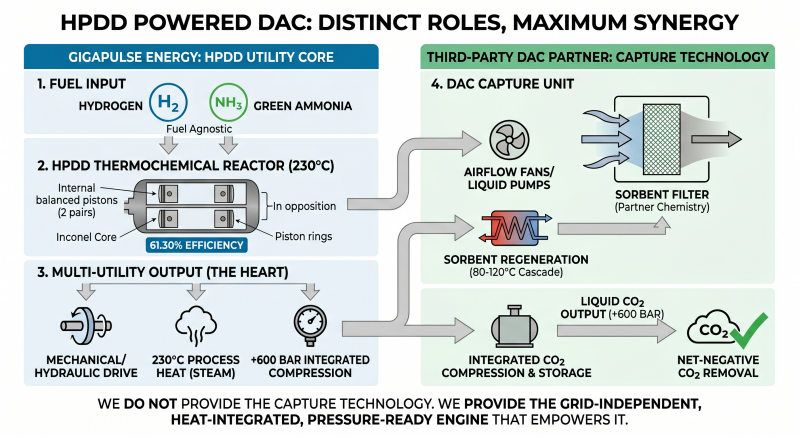
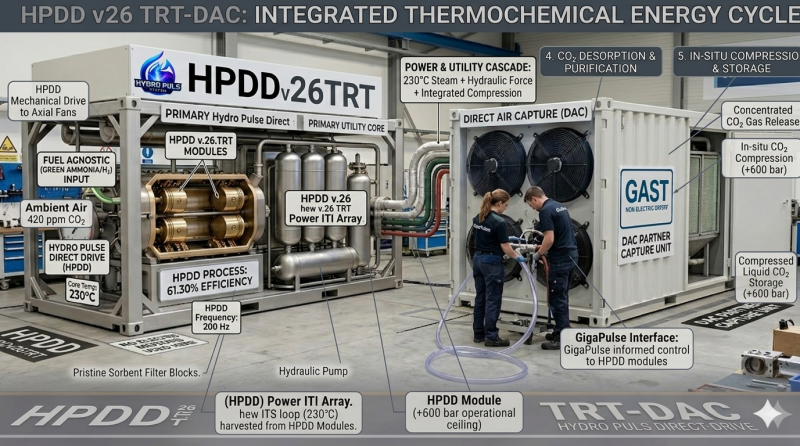
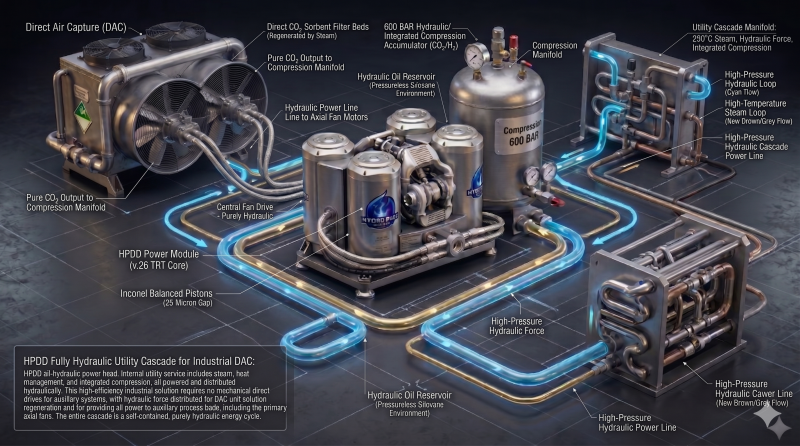
PLEASE NOTE: The Hydro Puls Direct-Drive (HPDD) is a high-efficiency utility and power source. We do not provide the DAC technology itself, but the 'Engine' that powers existing DAC systems, delivering direct mechanical drive, process heat (230°C), and integrated compression (+600 bar) in one off-grid unit.
Direct Air Capture (DAC) is vital for net-zero targets, but operators face three critical hurdles: grid dependency, high thermal penalties, and expensive downstream compression stages. The Hydro Puls Direct-Drive (HPDD) v.26.TRT is not a new capture process. It is a plug-and-play energy and utility engine designed to power, scale, and optimize existing third-party DAC systems.
The Ultimate "Utility-in-a-Box" for DAC Manufacturers
Conventional DAC installations suffer from compounding efficiency losses due to multiple energy conversion steps (Grid -Electricity - Mechanical Motion/Heat). The HPDD v.26.TRT eliminates these conversion penalties entirely by delivering three vital utilities directly from a single, high-efficiency core:
1. Direct Hydraulic Power (Replacing Electric Motors)
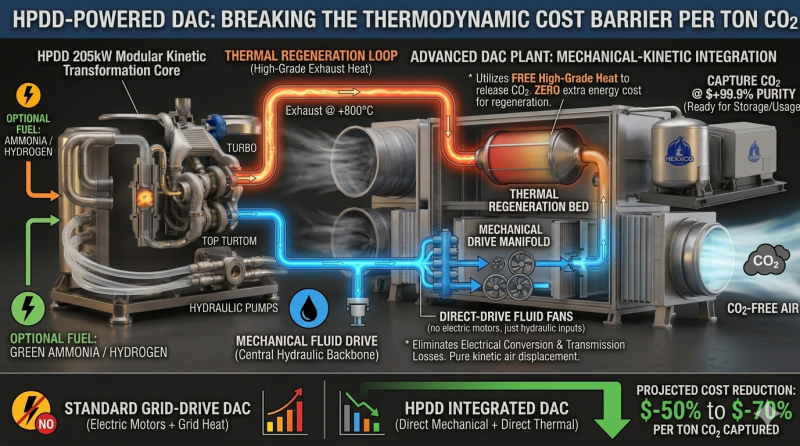
The HPDD provides the direct mechanical force required to drive high-volume air-displacement fans and fluid pumps. By replacing traditional electrical drivetrains with our centralized hydraulic backbone, we achieve a system efficiency of 61.30%, cutting kinetic energy consumption by up to 50% compared to standard electric setups.
2. Thermodynamic Synergy (Constant 230°C Process Heat)
Regenerating sorbents and releasing captured CO_2 requires massive amounts of thermal energy. The HPDD core operates at a constant standard temperature of 230°C, harvesting high-grade exhaust and process heat to deliver "free" thermal regeneration. This eliminates energy-intensive electrical heating elements, drastically reducing your energy-per-kilogram penalty.
3. Integrated High-Pressure Compression (+600 bar)
Bypass the need for costly, bulky, and power-hungry secondary compressors. Leveraging its patented pulse architecture, the HPDD delivers a standard output pressure of +600 bar autonomously. This allows for immediate liquefaction, storage, or transport of the captured gases straight from the unit.
Strategic Advantages for DAC Partners
- 100% Off-Grid Deployment: Housed in a standardized 20ft containerized footprint, this utility core allows your DAC technology to be deployed in remote areas with the highest carbon-capture potential, completely independent of grid availability.
- Fuel Agnostic (Green Ammonia / H_2): Power your carbon removal systems with the fuels of the future. Operating on green ammonia or hydrogen, the HPDD generates its own power and produces water as a direct byproduct, ensuring continuous operation in any climate.
- Radical OPEX Reduction: By removing the electrical conversion penalty from both the air-intake fans and the high-pressure compression loop, the HPDD helps you produce high-integrity carbon removal credits at a fraction of current market costs.
We don't build the DAC. We provide the high-efficiency heart that powers them, grid-independent, heat-integrated, and pressure-ready.

For those who wish to follow the scientific foundation and in-depth nuances of the DAC challenges, the expertise of Syed Mughees Ali, PhD is indispensable.
His research provides an essential framework for the energy hurdles that we are addressing directly with the HPDD. You can follow his full study and academic updates here:
👉 https://www.linkedin.com/feed/update/urn:li:activity:7458806183055958017/
Highly recommended for anyone looking to follow the transition of theoretical Direct Air Capture into a profitable industrial process.
Global Academic Validation: Direct Air Capture (DAC) "We are proud to collaborate with leading experts like Syed Mughees Ali, PhD, to bridge the gap between advanced thermal research and industrial application. By integrating our Decoupled Architecture with cutting-edge DAC insights, we are transforming global carbon capture from a scientific challenge into a commercially viable reality. This international partnership ensures that the HPDD operates at the forefront of the global energy transition."
Contribution written by: Muhammad Abdi yunus
SHARING KNOWLEDGE OF:
🌁 ♨️ The DAC (Direct Air Capture) industry urgently needs breakthrough energy-integration solutions, not only better CO₂ capture chemistry. 🌍⚡
Today, the biggest DAC cost drivers remain:
• Sorbent heat regeneration
• Large-scale air handling systems
• CO₂ compression & downstream processing
Without major efficiency improvements, scaling DAC to commercially sustainable levels will remain difficult.
Global projects already demonstrate the scale challenge:
• Orca (Iceland) → ~4,000 tCO₂/year
• Mammoth (Iceland) → ~36,000 tCO₂/year
• STRATOS (USA) → targeting ~500,000 tCO₂/year
Future DAC competitiveness will likely depend on deeper integration between:
✅ Waste heat recovery
✅ High-efficiency compression systems
✅ Smart automation & controls
✅ Advanced drive technologies
✅ Lower parasitic energy consumption
Technologies such as HPDD (Hydro Puls Direct Drive) may offer an interesting engineering pathway for improving dynamic energy transfer, reducing mechanical losses, and optimizing pressure-flow efficiency in future DAC infrastructure.
The future winners in DAC may not only be carbon-capture companies, but also industrial engineering innovators capable of integrating thermal, mechanical, hydraulic, and energy systems into one optimized industrial ecosystem. ⚙️🏭🌱
For deeper technical insight into HPDD technology: https://lnkd.in/gZJtWJDv
Contact: Gerd Van Driessche