

This series of articles was written by:
SYED MUGHEES ALI - PHD
Trinity College Dublin
linkedin.com/in/syed-mughees-ali-phd-980562206
https://www.webofscience.com/wos/author/record/ABD-9375-2021
Series Introduction
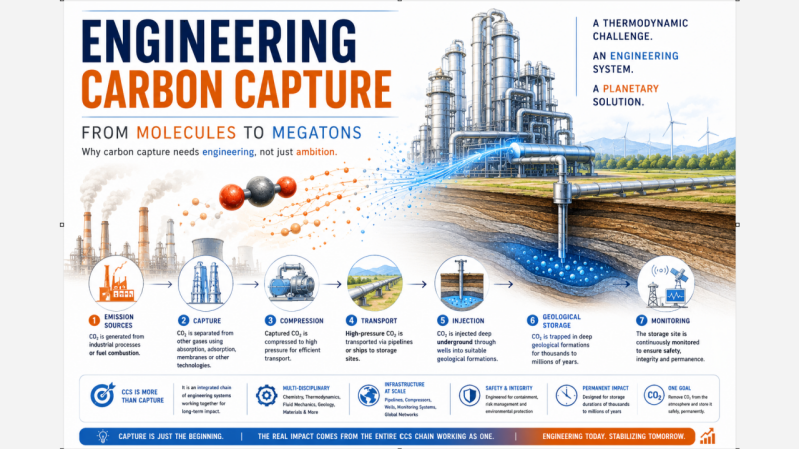
Why Carbon Capture Needs Engineering, Not Just Ambition
Every second…
Humanity releases more than 1,000 tonnes of CO₂ into the atmosphere.
Most of it becomes invisible almost immediately.
It disperses. Mixes into the air. And disappears into the background of the planet.
But here’s the real question:

Because this is the real challenge of carbon capture:
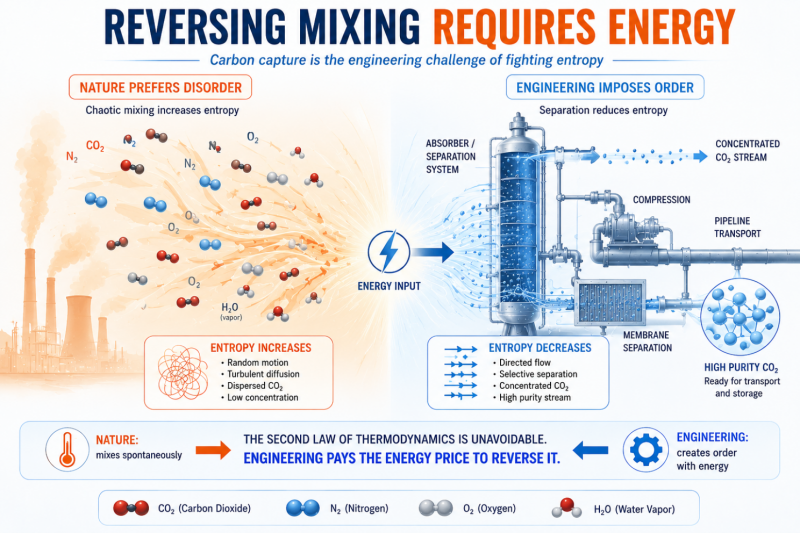
⚛️ We are trying to reverse mixing at an industrial scale
And physics does not make that easy.
Most people imagine carbon capture as: A filter, a machine, and a box attached to a smokestack
But in reality…
👉 Carbon capture is an entire engineering system.
It involves:
Thermodynamics
Heat transfer
Mass transfer
Fluid mechanics
Chemical kinetics
Materials science
Reservoir engineering
Infrastructure design
🎯 Insight:
👉 Carbon capture is NOT one technology
👉 It is a chain of interconnected engineering problems
So why does carbon capture exist at all?
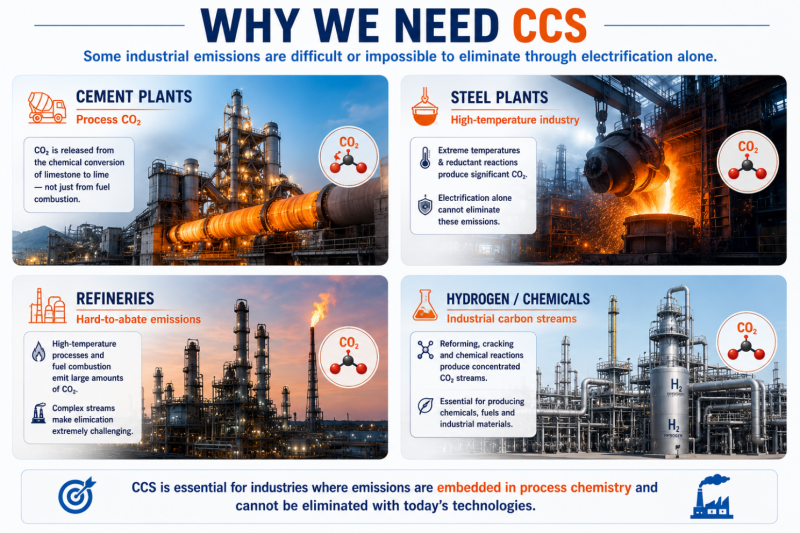
Because some emissions are extremely difficult to eliminate.
Especially in: Cement, Steel, Refining, Chemicals, Hydrogen production, High-temperature industrial heating
And here’s the important part:
In many industries…
CO₂ is NOT only produced by combustion.
👉 It is produced by the chemistry of the process itself.
Take cement production 👇
Even if the kiln were powered entirely by renewable electricity…
The conversion of limestone into lime would STILL release large amounts of CO₂.
🎯 Insight:
👉 Some industrial CO₂ emissions are embedded directly into the chemistry of modern materials production
Carbon capture is fundamentally a separation problem
At its core, CCS asks one deceptively simple question:
👉 How do we separate CO₂ from everything else?
That “everything else” may include:
Nitrogen, Oxygen, Water vapour, Hydrogen, Methane, Sulfur compounds, Industrial exhaust gases
And this is where thermodynamics becomes unavoidable.
Because nature has already mixed those gases.
To capture CO₂…
👉 Engineers must partially reverse that mixing.
And reversing mixing requires energy.
🎯 Signature Insight:
👉 Carbon capture is the engineering challenge of fighting entropy at an industrial scale
Now here’s where things become even more interesting 👇
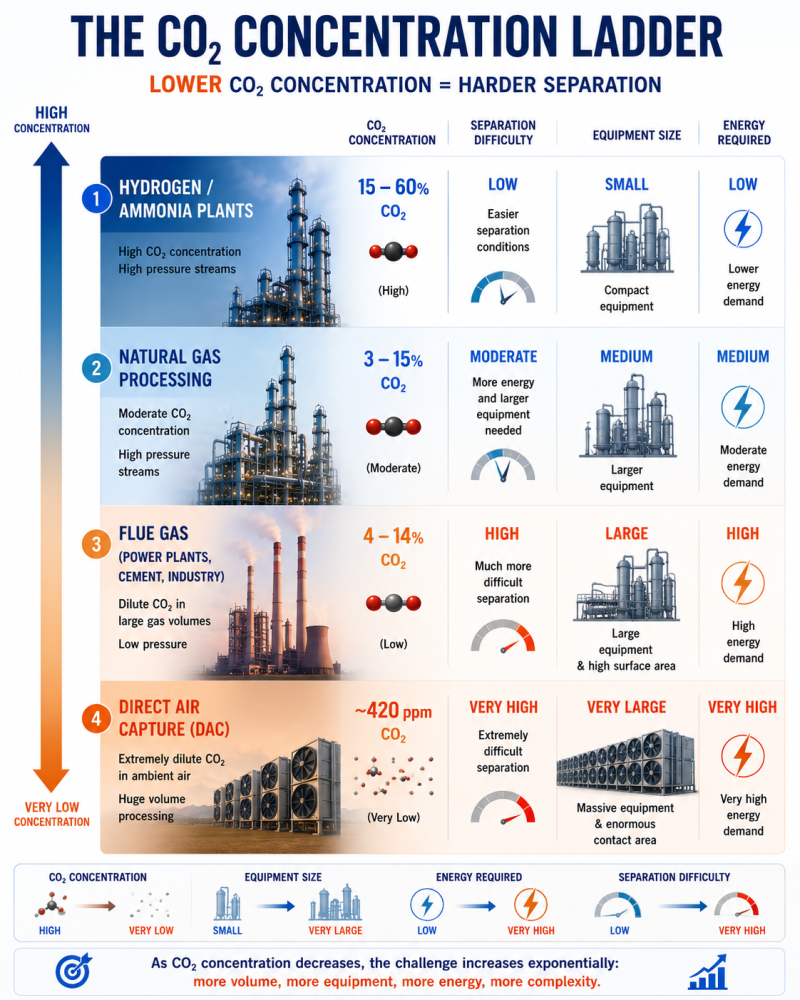
The difficulty changes dramatically depending on the source.
1️⃣ Concentrated Industrial Streams
Examples:
Natural gas processing, Ammonia production, and hydrogen plants
These streams often contain:
Higher CO₂ concentration,
Higher pressure,
Easier separation conditions.
Referenties voor content bekijken
🎯 Insight:
👉 High CO₂ concentration usually means lower separation difficulty
2️⃣ Flue Gas Capture
Typical sources:
Power plants, Cement kilns, and Industrial furnaces
Here, CO₂ is much more dilute, often only ~4–14%. The rest is mostly nitrogen.
👉 That means: Larger equipment, higher energy penalty, and more difficult separation
🎯 Insight:
👉 Dilute CO₂ streams make carbon capture dramatically harder
3️⃣ Direct Air Capture (DAC)
This is where physics becomes brutal. Atmospheric CO₂ concentration: ~420 ppm. That means CO₂ is extremely diluted in air.
So engineers must process enormous volumes of atmosphere to recover relatively small amounts of CO₂.
🎯 Insight:
👉 The lower the CO₂ concentration, the harder the thermodynamic challenge becomes
CCS is much bigger than “capture”
Most discussions stop at the word “capture.”
But the real system is far larger.
One such example of a complete CCS chain is:
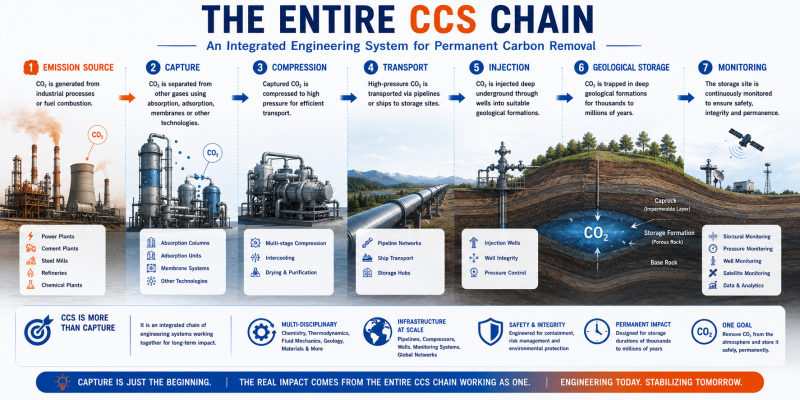
And every stage introduces new engineering challenges.
Compression requires enormous power.
Water creates corrosion risks.
Pipelines must avoid phase instability.
Reservoirs must contain CO₂ for decades or centuries.
Monitoring requires seismic imaging and subsurface modelling.
🎯 Insight:
👉 CCS is not only a chemistry problem
👉 It is also an infrastructure problem at a planetary scale
So what will this series explore?
Over the coming weeks, I’ll break down carbon capture from first principles to real industrial systems.
We will explore:
Post-combustion capture
Pre-combustion systems
Oxy-fuel combustion
Absorption & adsorption
Membrane separation
Cryogenic capture
Calcium looping
Chemical looping
CO₂ compression & transport
Geological storage
Trapping mechanisms
Direct air capture
Carbon utilization
Gigaton-scale deployment challenges
But throughout the series…
We will continuously return to four engineering questions:
⚡ 1️⃣ Energy Penalty
👉 How much energy does the process consume?
🌍 2️⃣ Scale
👉 Can it work at a million-ton or gigaton scale?
💰 3️⃣ Cost Drivers
👉 What actually makes it expensive?
⚖️ 4️⃣ Physics Limitation
👉 What fundamental constraint limits performance?
Because engineering reality lives in these details.
A material may perform beautifully in the lab…
…and fail in industrial flue gas.
A solvent may capture CO₂ efficiently…
…but require enormous regeneration energy.
A membrane may be highly selective…
…but require a massive surface area.
A reservoir may have a large storage capacity…
…but poor injectivity.
🎯 Final Takeaway
Carbon capture is NOT a single machine.
It is the integration of:
chemistry,
thermodynamics,
transport phenomena,
combustion,
geology,
infrastructure,
and economics.
🔥 Signature Closing Insight:
👉 Carbon capture is not just about removing CO₂
👉 It is about engineering entire systems capable of managing carbon at the planetary scale
🚀 In the next article:
“Why Carbon Capture is Fundamentally a Thermodynamic Separation Problem”
We’ll begin with the physics that governs the entire field.
#CarbonCapture #CCS #CarbonRemoval #Engineering #Thermodynamics #ProcessEngineering #EnergyTransition #ChemicalEngineering #NetZero #Decarbonization