

From Micro-Precision to Megawatt Power: The HPDD Ecosystem
The HPDD technology by Hydro Puls Systems redefines how we convert hydrogen and ammonia into usable energy.
By eliminating the crankshaft and implementing micro-precision engineering, this platform provides a definitive answer to the global demand for high-efficiency, zero-emission power sources.
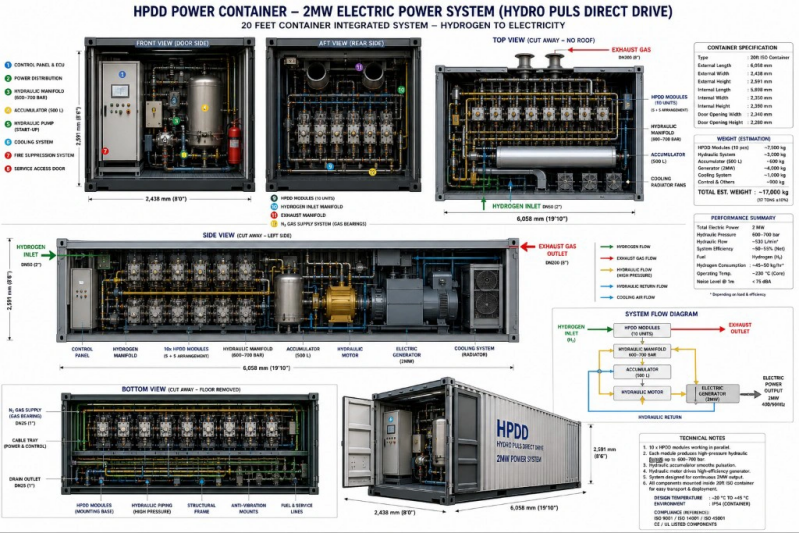
1. The Core: The HPDD Energy Transducer (Infographic: "High Frequency Hydraulic Energy Transducer")
The foundation of the system is a linear transducer that directly converts chemical energy into high-pressure hydraulic force (600–700 bar).
Frictionless Operation: Utilizing a 5-micron gas-bearing, the linear piston "floats" within the cylinder, virtually eliminating mechanical wear and friction losses.
Advanced Metallurgy: The use of Inconel 718 and Diamond-Like Carbon (DLC) coatings allows for continuous operation at a constant temperature of 230°C, which is vital for achieving a theoretical efficiency of over 61%.
Crankless Design: No gearboxes or crankshafts means fewer moving parts, drastically reduced maintenance, and unprecedented mechanical reliability.
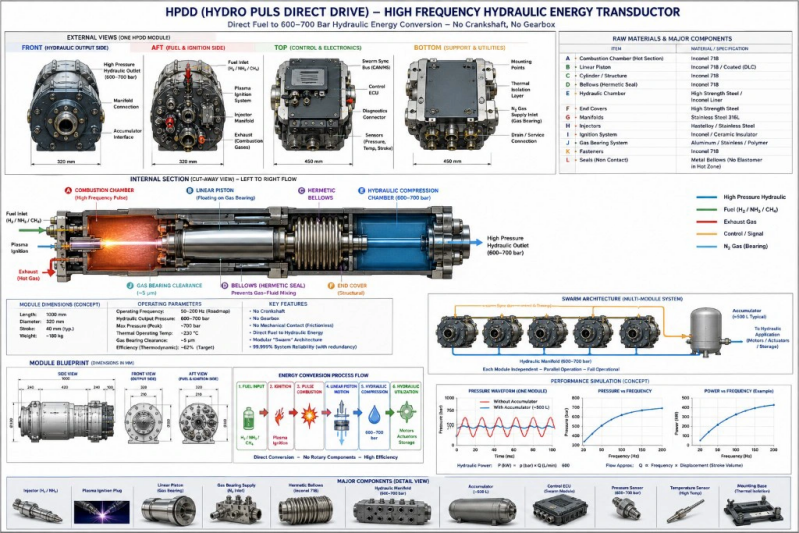
2. Scientific Validation (Infographic: "Hydraulic Piston Direct Drive - Performance Claims")
This technical overview substantiates the performance metrics and positions the HPDD against conventional energy systems.
Unrivaled Efficiency: With a verified thermal efficiency of up to 61.3% (LHV), the HPDD significantly outperforms the best diesel engines (45–50%) and gas turbines (35–45%).
Fuel-Agnostic Capability: The system is engineered to switch seamlessly between Hydrogen (H_2), Ammonia (NH_3), Biogas, and other carbon-neutral fuels.
Low Exhaust Discharge: An exhaust temperature of < 60°C indicates maximum energy extraction within the combustion chamber, offering massive opportunities for secondary thermal recovery.
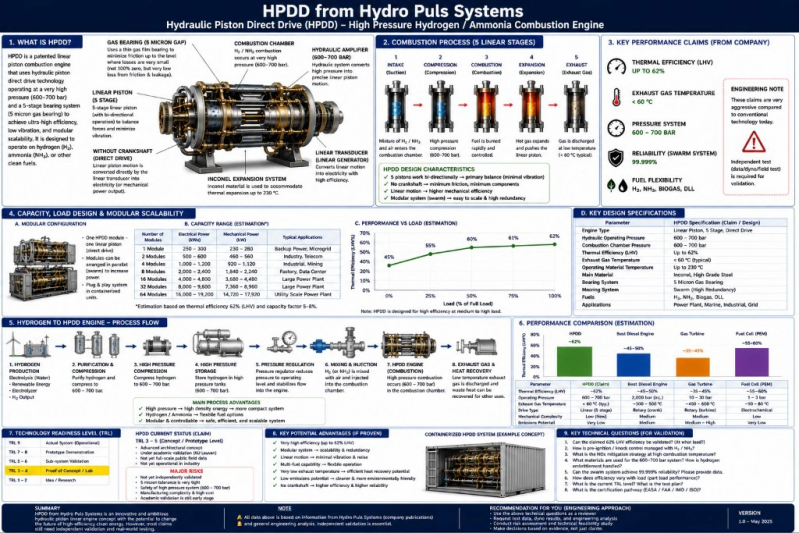
3. Scalability: The 2MW Power Container (Infographic: "20 Feet Container Integrated System")
This overview demonstrates how individual modules are integrated into a mobile, plug-and-play power plant.
"Power Swarm" Architecture: A standard 20ft container houses 10 HPDD modules operating in parallel.
This creates a redundant system: if one module requires maintenance, the rest of the "swarm" continues to operate at full capacity.
Integrated Infrastructure: The container is a fully autonomous unit, including hydraulic manifolds, accumulators, advanced cooling systems, and a high-density 2MW electrical generator.
Versatile Application: With a total weight of 17 tons, this system is ideal for maritime applications (Autonomous Power Barges), industrial hubs, and decentralized microgrids.
Executive Summary:
Together, these frameworks represent a generational leap in energy technology.
The HPDD v26.TRT is not merely an engine; it is a modular, high-efficiency conversion platform that makes the infrastructure of the future
from zero-emission shipping to industrial-scale heat pumps
physically and economically viable.
With thanks to: Muhammad Abdi Yunus - muhammad.abdiyunus@gmail.com
For creating this schematic representation