

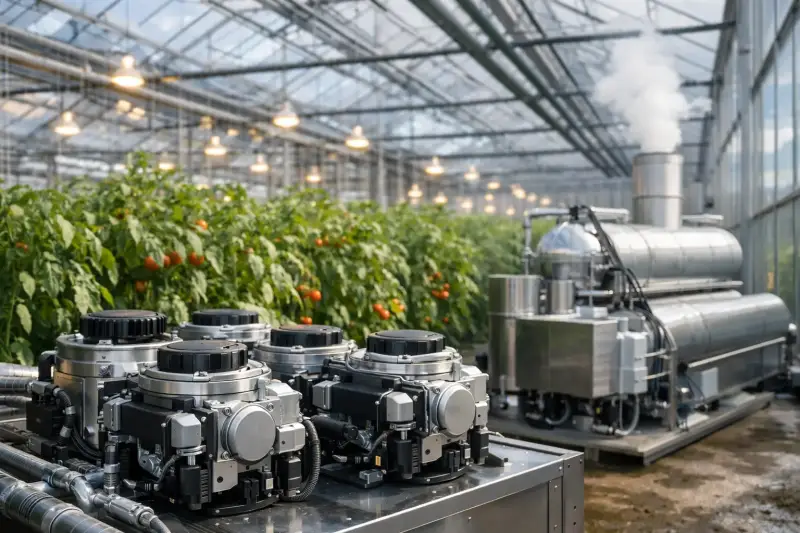
A greenhouse operator does not buy energy in one form. They buy temperature control at 3 a.m., electrical stability during winter lighting peaks, and usable CO2 exactly when the crop can turn it into biomass. That is why combined heat and power for greenhouses remains one of the few energy strategies that can change both the operating cost line and the production curve at the same time.
The basic logic is well known. A prime mover generates electricity on-site. The thermal losses that conventional power systems throw away are recovered as useful heat for the greenhouse loop, and in many cases the exhaust stream can be treated and used as a CO2 source for fertilization. But the commercial outcome does not come from the acronym alone. It comes from thermodynamic matching, control architecture, fuel strategy, and the ability of the plant to stay efficient across real horticultural load profiles.
Why combined heat and power for greenhouses fits the load profile
Greenhouse horticulture is unusually well aligned with CHP economics because the site often needs three outputs at once - electricity, heat, and CO2. Few industrial facilities can monetize all three with the same consistency. In a greenhouse, heating demand rises with weather conditions, electricity demand can spike with supplemental lighting and pumps, and CO2 enrichment creates a third value stream tied directly to crop performance.
That multi-output demand matters because CHP becomes economically compelling when waste heat is not waste. If the site can absorb recovered thermal energy for hydronic heating, root-zone control, dehumidification support, or hot water storage, overall fuel utilization can rise far above separate generation. Instead of buying grid power at one efficiency and producing heat in a boiler at another, the operator extracts more useful work from the same fuel input.
The caveat is seasonality. A greenhouse in a cold climate with heavy winter lighting has a stronger CHP case than a site with mild temperatures and low annual heat demand. Summer can also weaken performance if thermal demand collapses and there is no sink for recovered heat. That is where storage, thermal integration, or flexible dispatch become critical.
The real value stack: power, heat, and CO2
Most discussions reduce CHP to efficiency percentages. That is too narrow for greenhouse investors and engineering teams. The better framework is stacked value.
Electricity is usually the first driver because on-site generation can hedge grid price volatility, reduce exposure to curtailment, and improve operational continuity. For facilities running high-pressure sodium or LED lighting at scale, electricity cost is not a background variable. It is a strategic input.
Heat is the second layer. Greenhouses need stable thermal control, not just raw energy volume. Recovered heat from CHP can support base-load heating efficiently, especially when integrated with hot water buffering and zone-level control. The more stable the thermal output and the better the load matching, the more valuable the system becomes.
CO2 is the third and often underappreciated layer. If exhaust treatment is engineered correctly and local regulations permit, CHP can provide a controllable CO2 source that offsets purchased supply. For some crops, that changes the revenue equation, not just the utility bill. The system stops being only an energy asset and starts acting as a production asset.
What separates good greenhouse CHP from expensive disappointment
A greenhouse CHP project fails when developers size to theoretical peak conditions instead of annual operating reality. Oversizing is common. It looks attractive on a spreadsheet, especially when power exports are assumed at favorable rates, but in practice it can push the engine into part-load operation, increase cycling, reduce maintenance intervals, and strand thermal output.
Good design starts with hourly load data. Not monthly averages. Operators need to understand the interaction between lighting schedules, weather-driven heating demand, CO2 dosing windows, thermal storage, and tariff structures. Once those inputs are modeled, the plant can be sized for the most valuable operating band rather than the largest nameplate.
Control philosophy matters just as much as equipment selection. Conventional engine-based CHP systems often suffer when the electrical load and thermal load move out of alignment. A greenhouse is not a static industrial process. Cloud cover changes solar gain. Crop cycles change humidity and heat demand. Grid economics change dispatch priorities. The energy core must either tolerate these shifts efficiently or be architected to decouple generation from variable end use.
That is where next-generation system design becomes strategically relevant. Hydro Puls Systems has argued for a different class of CHP architecture built around isolated combustion, hydraulic energy transfer, and operation at a controlled performance sweet spot rather than the compromises of crankshaft-driven mechanics. For greenhouse applications, that design logic is not academic. It addresses one of the sector's hardest problems: how to keep conversion efficiency high while serving variable on-site demand without turning the prime mover into a slave of fluctuating load conditions.
Fuel choice changes the investment case
Natural gas still dominates greenhouse CHP because supply chains, permitting pathways, and service ecosystems are mature. That does not mean it is the long-term answer everywhere. Carbon pricing, methane policy, grid decarbonization pressure, and customer procurement standards are changing the assumptions behind every new thermal asset.
A serious greenhouse CHP strategy now has to consider fuel transition. Can the system run on biogas where available? Is there a path to hydrogen blends? Can the platform move toward ammonia-derived energy carriers in the future? If the asset life is 15 to 25 years, fuel optionality is no longer a nice feature. It is a capital protection requirement.
This is where conventional CHP designs start to show their age. Many legacy systems were optimized around one fuel and one operating mode. Greenhouse operators and investors need more than that. They need architectures that can survive the transition from hydrocarbon efficiency to low-carbon dispatch without writing off the installed base.
Integration with the greenhouse is the project
The generator is only one component. The commercial result depends on the full plant architecture.
Heat recovery has to be designed around real greenhouse circuits, including supply temperatures, return temperatures, buffer tanks, and the possibility of combining CHP with condensing boilers, heat pumps, or geothermal sources. Electrical integration has to account for interconnection constraints, islanding strategy, and whether power is consumed on-site or exported. CO2 recovery requires treatment, monitoring, and dosing controls that align with plant physiology and food safety requirements.
There is also a water story. CHP can support dehumidification and condensation management when integrated correctly, which affects disease pressure and crop quality. In modern horticulture, energy systems cannot be designed in isolation from climate systems. The greenhouse is a coupled thermodynamic environment.
Economics depend on operating hours, not brochure claims
CHP vendors often lead with high total efficiency figures. Those numbers can be real, but they only matter if the site can use the recovered outputs consistently. For greenhouse projects, annual runtime and output utilization are more important than headline efficiency.
A system that runs many hours near its optimal point, with strong thermal absorption and valuable CO2 use, can outperform a larger unit with better nominal specs but poor utilization. Investors should test projects against spark spread, maintenance cost, outage assumptions, carbon cost exposure, and declining grid emissions intensity. They should also model what happens if export revenue drops or if summer heat rejection becomes necessary.
The strongest projects usually share three characteristics. They are sized to the usable base load, integrated with thermal storage or complementary assets, and built around an energy core that does not collapse in efficiency when the site shifts away from ideal conditions.
Where the market is going
The greenhouse sector is moving toward more electrification, tighter climate control, and higher productivity per acre. That does not eliminate CHP. It raises the bar for what CHP must do.
Future-ready combined heat and power for greenhouses will not be judged only by kilowatts and boiler offset. It will be judged by dispatch flexibility, fuel agility, emissions pathway, control precision, and the ability to function as part of a broader on-site energy ecosystem that may include batteries, thermal storage, carbon capture, hydrogen, and controlled CO2 utilization.
That shift favors engineering-led platforms over commodity engine packages. It favors architectures that treat energy conversion as a controllable industrial process rather than a mechanical compromise inherited from legacy engines. For operators facing volatile energy markets and tighter margin pressure, that distinction is no longer theoretical.
A greenhouse is one of the few industrial environments where every unit of energy can influence both cost and crop output. That makes CHP unusually powerful when it is engineered as a system, not purchased as a box. The right question is not whether CHP works. It is whether the underlying architecture is advanced enough to keep working as fuels, grids, and growing economics change around it.