Magnesium Nitrate
Desalination Reject Valorization (Oman Case: 100 MLD Intake)
1. Chemical Principle & Ammonia Mass Balance
In seawater reverse osmosis (SWRO) brine, magnesium is primarily present as dissolved magnesium chloride (MgCl2).
As noted, 4 moles of ammonia (NH3) are utilized per mole of magnesium ion (Mg):
- 2 moles of ammonia are converted into nitrate (NO3) to bind the magnesium. This yields the target product Magnesium Nitrate [Mg(NO3)2], produced as commercial fertilizer flakes in the hexahydrate form.
- 2 moles of ammonia bind directly with the displaced chloride ions (Cl) from the magnesium chloride. This yields the co-product Ammonium Chloride (NH4Cl), a high-demand nitrogen fertilizer.
2. Daily Mass Balance (Basis: Gulf of Oman Seawater)
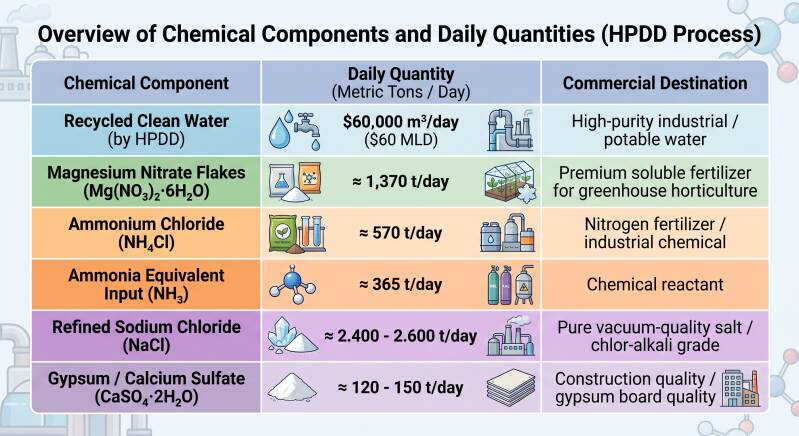
- Seawater Intake: 100 MLD (100,000 cubic meters per day)
- Clean Potable Water via Primary RO: 40 MLD (40,000 cubic meters per day)
- Brine Reject to HPDD Platform: 60 MLD (60,000 cubic meters per day)
- Dissolved Magnesium in Brine: approx. 130 tonnes of pure magnesium per day
Daily Production & Chemical Inputs:
- Additional Clean Water via HPDD: approx. 60 MLD (60,000 cubic meters per day)
- Magnesium Nitrate Flake (fertilizer grade, hexahydrate): approx. 1,370 tonnes per day
- Ammonium Chloride (dry solid fertilizer): approx. 570 tonnes per day
- Ammonia Input Requirement (NH3 equivalent): approx. 365 tonnes per day
- Refined Commercial Salt (NaCl): approx. 2,500 tonnes per day
- Gypsum (Calcium Sulfate): approx. 130 tonnes per day
3. Process Block Flow Diagram
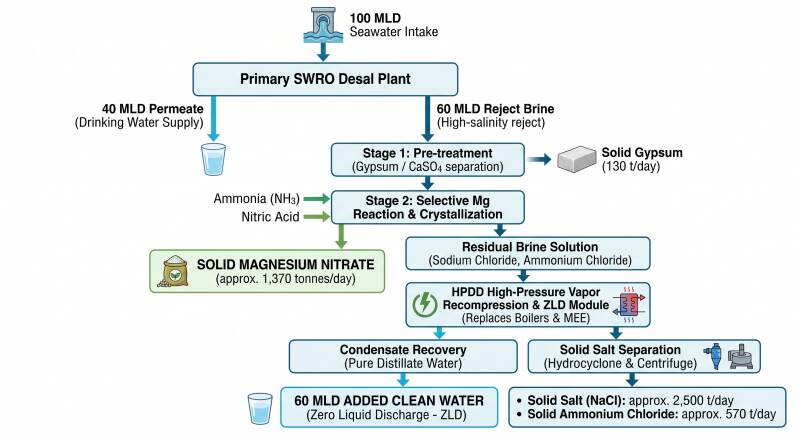
4. How Salts Precipitate as Solids & 60 MLD Clean Water is Recovered
Elimination of Boilers, MEE, and Cooling Towers:
Conventional thermal plants rely on massive steam boilers, multi-effect evaporators (MEE), and cooling towers that dissipate heat into the air. The HPDD platform operates through direct volumetric mechanical compression:
-
Vapor rising from the brine is compressed directly using linear hydraulic displacement.
-
Latent heat released when the vapor condenses is transferred directly back into incoming pressurized brine via internal heat exchangers.
-
Because thermal energy is recycled inside a closed loop rather than dumped to cooling water, virtually the entire 60 MLD water volume condenses out as pure, high-grade distillate.
Fractional Salt Separation (Clean Solid Output):
Salts do not drop out as an unusable mixed sludge; they are separated in distinct stages governed by solubility differences:
-
Calcium Sulfate (Gypsum): Drops out first upon initial temperature elevation and is filtered out immediately, preventing pipe scaling downstream.
-
Magnesium Nitrate: Dosing nitric acid and ammonia reacts selectively with the magnesium ions. Under dedicated thermal concentration, it crystallizes cleanly as pure fertilizer flakes.
-
Sodium Chloride (Commercial Salt): As water is recovered and the brine approaches saturation, sodium chloride reaches its limit first and precipitates out as high-purity cubic crystals, dewatered via continuous centrifuges.
-
Ammonium Chloride: Ammonium chloride has higher solubility at elevated temperatures than sodium chloride. By chilling the residual liquor in a secondary step, ammonium chloride crystallizes out separately as a dry solid.
The outcome is Zero Liquid Discharge (ZLD): no liquid effluent remains. 100 MLD seawater intake yields 40 MLD RO permeate plus 60 MLD HPDD recovered water, totaling 100 MLD clean water, alongside separated, market-ready solid chemicals.
5. Alignment with the 3 Promotional Verticals
-
Industrial ZLD (Textile, Paper, Chemical):
Replaces the entire traditional utility train (boiler, multi-effect evaporator, condenser, cooling tower) with a single modular HPDD skid, significantly cutting capital costs and energy consumption while recovering process water and dry cake.
-
Sodium Bicarbonate & Ammonium Sulfate:
Reacting brine sodium chloride with captured carbon dioxide and ammonia produces sodium bicarbonate (baking soda) and ammonium chloride. Integrating sulfate-rich streams allows direct production of ammonium sulfate fertilizer.
Modular Magnesium Nitrate Platform:
Converts low-value magnesium chloride brine into premium, water-soluble greenhouse fertilizer without requiring mined magnesium rock. This is well-suited for water-scarce agricultural regions like Oman.