

HPDD Marine PTI Core
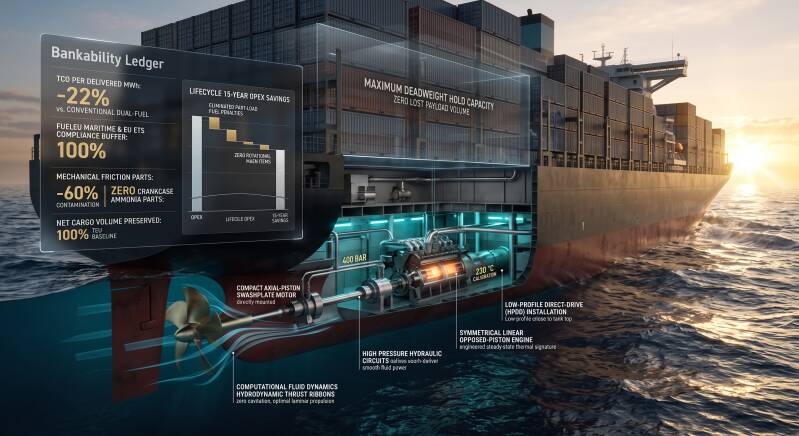
HPDD Marine PTI Core: Technical Specifications & Integration Parameters
Direct Hydraulic Power Boost (250 kW) & Dynamic Shaftline Protection for Marine Retrofits
The Hydro Puls Direct-Drive (HPDD) Marine PTI (Power Take-In) Core converts high-enthalpy waste heat and process energy into deterministic mechanical propulsion on the main shaftline or reduction gear. By replacing rigid mechanical linkages with high-stiffness fluid dynamics, the architecture delivers an auxiliary mechanical boost of 250 kW while protecting the primary engine from transient hydrodynamic shock loads.
1. Swashplate Motor Sizing & Dynamic Control Integration
The secondary hydraulic loop drives a variable-displacement axial piston motor regulated via active swashplate angle modulation. This enables microsecond torque matching against the main engine reduction gear or propeller shaft across changing sea states without destabilizing the HPDD core's thermal-mechanical steady state (calibrated at 230 degrees Celsius).
- Target Mechanical Power Delivery (N): 250 kW continuous shaft power
- Operating Pressure Range (p_work): 350 to 420 bar (Design Working Pressure set to 400 bar)
- Total Machine Efficiency (eta_total): 0.92 to 0.95
Motor Displacement Calculation:
Working displacement (Vg) is derived dynamically based on target shaft power, system pressure drop, and shaft rotational speed:
N = (p_work * Vg * n * eta_total) / 600
Solving for active motor displacement (Vg in cm3/rev):
Vg = (600 * N) / (p_work * n * eta_total)
Where:
- N = Mechanical Power (250 kW)
- p_work = Differential Pressure Drop (design setpoint: 400 bar)
- n = Shaft Rotational Speed (rpm)
- eta_total = Total hydraulic-to-mechanical efficiency (0.92 to 0.95)
2. Separator Module & Accumulator Sizing Parameters
An intermediate accumulator module (piston or bladder/membrane accumulator bank) bridges the primary expansion stage and the secondary shaft drive, acting as a low-pass hydraulic filter and fluid capacitor.
- Core Boundary Protection: Acts as a heavy-duty hydraulic damper, absorbing shaftline torsional torque spikes, propeller racing events, and valve-switching transients before they can reflect back into the linear expansion stage.
- Sealing Bellows Differential Clamp: Limits and strictly clamps the cyclic differential pressure across internal sealing bellows within Delta p <= 5 bar.
- Pre-charge Pressure Calibration (p_0): Set strictly below minimum circuit operating pressure (p_0 = 0.75 * p_min) to ensure smooth, ripple-free transformation of discrete linear displacement pulses into a continuous hydraulic feed.
- Capacitance Sizing: Dimensioned to buffer the maximum transient fluid volume discharged during full-stroke switching events and aggressive shaftline load rejections.
3. Thermal Preparation & Heat Exchanger Engineering
Cold-Zone Pre-heating & Pressurization:
To establish baseline operating pressure (approximately 75 bar in the closed loop) prior to main engine engagement, the system applies a segregated two-zone thermal strategy:
- Targeted Trace Heating: Low-power electrical trace heating is restricted strictly to cold-zone storage reservoirs and feed lines. This prevents local thermal cracking or fluid degradation around heating elements while accelerating working medium vaporization.
- Exhaust Energy Harvesting: The primary thermal volume is brought to temperature using waste heat recovered from the main engine exhaust tract, eliminating parasitic secondary loops and maintaining high balance-of-plant reliability.
Inconel 625 Heat Exchanger Tubing with Helical Inserts:
To ensure maximum thermal transfer within dirty marine exhaust streams, the heat exchanger utilizes high-nickel Inconel 625 bare-wall tubes fitted with internal helical wire-coil inserts (or twisted-tape turbulators):
- Manufacturing Advantage: Completely eliminates deep internal mechanical micro-grooving, preserving parent metal fatigue integrity on tough Inconel alloys.
- Boundary Layer Destruction: Forces turbulent swirling flow along the internal tube perimeter, substantially increasing gas-side convective heat transfer coefficients.
- Marine Serviceability: Tube straight-bores remain fully accessible and cleanable during routine drydock and scheduled harbor service intervals.
4. Transient Maneuvering Strategy & Load Shedding
During harbor maneuvering, sudden sea-state shifts, or crash-stop procedures, the HPDD Marine PTI Core guarantees uninterrupted shaft stability:
- Hydraulic Capacitance Buffer: The intermediate accumulator bank instantly sources or sinks hydraulic fluid during sudden propeller load drops, preventing overpressure surges.
- Dynamic Swashplate Modulation: The variable displacement motor adjusts its angle in direct response to fluctuating exhaust heat input, maintaining target shaftline torque without allowing core pressures to decay.
- Thermal Baseline Hold: During prolonged low-load steaming or idling, the system activates isolated cold-zone trace heating to lock the expansion core at its 230 degrees Celsius thermal calibration point, ensuring instant 250 kW boost delivery the moment full throttle is demanded.
Integration Studies & Engineering Inquiries:
For vessel-specific shaftline matching calculations, class approval packages (DNV / Lloyd's Register), and retrofit skid layouts, contact our marine propulsion engineering team.