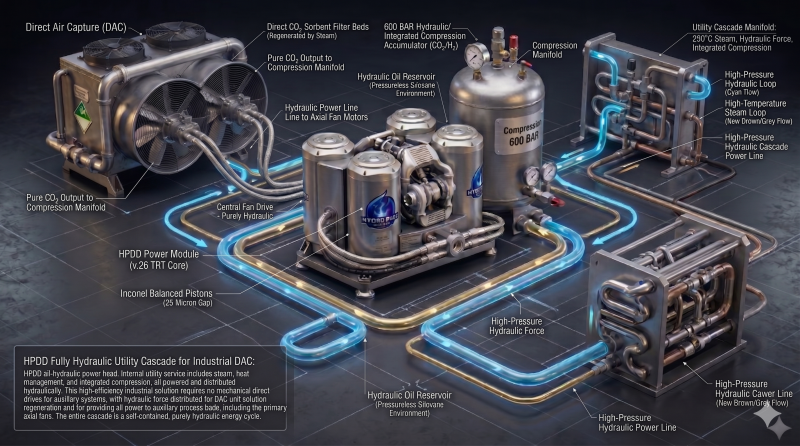
The HPDD Utility Core: Empowering Autonomous Negative Emissions, Anywhere.

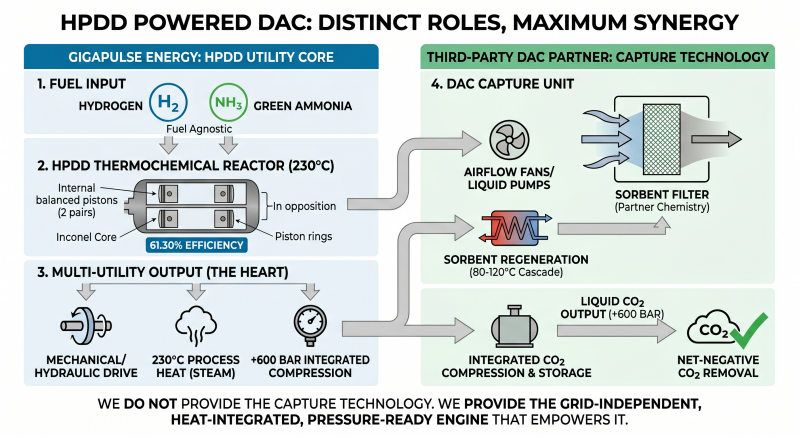
PLEASE NOTE: The Hydro Puls Direct-Drive (HPDD) is a high-efficiency utility and power source. We do not provide the capture technology itself, but the 'Engine' that powers existing DAC systems—delivering direct mechanical drive, process heat (230°C), and integrated compression (+600 bar) in one off-grid unit.


Direct Air Capture (DAC) is vital for net-zero targets, but manufacturers face three major hurdles: grid dependency, high thermal demands, and expensive compression stages. The Hydro Puls Direct-Drive (HPDD) v.26.TRT is not a new capture process; it is the integrated energy and utility engine designed to power and optimize existing DAC systems.

The Ultimate "Utility-in-a-Box" for DAC Manufacturers

Most DAC systems lose efficiency through multiple energy conversion steps (Grid → Electricity → Heat/Motion). The HPDD v.26.TRT eliminates these losses by providing three critical utilities directly from a single, high-efficiency reactor:

  • Direct Hydraulic Power (Replacing Electric Motors): The HPDD provides the direct mechanical force needed to drive high-volume fans and pumps. By switching from electrical to hydraulic drive-trains, we achieve a system efficiency of 61.30%, reducing energy consumption by up to 50% compared to traditional electrical setups.

  • Thermal Synergy (Constant 230°C Steam): Regenerating captured CO2 requires significant heat. The HPDD core operates at a constant 230°C, providing "free" high-grade steam and process heat. This replaces the need for energy-intensive electrical heating elements, drastically lowering the energy-per-kg of CO2 captured.

  • Integrated High-Pressure Compression (+600 bar): Eliminate the need for costly external secondary compressors. The HPDD utilizes its patented power to deliver standard output at +600 bar, allowing for immediate liquefaction, storage, or transport of the captured gases.

Strategic Advantages for DAC Partners:

  • 100% Off-Grid & Mobile: Our 20ft containerized utility core allows your DAC technology to be deployed in remote areas with the highest carbon-capture potential, completely independent of the power grid.

  • Fuel Agnostic (Green Ammonia/H2): Run your capture units on the fuels of the future. The HPDD generates the power and water (as a byproduct) needed for continuous operation in any climate.

  • Lower OPEX, Higher Integrity: By drastically reducing the "energy penalty" of capture and compression, we help you produce high-integrity carbon removal credits at a significantly lower cost.

We don't build the capture filters. We provide the high-efficiency heart that powers them—grid-independent, heat-integrated, and pressure-ready.

The HPDD Principle: Why the "Engine" Never Struggles

The HPDD Principle: Why the "Engine" Never Struggles

One common misconception in Direct Air Capture (DAC) is that the power source must react to the process. In traditional systems, when the air resistance changes or compression demand peaks, the motor has to "work harder," leading to fluctuating RPMs, heat spikes, and efficiency drops.

The HPDD v26 TRT reverses this logic.

1. The Autonomous Rhythm (The "Metronome" Effect)

The HPDD does not follow the DAC process; the DAC process follows the HPDD. Our module cluster operates like a high-precision metronome—it follows its own built-in, optimized frequency. It is locked into its kinetic and thermal sweet spot from the moment it starts.

2. No Stress, No Surprises

Because the HPDD maintains a constant internal equilibrium:

  • Thermal Stability: The reactor stays at a rock-solid 230°C. There are no "cold starts" or sudden cooling cycles that cause material fatigue.

  • Constant Load: The GigaPulse control act as a buffer. The HPDD "feels" the same resistance every single stroke, regardless of whether the DAC fans are at full tilt or the CO_2 tanks are reaching max pressure.

  • Zero Overload: By design, the system cannot be "overworked." It simply pulses at its ideal design point, ensuring that every drop of green ammonia is converted with maximum theoretical efficiency.

3. Decoupling Drive from Function

We have effectively decoupled the Energy Core from the Service Function. By providing a perfectly stable flow of mechanical torque and high-grade heat, we allow the DAC sorbents to work under ideal conditions.

In short: We don't build motors that try to keep up with the work. We build a stable energy heart that provides a relentless, optimized pulse leaving the "struggle" of variable loads behind.

How does a DAC (HPDD-DAC) work?

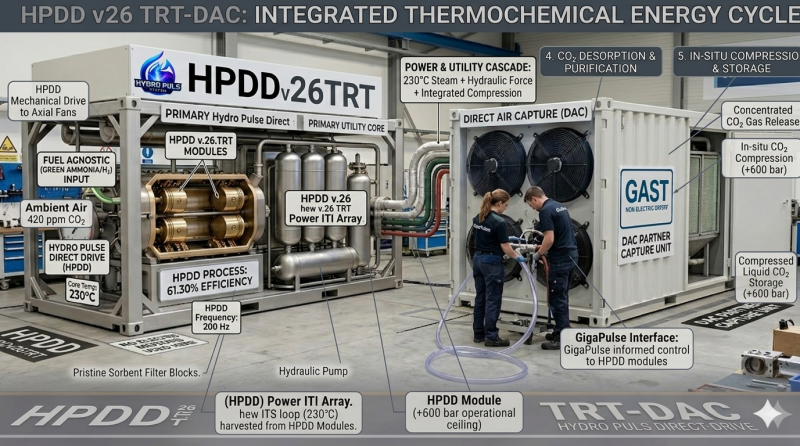
Technical Deep-Dive: How the HPDD-Powered DAC Pod Operates

Direct Air Capture (DAC) is fundamentally a battle against thermodynamics: extracting dilute CO_2 (420 ppm) from the atmosphere requires massive mechanical movement, high-grade thermal energy, and extreme compression. While conventional systems struggle with energy losses across these three stages, the HPDD v.26 TRT integrates them into a single, cohesive thermochemical cycle.

Here is the step-by-step operational blueprint of the HPDD DAC Pod.


Phase 1: Mechanical Capture & Adsorption

The process begins with the intake of massive volumes of atmospheric air. To capture significant amounts of CO_2, air must be forced through chemical sorbent structures (solid ammines or liquid hydroxides).

  • The HPDD Integration: The HPDD modules provide a high-torque, direct mechanical drive to massive axial fans. By bypassing the electrical grid and secondary motors, we eliminate "well-to-wire" conversion losses.

  • Intelligent Flow Control: Utilizing the GigaPulse control layer, the system dynamically adjusts fan speeds and blade pitch based on real-time ambient CO_2 concentration, humidity, and air pressure, ensuring the sorbent filters reach peak saturation with minimum energy expenditure.

Phase 2: High-Grade Thermal Desorption (Regeneration)

Once the sorbent filters are saturated, the CO_2 must be released (desorbed). This is the most energy-intensive stage of any DAC operation, typically requiring temperatures between 80°C and 100°C for solid sorbents, and much higher for liquid systems.

  • The HPDD Integration: We utilize the Internal Thermal System (ITS). The HPDD reactor maintains a constant wall temperature of 230°C. Instead of venting this heat, it is harvested via a closed-loop thermal oil system and directed to the filter chambers.

  • Energy Synergy: In our configuration, the thermal energy required for carbon release is effectively "free"—it is a byproduct of the mechanical work performed in Phase 1. This "waste heat" recovery is what makes the HPDD pod the most energy-efficient DAC solution on the market.

Phase 3: Stoichiometric Water Management

Maintaining the chemical health of sorbent filters often requires a steady supply of clean water, a major logistical hurdle for DAC units in arid regions or deserts.

  • The HPDD Integration: The HPDD operates on green ammonia (NH_3). The chemical reaction inside the reactor yields nitrogen (N_2) and water vapor (H_2O).

  • Resource Circularity: The HPDD Pod captures and condenses this exhaust vapor into high-purity water. This water is fed back into the DAC system to hydrate the sorbents or wash the CO_2 capture medium. This makes the Pod a resource-positive asset, capable of operating in the harshest desert environments without an external water supply.

Phase 4: In-situ High-Pressure Compression

To be useful or storable, the captured CO_2 gas must be compressed into a supercritical or liquid state for transport or geological sequestration.

  • The HPDD Integration: Standard DAC plants require massive, expensive secondary compressors. The HPDD v.26 TRT eliminates this need. Leveraging its +600 bar operational ceiling, the HPDD uses a dedicated compression stroke to liquefy the captured CO_2 gas directly within the module.

  • Direct-to-Tank: The CO_2 leaves the containerized Pod already at storage-ready pressure, ready for immediate injection into basaltic rock formations or transport to industrial users.


The Conclusion: A Closed-Loop Climate Machine

In a traditional DAC setup, the fans, the heaters, and the compressors are three separate, energy-draining systems. In the HPDD DAC Pod, they are one.

By using green ammonia as a high-density energy carrier, the HPDD transforms a standard 20ft container into a powerful carbon-negative tool. It produces zero CO_2, consumes zero grid power, generates its own process water, and delivers liquid CO_2 at 600 bar.

This is not just carbon capture; it is the industrial-scale reversal of the combustion era.


For those who wish to follow the scientific foundation and in-depth nuances of the DAC challenges, the expertise of Syed Mughees Ali, PhD is indispensable.

His research provides an essential framework for the energy hurdles that we are addressing directly with the HPDD. You can follow his full study and academic updates here:

👉 https://www.linkedin.com/feed/update/urn:li:activity:7458806183055958017/

Highly recommended for anyone looking to follow the transition of theoretical Direct Air Capture into a profitable industrial process.

Global Academic Validation: Direct Air Capture (DAC) "We are proud to collaborate with leading experts like Syed Mughees Ali, PhD, to bridge the gap between advanced thermal research and industrial application. By integrating our Decoupled Architecture with cutting-edge DAC insights, we are transforming global carbon capture from a scientific challenge into a commercially viable reality. This international partnership ensures that the HPDD operates at the forefront of the global energy transition."