SMR-HPDD power Barge/Ship
SMR + HPDD-NEXUS: Decoupling Nuclear Heat from Legacy Turbines
Small Modular Reactors (SMRs) represent the pinnacle of compact, continuous, zero-carbon thermal energy. However, coupling modern SMR cores to century-old, rotating Rankine steam turbines introduces severe bottlenecks: massive footprints, high vibration risks, extreme thermal inertia during load changes, and the catastrophic operational cost of single-point trip events.
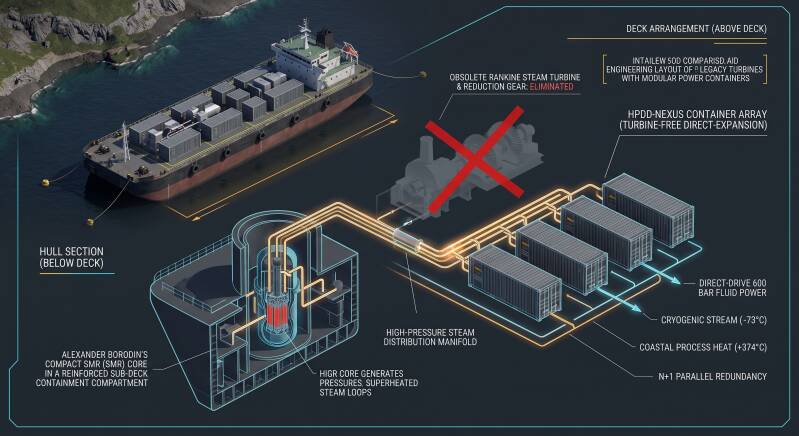
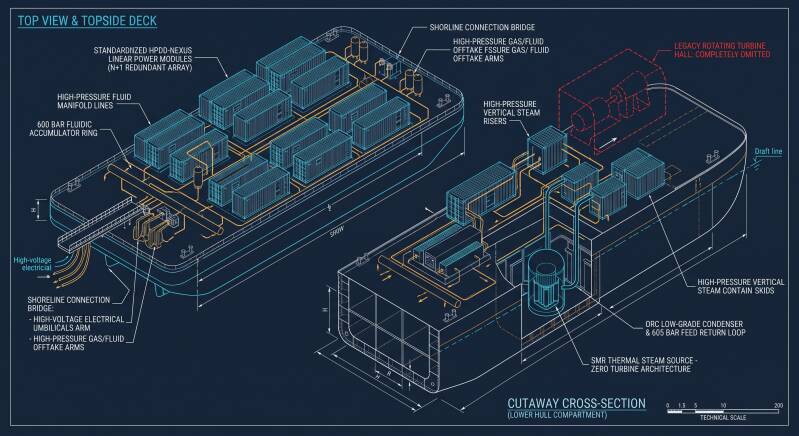
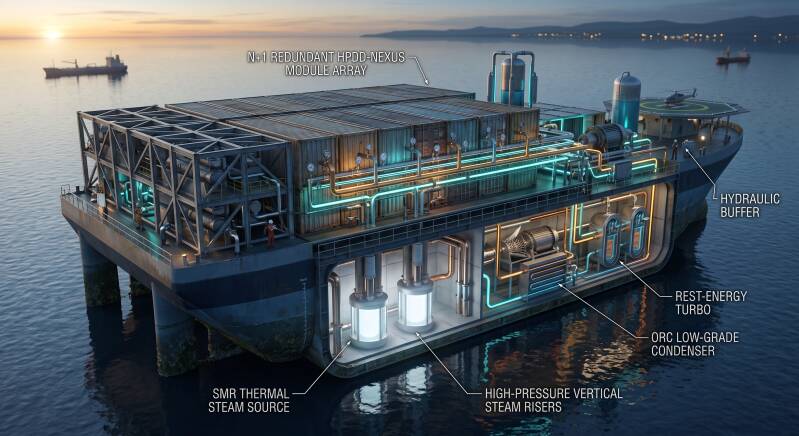
The integration of Small Modular Reactors with the HPDD-NEXUS Linear Fluidic Matrix eliminates traditional turbine halls entirely, replacing massive rotating machinery with a modular, containerized power array engineered for high-pressure direct conversion.
The Architecture: Direct Steam-to-Hydraulic Conversion
Instead of feeding high-pressure reactor steam into rotating blades, the SMR thermal output routes directly into a parallel matrix of HPDD-NEXUS modules:
- Blade-Free Direct Expansion (605 Bar Inlet): High-pressure primary/secondary steam expands directly against balanced opposed pistons (2 pairs arranged in absolute opposition) operating with a 1.2 mm micro-stroke, completely eliminating centrifugal stresses and rotor dynamics.
- Metallurgical Symmetry at 230°C: Identical Inconel-718 cylinder bores and linear pistons synchronize with a matching thermal expansion of 109 µm at 230°C standard operation, preserving the critical fluidic gap under continuous nuclear base-load duty.
- The Fluidic Battery (600 Bar Accumulator): Kinetic energy transfers directly into a 600-bar hydraulic accumulator network. This decouples the reactor’s thermal loop from downstream power delivery, feeding generators or direct mechanical drives with smooth, ripple-free fluid power.
- Active ORC Condensation Loop: Low-pressure exhaust steam (~5 bar) leaving convergent-divergent DeLaval nozzles is routed directly into an Organic Rankine Cycle (ORC). The ORC extracts secondary electrical power while acting as a liquid return condenser, allowing low-energy feed pumps to cycle water back to 605 bar baseline pressure with minimal parasitic losses.
SMR Integration: Monolithic Turbine vs. HPDD-NEXUS Array
Unlocking Next-Generation Floating & Coastal SMRs
This integrated architecture transforms floating nuclear power plants (barge installations) and decentralized industrial microgrids:
- Naval & Barge Compactness: Eliminating the vertical height and mass of steam turbines allows complete SMR power conversion decks to fit inside standard container bays.
- Autonomous Islanding: The hydraulic accumulator buffer absorbs rapid grid dropouts without reflecting pressure spikes or thermal transients back onto the nuclear core.
- Zero Contamination Risk: Closed-loop isolated operation ensures complete containment of working fluids with no auxiliary nitrogen injection lines or separate physical separation vessels within the working loop.
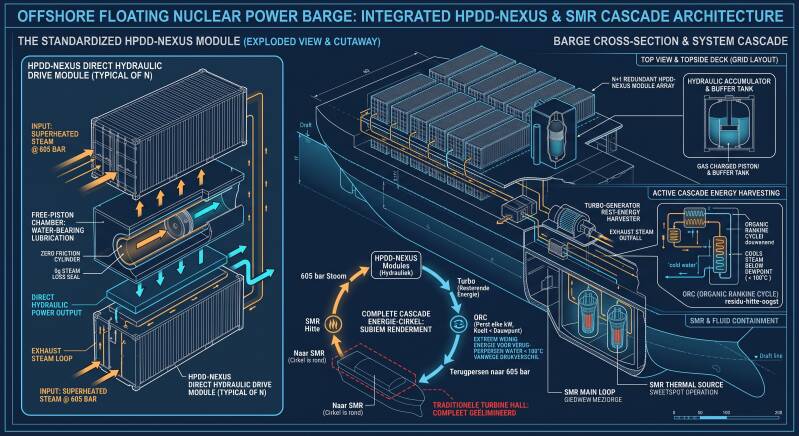
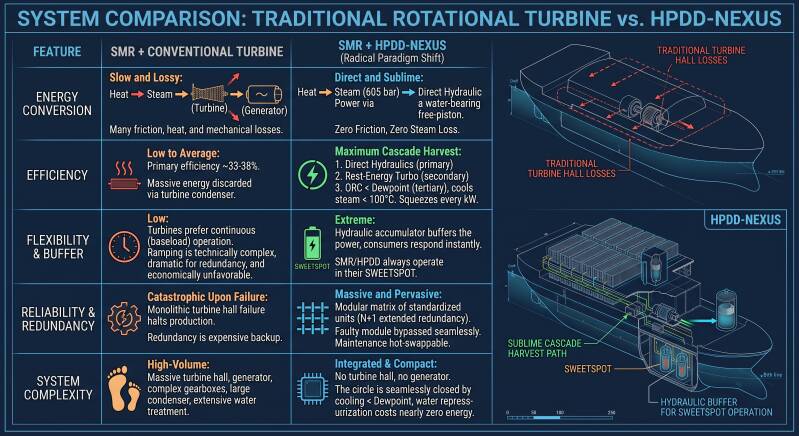
Advantages compared to: SMR/HPDD-NEXUS and an SMR with a traditional steam turbine:
Advantages of the SMR + HPDD-NEXUS Direct Hydraulic Cascade Barge
The integration of a Small Modular Reactor (SMR) with the HPDD-NEXUS energy conversion system represents a fundamental paradigm shift from rotational electricity generation to an integrated, direct-drive hydraulic power hub. This architecture offers sublime improvements in efficiency, flexibility, and safety.
1. Sublime, Cascaded Energy Harvesting
Unlike traditional systems that suffer massive thermal and mechanical losses between the steam source and final power output, the HPDD-NEXUS utilizes a multi-stage energy harvesting cascade to squeeze every possible kilowatt of energy from the primary loop:
- Primary Stage (Direct Hydraulics): High-grade steam at 605 bar is fed directly into standardized HPDD-NEXUS modules. Utilizing a water-bearing, free-piston design, the system achieves zero friction lubrication and zero steam loss, converting the brute force of the high-pressure steam directly into instant hydraulic power without any intermediate rotational steps.
- Secondary Stage (Rest-Energy Turbo): The exhaust steam, having completed its primary drive, is routed through a specially designed turbo-generator to harvest its remaining kinetic and thermal energy.
- Tertiary Stage (ORC Low-Grade Harvest): The final residual heat is captured by an Organic Rankine Cycle (ORC) loop. This loop performs the critical task of cooling the steam below its dew point (< 100°C). Because the working fluid is now liquid water at relatively low temperature, the energy required to pressurize it back to 605 bar and return it to the SMR is negligible. The circle is seamlessly closed with unmatched net efficiency.
2. Revolutionary Flexibility and Buffering
Traditional turbines are rigid, favoring constant "baseload" operation; ramping them up or down is complex, inefficient, and stressful on components. The HPDD-NEXUS system shatters this limitation:
- Hydraulic Buffer: The modules deliver their direct power output into a massive hydraulic accumulator. This acts as an instant power buffer, decoupling the primary energy generation (SMR) from the immediate demand of the consumers.
- Operation in the Sweetspot: Both the SMR and the HPDD-NEXUS modules can operate continuously within their optimal thermodynamic "sweetspot," regardless of fluctuating load demands. The hydraulic buffer smoothly absorbs or releases power as needed, maximizing the lifespan and efficiency of the entire system.
- Instant Load Following: The system’s modularity and lack of rotational inertia allow individual modules to switch on or off extremely quickly. This provides instant load-following capability, significantly reducing the need for separate backup power sources.
3. Extreme Reliability through Extended Redundancy
In a traditional plant, a fault in the monolithic steam turbine hall is catastrophic, immediately halting all power production. Redundancy is typically a binary, expensive proposition (a complete second turbine).
The HPDD-NEXUS barge is engineered as a massively parallel matrix of standardized modules. This provides extended, pervasive redundancy:
- The system consists of a multitude of independent modules.
- If one module fails or requires maintenance, its impact on the total power output is marginal. The faulty module is seamlessly bypassed while the remaining modules continue to operate.
- Maintenance becomes a routine process of hot-swapping standardized components, ensuring maximum uptime for critical infrastructure.