

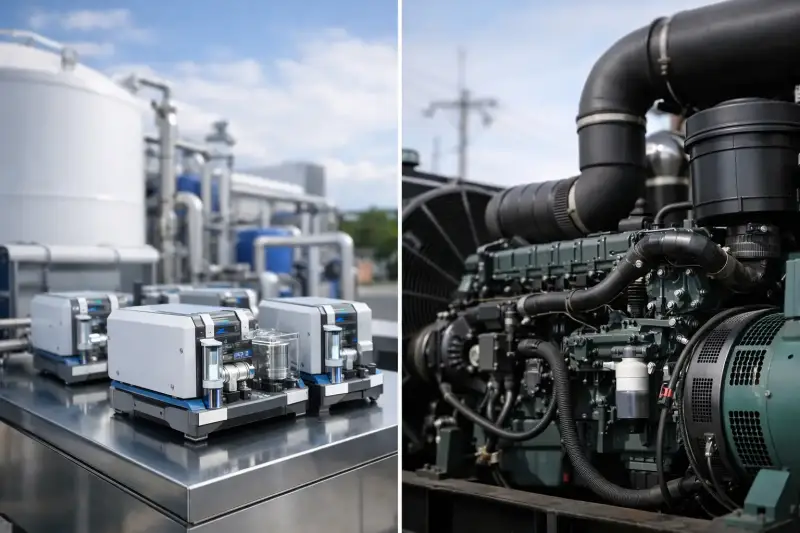
A remote industrial site loses grid access for 36 hours. The old answer is simple: start the diesel set, accept the fuel burn, and deal with the emissions profile later. That reflex is now under pressure. In ammonia power systems vs diesel generators, the real question is no longer whether diesel is familiar. It is whether familiarity still justifies the thermodynamic, regulatory, and fuel-strategy compromises it imposes.
For industrial operators, utilities, and project developers, this comparison is not about novelty. It is about asset life, fuel security, emissions exposure, and the ability to keep power architecture relevant through the next two decades of policy and infrastructure change. Diesel remains the incumbent because it is proven, compact, and supported by mature service networks. Ammonia is emerging because it can function as a carbon-free energy carrier at scale, with storage advantages that hydrogen often struggles to match in real-world logistics.
Ammonia power systems vs diesel generators: the core difference
Diesel generators are combustion machines built around a liquid hydrocarbon fuel with high volumetric energy density, fast transient response, and well-understood maintenance behavior. Their value proposition has always been practical deployment: fuel is broadly available, the generator package is standardized, and operators know what failure modes to expect.
Ammonia power systems start from a different premise. The fuel itself contains no carbon, can be stored as a liquid under moderate pressure or refrigerated conditions, and can be produced from low-carbon or renewable pathways. That changes the strategic role of the power plant. Instead of treating generation as a fuel-consuming endpoint, ammonia-based systems can become part of a wider energy chain linking renewable production, long-duration storage, transport, and firm dispatchable power.
This is why direct one-to-one comparisons can be misleading. A diesel generator is usually judged on near-term simplicity. An ammonia power platform is often judged on whether it can future-proof industrial power against carbon constraints and fuel transition risk.
Where diesel still wins
Diesel is not disappearing because it solves immediate problems well. It starts reliably, especially in emergency standby roles. The supply chain is global. Service technicians are widely available. For temporary power, construction sites, emergency backup, and smaller off-grid installations, diesel often remains the lowest-friction option.
Its combustion characteristics are also favorable for compact engines. Ignition is straightforward, flame speed and energy release are familiar to engine designers, and power density is high. If an operator values low upfront complexity more than long-term decarbonization, diesel still has a strong position.
There is also a financing reality. Lenders, insurers, and procurement teams understand diesel risk. Spare parts, maintenance intervals, overhaul expectations, and residual values are easy to benchmark. In capital-intensive markets, that institutional familiarity matters.
Where ammonia changes the equation
Ammonia becomes compelling when the project is large enough, long-lived enough, or emissions-sensitive enough that fuel strategy matters as much as engine selection. Unlike diesel, ammonia offers a route to dispatchable power without direct carbon emissions at the point of use, assuming the combustion or conversion pathway is engineered correctly.
That does not make ammonia easy. It has a lower flame speed, narrower flammability envelope, and higher ignition challenges than diesel. It also raises serious safety and materials-handling requirements because it is toxic and must be managed with disciplined containment, detection, and operating protocols.
But if the engineering is done properly, ammonia has one major strategic advantage: it is easier to store and transport at scale than hydrogen. For ports, industrial clusters, agricultural processing sites, remote infrastructure, and large microgrids, that storage practicality can outweigh the operational complexity.
Efficiency is not just about fuel
Many buyers initially compare fuel heating values and stop there. That is too shallow for serious infrastructure decisions. System efficiency depends on combustion stability, parasitic losses, load-following behavior, heat recovery, and how effectively the prime mover couples generated energy to useful work.
Diesel generators are often efficient at rated load but degrade under partial-load operation, especially in applications with volatile demand profiles. That is a familiar problem in off-grid and standby-heavy installations, where oversized gensets spend too much time operating away from their best efficiency point.
Ammonia systems face a different challenge. The fuel is harder to burn cleanly and efficiently, so the architecture matters more. This is where advanced thermal conversion platforms can create separation from conventional engine logic. If a system can maintain a stable internal operating condition, decouple combustion from load variation, and transfer energy with lower mechanical losses, ammonia becomes more viable as an industrial fuel rather than an academic alternative.
That distinction is central. The question is not simply whether ammonia can power an engine. It is whether the power system architecture can extract useful work from ammonia without inheriting the weaknesses of crankshaft-bound combustion design.
Emissions: local compliance vs long-term carbon exposure
Diesel’s emissions profile is well known: CO2, NOx, particulate matter, and other pollutants depending on aftertreatment quality, fuel quality, and duty cycle. Regulations can reduce local pollutants, but carbon emissions remain intrinsic to the fuel.
Ammonia removes carbon at the point of use, which is a major structural advantage for projects exposed to decarbonization mandates or carbon pricing. However, ammonia combustion is not automatically clean. NOx formation can still be significant and must be controlled through combustion design, temperature management, and aftertreatment where needed. There is also the issue of ammonia slip, which is operationally unacceptable if not tightly managed.
So the honest comparison is this: diesel is operationally mature but carbon-intensive. Ammonia can be carbon-free at the point of use, but only if the system is engineered to control combustion chemistry with precision.
Fuel logistics and energy security
Diesel has the better current distribution network. That is obvious. Yet fuel security is not just about what is easiest to buy today. It is about what remains available, financeable, and politically durable over the life of the asset.
Ammonia is already traded globally at industrial scale, primarily for fertilizer markets. That matters because it means storage terminals, shipping practices, handling expertise, and bulk transport pathways already exist. Those assets can support energy use cases as the fuel transition accelerates.
For projects seeking long-duration energy storage or importable clean fuel, ammonia has a stronger strategic position than many alternatives. It can serve as an energy vector, not just a consumable. That opens a path for renewables-backed production, seasonal storage, and multi-site fuel sourcing strategies that diesel cannot match.
CAPEX, OPEX, and the risk curve
In the near term, diesel usually wins on CAPEX and deployment speed. The equipment is standardized, packaging is mature, and engineering unknowns are limited. For many buyers, that is enough to close the case.
But OPEX and risk exposure tell a different story over longer asset horizons. Diesel assets face volatile fuel costs, potential carbon costs, stricter permitting pressure, and the prospect of technological obsolescence in emissions-constrained sectors. What looks cheap upfront can become expensive when regulation, fuel volatility, and retrofit burden accumulate.
Ammonia systems typically require more specialized fuel handling, more rigorous controls, and more advanced combustion or conversion architecture. That can raise initial capital cost. Still, in applications where carbon-free dispatchable power has premium value, or where fuel flexibility matters, the business case can turn quickly.
This is especially true if the platform is designed as a broader energy system rather than a simple genset replacement. Combined heat and power, industrial steam support, desalination, and direct coupling to hydraulic or process loads can materially improve total project economics.
What matters most in ammonia power systems vs diesel generators
The right choice depends on duty cycle, emissions constraints, fuel access, and asset lifespan. For temporary duty, emergency backup, and low-complexity deployment, diesel remains hard to displace. For strategic infrastructure, industrial decarbonization, and sites that need fuel flexibility beyond the fossil era, ammonia deserves serious consideration.
The deeper issue is architectural. Conventional engines were built around fuels that were easy to burn, not around the demands of next-generation energy systems. As fuels become more diverse and emissions tolerance shrinks, the winning platforms will be those that control combustion conditions more precisely, reduce mechanical loss pathways, and deliver useful power without forcing the prime mover to chase every load fluctuation.
That is why the market is moving beyond the old engine-vs-engine comparison. The more useful comparison is between conventional generator logic and engineered energy platforms designed for fuel transition. Hydro Puls Systems is part of that shift, advancing a power architecture built to operate in a controlled performance window rather than inside the compromises of legacy rotating machinery.
For buyers making decisions today, the practical move is not to ask which fuel won the last century. It is to ask which power architecture will still make technical and financial sense when your project is halfway through its operating life.