

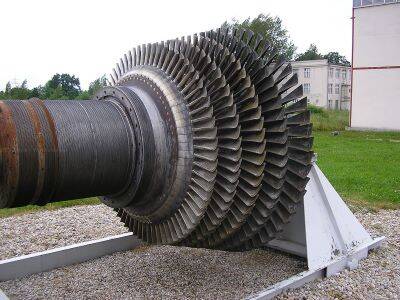
⚙️ The Turbine: The Most Expensive Spinning Wheel in History
Let's be honest: the turbine marketing department deserves a standing ovation. For decades, they've wrapped it in a shiny, "high-tech" aura. But if you strip away the polished renders, what are we looking at? A glorious, 18th-century spinning wheel that is an absolute energetic disaster.
The Grand Over-Complicated Industrial Detour
Imagine you need linear, straight-line pressing force. A logical person goes straight. How does a modern turbine-powered plant do it? Take a breath:
Burn fuel - create raw linear pressure - slam it against blades to force a rotational detour - lose half to a parasitic compressor - spin a generator to make electricity - route it to an electric motor to spin again - drive a hydraulic pump - finally get your linear force.
We spend millions to turn a straight line into a circle, into magnetism, into another circle, just to go back to a straight line. It's mechanical gymnastics.
Thermodynamics Doesn't Care About Marketing
By the time this rollercoaster ride ends, the traditional setup has thrown 75% of its efficiency right out the window , mostly escaping as massive white steam clouds. We burn cash to heat the atmosphere, leaving a miserable 25% mechanical yield for the actual work.
It's like buying a crate of 24 beers, dropping 18 on the pavement, spilling 4 in the car, and celebrating the two sips left when you get home.
Enter the Party Pooper: HPDD v26
With the Hydro Puls Direct-Drive (HPDD) v26 , we end the circus. Running on green ammonia, our opposed piston pairs convert raw linear expansion directly into +600 bar hydraulic pressure at the source. No crankshafts, no spinning turbines, no electric motors.
We route 61.3% of the core energy straight into the hydraulics . Because perfection is a myth, we factor in 5.0% thermal radiation and 3.3% friction losses. Yet, the net output is 58%, more than double the turbine route.
Oh, and that "waste" heat? Our closed siloxane jacket traps it at a blistering 230°C to feed your steam demand, while the cryogenic exhaust condenses your process water indoors.
The turbine had a great run, but the illusion is over. It's time to stop optimizing the spinning wheel and start moving in a straight line.