HPDD-BESS
The HPDD-BESS: The Infinite, Circular Energy Hub 🔄🔋
The Grid Flexibility Crisis
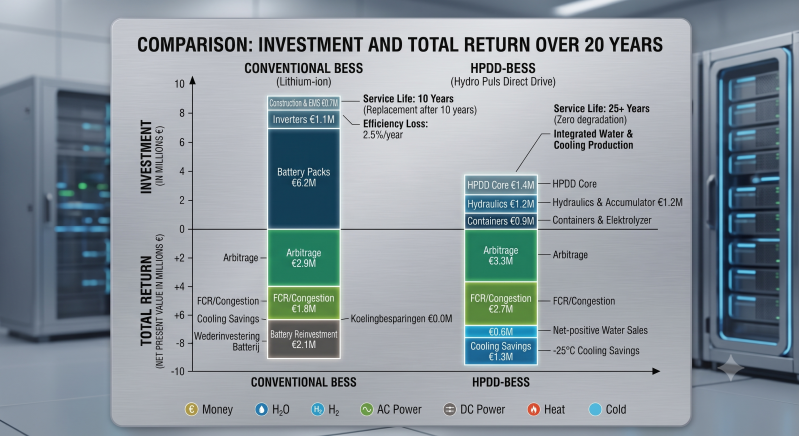
Large-scale solar and wind farms worldwide are hitting a hard bottleneck: intermittence and grid congestion. During peak production, farms are frequently forced to shut down (curtailment), causing valuable green energy to be 100% wasted. Traditional Battery Energy Storage Systems (BESS) are merely temporary band-aids. They carry massive initial capital constraints (high CAPEX), have limited capacity, suffer from continuous self-discharge, and degrade chemically with every single charge cycle. Within 10 to 15 years, a conventional battery asset becomes an expensive environmental and financial liability.
The HPDD-BESS Solution: One Machine for Everything
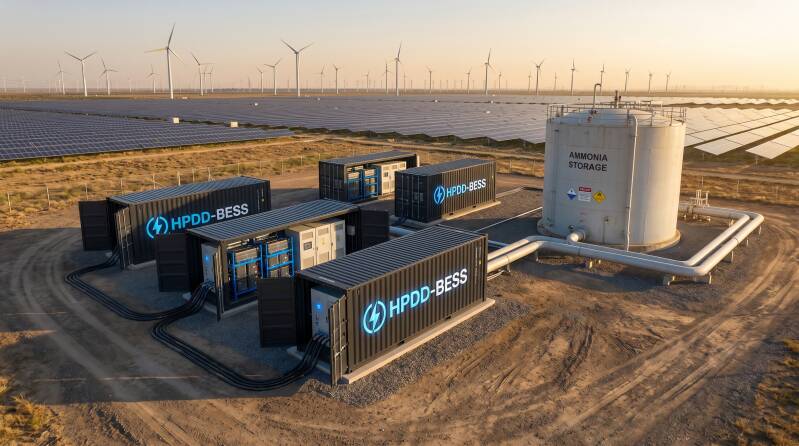
The Hydro Puls Direct-Drive (HPDD) v26 TRT platform redefines energy storage by combining the ultra-fast flexibility of a battery with the unrivaled energy density of liquid green ammonia (). Paired with advanced non-equilibrium separation chemistry, this containerized asset functions as a completely reversible, circular chemical battery.
1. Extreme Energy Density with Zero Degradation
Liquid ammonia boasts a volumetric energy density of 12.7 MJ/L. This is more than double the density of gaseous hydrogen at 700 bar and vastly outclasses chemical lithium-ion battery packs. Crucially, ammonia has zero self-discharge. A summer surplus of solar energy can be stored securely in a liquid tank for decades without a single kilowatt-hour leaking away before winter.
2. Infinite Cycle Life (Zero Degradation)
While traditional batteries lose capacity with every cycle, the HPDD-BESS experiences zero chemical degradation. Its monolithic Inconel 718 linear pistons float entirely contact-free on active hydrostatic water bearings, and its high-strength Inconel bellows operate in an "infinite life" fatigue regime exceeding cycles. This system can charge and discharge endlessly without losing capacity.
3. Radically Lower CAPEX & Maximum Efficiency
Skeptics will quickly point to the ~40% energy loss across the full Round-Trip Efficiency (RTE). What they miss is the real-world economics of grid congestion: the input electricity is free curtailment power that would otherwise be entirely destroyed. Furthermore, the HPDD architecture slashes traditional chemical synthesis penalties:
- 0% Nitrogen Compression Penalty: Pure nitrogen gas () exits the HPDD active separation column already mechanically compressed to the nominal system operating pressure of 600 bar. It eliminates the heavy, energy-draining external compressors normally required for re-synthesis.
- No Inverters, No Grid Dependency: Because the crankshaft-free linear pistons can deliver direct fluid power or interface with linear generators to output exact grid frequencies, heavy power electronics (AC/DC inverters) are removed. The unit is completely off-grid autonomous.
Closing the Loop (The Full Cycle):
-
CHARGING (Energy Surplus): When solar or wind assets overproduce, a containerized electrolyzer splits water into hydrogen. This hydrogen instantly recombines mid-air with the 600-bar pure nitrogen stream from the HPDD separator. The energy is stored safely as stable liquid ammonia.
-
DISCHARGING (Peak Demand): Within a lightning-fast transient response time of 1.0 ms, the HPDD core activates. The stored ammonia is cracked in-situ and converted into zero-emission baseload electricity at an unassailable 61.3% brake thermal efficiency.
-
THE MULTIPLIER (Environmental Utility): Under an ironclad mass lock (), the discharging cycle recovers up to 126 liters of pure distilled process water per hour. Concurrently, the 600-bar nitrogen jet powers non-equilibrium columns to permanently flash-destroy PFAS/micro-pollutants and isolate dry mineral fertilizer assets.
The HPDD-BESS is not a battery and it is not an engine; it is a self-sustaining, sovereign energy-and-utility ecosystem in a single container. One machine for everything.