

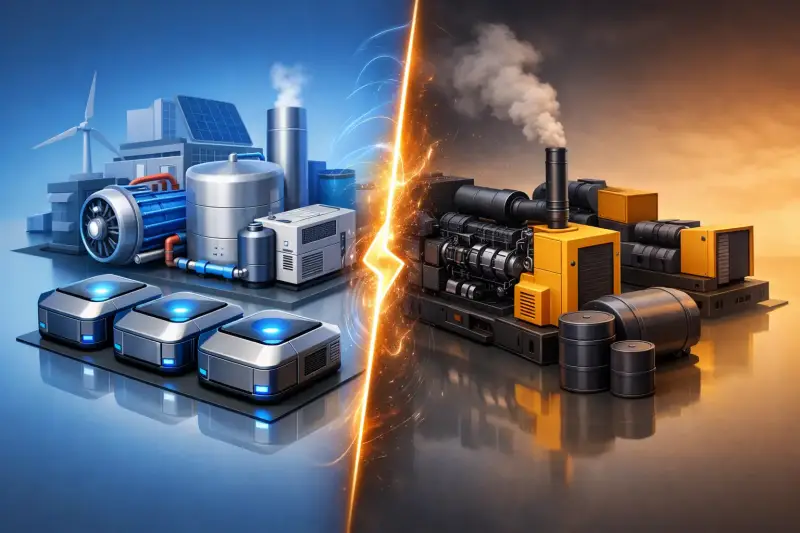
When a facility is paying for both electricity and thermal energy, the real comparison is not simply backup power versus prime power. It is energy architecture versus fuel burn. That is why the debate around CHP systems vs diesel generators matters far beyond nameplate output. For industrial operators, utilities, greenhouse owners, data center developers, and project financiers, the wrong choice can lock in avoidable fuel cost, stranded heat, and poor emissions performance for years.
Diesel generators still dominate where emergency readiness, fast deployment, and familiar maintenance practices carry the most weight. They are mechanically understood, globally available, and effective when the job is intermittent runtime under high reliability constraints. But once runtime increases and thermal demand enters the picture, diesel starts to reveal its structural limits. A conventional genset converts fuel into electricity and rejects a large share of input energy as waste heat. CHP is built around the opposite logic. It treats heat as a valuable product, not an unavoidable loss.
CHP systems vs diesel generators in real efficiency terms
The simplest way to separate the two is to stop looking only at electrical efficiency. A diesel generator might deliver acceptable electrical output, but in many applications it wastes 50 percent or more of fuel energy through exhaust and cooling losses. If a site then has to fire separate boilers to produce hot water, steam, or process heat, the plant is paying twice for energy that could have been captured once.
CHP changes the equation by combining electrical generation with heat recovery. In well-matched applications, total system efficiency can climb into the 70 to 90 percent range, depending on operating conditions, recovery design, and thermal utilization. That number is not marketing decoration. It is the difference between burning fuel once for multiple useful outputs versus burning fuel repeatedly across separate assets.
This is where many comparisons go wrong. Diesel generators are often benchmarked on first cost or electrical reliability alone. CHP should be evaluated on whole-site energy balance. If a facility has year-round or seasonal thermal loads that align with generation, CHP can materially reduce fuel consumption, operating expense, and emissions intensity.
Where diesel generators still make sense
Diesel is not obsolete. It is often the right answer when runtime is low, the duty cycle is unpredictable, or the site needs black-start capability with minimal integration complexity. Hospitals, telecom installations, temporary construction power, remote contingency applications, and critical backup systems continue to rely on diesel because the technology is proven and deployable under compressed timelines.
There is also a reason diesel remains attractive in regions with weak gas infrastructure or where liquid fuel logistics are already embedded into operations. Fuel can be stored on site. Startup is rapid. Service networks are broad. For emergency standby governed by infrequent operation, the efficiency penalty is less important because the machine is not expected to run continuously.
The problem begins when an emergency machine is quietly asked to behave like an economic engine. As annual run hours rise, fuel cost dominates. Emissions scrutiny increases. Maintenance intervals tighten. Noise, vibration, and local air quality impacts become more consequential. At that point, a diesel asset may still perform, but it is doing so from an architecture that was never designed to maximize total energy value.
Why CHP wins when heat has value
CHP is strongest in facilities that need electricity and usable heat at the same time. That includes industrial process plants, greenhouses, district energy systems, food production, hospitals, universities, laundries, desalination sites, and many off-grid or weak-grid industrial campuses. In these environments, thermal demand is not incidental. It is continuous, billable, and central to throughput.
Instead of venting exhaust energy into the atmosphere, CHP systems recover it through heat exchangers, thermal loops, steam production, hot water circuits, or absorption chilling. This can displace boiler fuel, stabilize on-site energy economics, and improve resilience by localizing multiple energy services into one integrated platform.
For operators under pressure to reduce carbon intensity without sacrificing dispatchability, that matters. Grid electricity may be cleaner in some markets, but it is not always stable, and it rarely solves process heat on its own. CHP remains one of the few mature pathways that addresses electrical reliability and thermal demand together.
The economics are decided by load profile, not slogans
In CHP systems vs diesel generators, there is no universal winner because economics depend on runtime, spark spread, thermal utilization, fuel availability, interconnection constraints, and maintenance strategy. A diesel generator may have lower upfront cost for a basic installation. CHP often requires more engineering, more balance-of-plant equipment, and more site integration. That raises CAPEX.
But industrial buyers do not make decisions on CAPEX alone. They make them on lifecycle economics. If recovered heat is fully utilized and the system runs enough hours annually, CHP can outperform diesel decisively on fuel spend per useful unit of energy delivered. It can also reduce dependence on separate thermal equipment and improve site-level energy predictability.
The key phrase is fully utilized. A CHP unit without a strong thermal sink becomes an expensive electrical generator with partial recovery value. Oversizing is a common error. The best CHP projects are engineered around actual thermal and electrical load curves, not peak optimism. Precision matters.
Fuel flexibility and transition risk
Traditional diesel generation is tied to a fuel with increasing regulatory and cost volatility. Even where diesel remains available and practical, many buyers are asking a harder question: will this asset still fit the operating and compliance environment five to ten years from now?
CHP platforms, especially newer architectures, offer a broader transition pathway. Natural gas remains common today, but the strategic value is in systems that can evolve toward hydrogen, ammonia-derived fuel pathways, biogas, synthetic fuels, or hybridized thermal platforms. That flexibility reduces transition risk and protects long-duration infrastructure investment.
This is where first-principles engineering starts to matter more than product labels. The next generation of power systems will not be judged only by what fuel they burn today. They will be judged by how efficiently they convert energy, how stably they operate under varying load conditions, and how readily they adapt to future fuels and carbon constraints.
Reliability is more than startup speed
Diesel advocates often frame reliability around instant availability, and that is fair in standby contexts. But for industrial and infrastructure projects, reliability also includes sustained operation, thermal stability, maintenance burden, component wear, and performance under continuous duty.
Conventional engine architectures are exposed to friction, transient loading stress, and off-design operation that can erode efficiency and service life. By contrast, advanced CHP concepts are increasingly engineered to decouple energy conversion from load variation so the prime mover can remain near its optimal operating point while downstream systems manage output demand. That architectural shift is significant. It is the difference between chasing the load mechanically and controlling the process thermodynamically.
For technically literate buyers, this is not a branding nuance. It is a design thesis. Systems that hold combustion and conversion in a controlled sweet spot can reduce parasitic losses, improve durability, and create a stronger platform for integrated heat and power delivery. That is one reason disruptive entrants such as Hydro Puls Systems are attracting attention from partners who no longer accept the crankshaft-era assumptions embedded in conventional generation.
Emissions, permitting, and site acceptance
Emissions performance is now a board-level issue in many sectors. Diesel generators face growing pressure on NOx, particulate matter, carbon intensity, and local permitting. Aftertreatment can mitigate some of this, but it adds complexity and cost. In dense industrial zones, urban infrastructure, and environmentally sensitive projects, diesel can become harder to justify as primary or high-hour generation.
CHP is not automatically low carbon, but it is often materially lower carbon per unit of useful energy because it captures and applies heat that would otherwise be wasted. That distinction matters in ESG reporting, energy procurement strategy, and public-sector project approval. If a site can displace both grid electricity and boiler fuel with one integrated asset, the emissions case becomes much stronger.
Which one should an industrial buyer choose?
If the requirement is emergency backup with low annual runtime, constrained budget, and fast deployment, diesel generators remain practical. If the requirement is continuous or high-hour operation with meaningful heat demand, CHP is usually the more intelligent energy system. Not because it sounds cleaner or more advanced, but because it extracts more useful work from the same fuel input.
The most sophisticated buyers go one step further. They do not ask whether they need a generator or a CHP system. They ask what architecture best matches their site physics, fuel roadmap, and operating profile. That is the right question.
The next decade will not reward facilities that buy power equipment as isolated hardware. It will reward those that treat generation as part of a larger thermodynamic strategy, where every unit of fuel is expected to deliver more than one job.