HPDD Milk Powder Unit
Conventional Spray Drying Tower vs. HPDD Molecular Eraser for Milk Powder Production.
Drying Principle and Speed
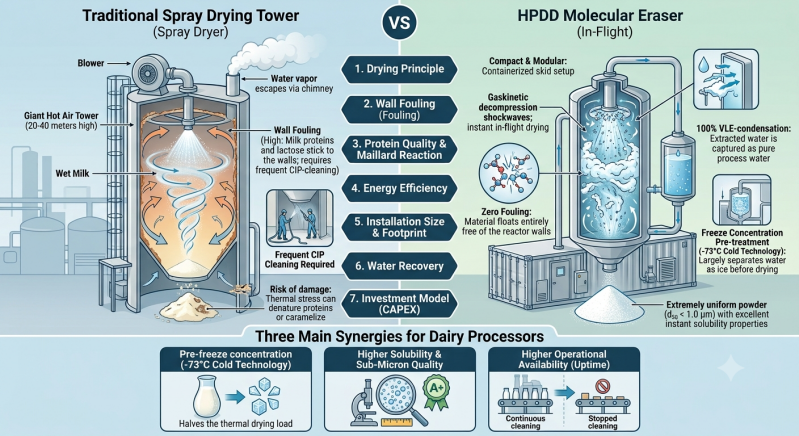
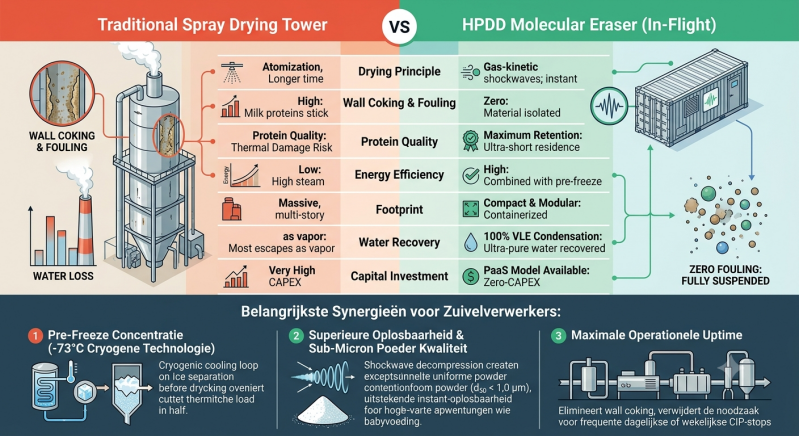
Conventional spray dryers rely on atomizing concentrated milk inside a massive hot-air tower with a relatively long drying residence time.
In contrast, the HPDD Molecular Eraser uses gas-kinetic decompression shockwaves to achieve instantaneous mid-air drying while the material remains fully in suspension.
Wall Coking and Fouling
Traditional towers suffer from high rates of wall fouling as milk proteins and lactose stick to the internal hot surfaces, requiring frequent and costly Cleaning-In-Place (CIP) downtime.
The HPDD Molecular Eraser achieves zero wall contact during the flash-drying phase, completely preventing material adhesion.
Protein Quality and Thermal Damage
In standard dryers, prolonged thermal exposure risks protein denaturation and unwanted Maillard reactions (caramelization).
The HPDD platform preserves the natural structure and bioactivity of sensitive dairy proteins (such as whey and caseins) due to its sub-second processing time and controlled thermal profiles.
Energy Efficiency and Thermal Integration
Conventional spray drying requires massive steam and natural gas inputs to evaporate water.
HPDD significantly reduces overall thermal energy demand by coupling deep cryogenic freeze-concentration (down to -73C prior to drying with integrated heat recovery.
Footprint and Equipment Dimensions
Standard drying plants demand huge multi-story industrial buildings to house towers up to 40 meters tall.
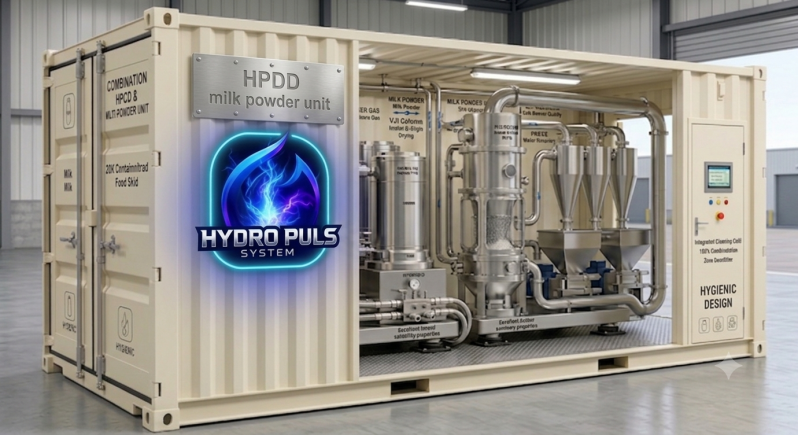
HPDD delivers equivalent drying capacity within a compact, modular, containerized skid layout.
Water Recovery
Traditional evaporators and spray towers vent significant amounts of moisture through the exhaust stack as lost vapor.
The HPDD system utilizes supercritical Vapor-Liquid Equilibrium (VLE) separation to condense and recover 100% of the extracted water as ultra-pure process water for factory reuse.
Capital Expenditure and Deployment
Building a standard spray drying plant requires massive upfront CAPEX for civil works and heavy equipment.
The HPDD platform can be deployed under a Process as a Service (PaaS) framework, allowing dairy processors to scale production capacity with zero initial equipment CAPEX.
Key Advantages for Dairy Processors
Freeze-Concentration Integration: Utilizing -73Ccryogenic cooling to freeze-concentrate raw milk before drying halves the thermal evaporation workload.
Sub-Micron Instant Powder Quality: Shockwave decompression yields highly uniform sub-micron powder d_50 < 1.0 with superior solubility, ideal for premium infant formula and protein isolates.
Maximized Operational Uptime: Eliminating wall coking removes the need for daily or weekly chemical CIP downtime, maximizing continuous plant operation.