

HPDD Industrial Icecream
🍦 Redefining Industrial Ice Cream Production:
High-Pressure Homogenization Meets -73°C Cooling.
What happens when you combine ultra-low temperature cooling (-73°C) with precision hydraulic impulse technology?
You eliminate the traditional bottlenecks of industrial ice cream manufacturing.
Traditional ice cream processing relies on energy-intensive plunger pumps for homogenization, followed by separate freezing units.
This multi-step approach suffers from mechanical friction heat and energy losses.
By applying the Hydro Puls Direct-Drive (HPDD) architecture, we can consolidate homogenization and flash-freezing into a unified, high-efficiency process:
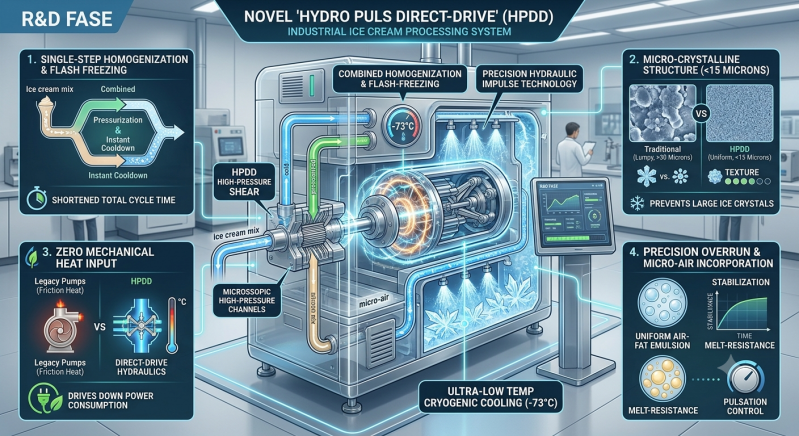
⚡ 1. Single-Step Homogenization & Flash Freezing
HPDD enables high-pressure shear and fluid dispersion directly alongside ultra-low cryogenic cooling (-73°C). The ice cream mix is homogenized and frozen simultaneously, shortening total cycle times.
🍨 2. Micro-Crystalline Structure (<15 Microns)
Ice cream texture is dictated by crystal size. Rapid -73°C cooling paired with direct hydraulic pulse control prevents large ice crystals from forming. The result is micro-crystals below 15 microns, delivering exceptional creaminess even in low-fat or plant-based formulations.
🌱 3. Zero Mechanical Heat Input
Legacy high-pressure pumps generate significant friction heat, forcing refrigeration systems to work twice as hard. HPDD’s direct-drive hydraulics minimize mechanical friction, preserving cooling energy and driving down total operational power consumption.
💨 4. Precision Overrun & Micro-Air Incorporation
Injecting and stabilizing microscopic air bubbles is critical for melt-resistance. HPDD’s pulsation control ensures uniform air-fat emulsion at a micro level, leading to superior product stability during storage and transport.
By merging high-torque hydraulic force with cryogenic thermal management, HPDD transforms complex food processing lines into compact, highly reliable, and energy-efficient systems.
💡 Interested in optimizing high-pressure fluid processing or low-temp manufacturing? Let’s connect!