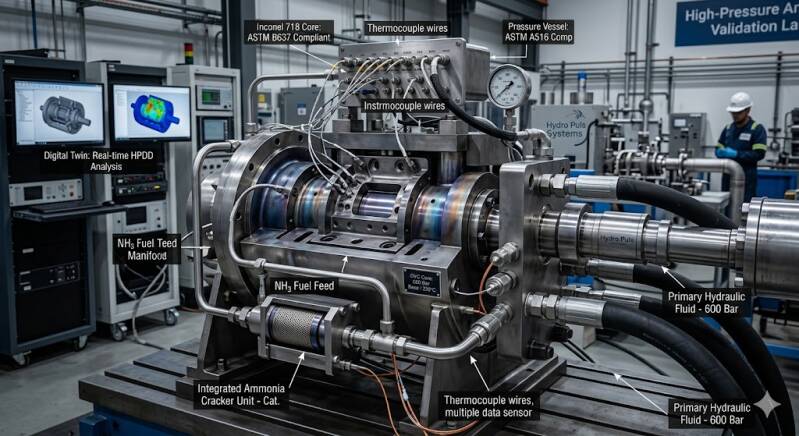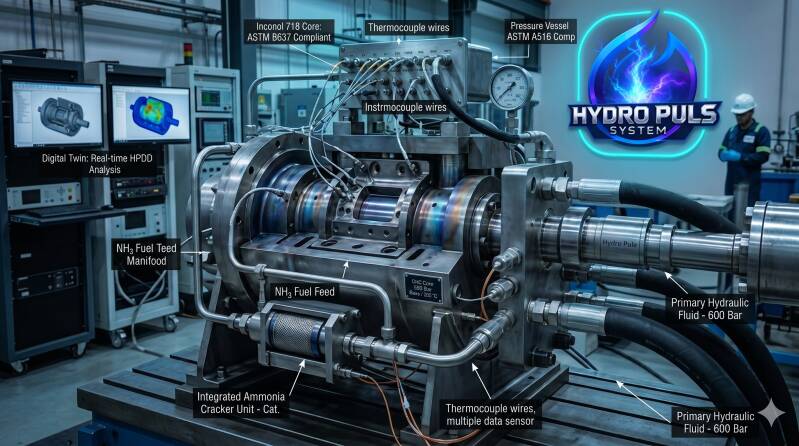
Bypassing the Legacy Limitations of Clean Fuels Through High-Pressure Architecture
Ammonia (NH_3) is universally recognized as one of the most viable zero-emission energy carriers for the future of heavy transport, maritime propulsion, and decentralized power generation. It contains no carbon atoms, emits zero CO_2 upon combustion, and boasts a significantly higher volumetric energy density than gaseous hydrogen, making it far easier to store and transport using existing global infrastructure.
However, traditional Internal Combustion Engines (ICE) and conventional turbines face severe mechanical and thermodynamic bottlenecks when burning ammonia:
- Low Flame Velocity & High Ignition Energy: Ammonia is notoriously difficult to ignite and burns exceptionally slowly.
- The "Pilot Fuel" Trap: To sustain a stable burn, conventional legacy engines are forced to inject a carbon-heavy "pilot fuel" (such as diesel), directly compromising their zero-emission status and introducing complex dual-fuel logistics.
- The Thermal & Catalytic Lag: While cracking a portion of ammonia into hydrogen (H_2) to act as an internal pilot is theoretically ideal, conventional engines cannot handle the dynamic thermal response times required by chemical reactors, especially during low-load operations.
The HPDD Paradigm Shift: Synchronous Crack & Pulse Combustion
The Hydro Puls Direct-Drive (HPDD) platform architecture solves the ammonia paradox from first-principles physics. Instead of forcing a slow-burning molecule into a legacy crankshaft geometry, the HPDD utilizes a highly stable, high-pressure core that transforms ammonia into an ultra-clean, high-density kinetic fluid power asset.
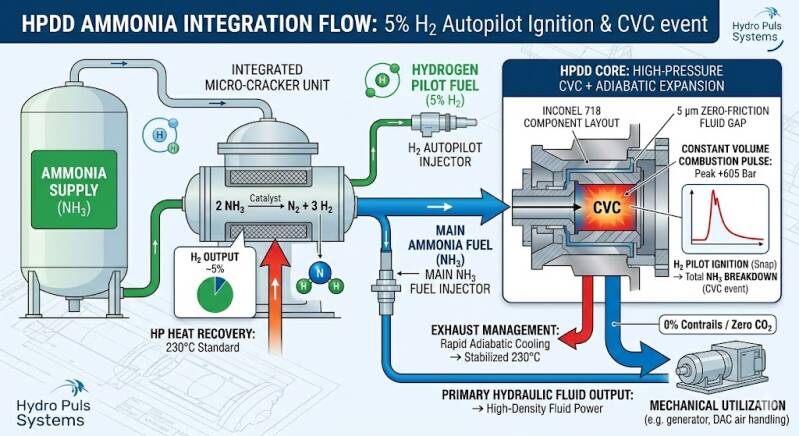
[ Raw NH3 Feed ] ──> [ Integrated Micro-Cracker ] ──> [ H2 Autopilot Boost ] │ [ Brute Hydraulic Output ] <── [ CVC Pulse Event (+605 Bar) ] ┘
1. Integrated In-Core Micro-Cracking
The HPDD platform operates under a continuous, heavily voorgespannen static baseline pressure of 600 bar, with core thermal dynamics stabilized at a constant 230°C. This uniform energy environment provides the perfect thermodynamic foundation to route a micro-fraction of the incoming ammonia through an integrated, catalytic cracking zone.
By harvesting the high-grade process heat directly from the Inconel 718 core, the system continuously cracks a precise stream of ammonia into hydrogen (H_2) without any external energy penalties.
2. Self-Sustained Hydrogen Autopilot Ignition
The generated hydrogen acts as the HPDD’s own, 100% emission-free pilot fuel. Because hydrogen possesses an extremely high flame speed and low ignition energy, it is software-dosed into the main combustion chamber to instantly trigger the Constant Volume Combustion (CVC) cycle. The hydrogen snap pulls the slower-burning ammonia along into a complete, rapid molecular breakdown, generating a highly controlled, high-frequency pulse that peaks at 605 bar.
3. Complete NO_x and Particulate Elimination
Traditional engines produce high NO_x emissions due to localized temperature spikes and prolonged exposure times at high heat. The HPDD counteracts this through its dual opposition piston layout and extreme expansion ratio.
The brute pressure drop during the expansion stroke causes rapid adiabatic cooling within the core. The exhaust gases drop swiftly to our managed 230°C standard, effectively freezing the chemical kinetics before harmful NO_x molecules can form. Furthermore, because no carbon-based pilot fuels are used, particulate matter and soot are entirely eliminated from the equation.
Engineering the Zero-Emission Infrastructure Ecosystem
By merging a high-pressure hydraulic transformer with an integrated chemical processing layout, the HPDD turns ammonia from a problematic fuel into a highly efficient, plug-and-play energy source.
- 0% Grid Interference: Generate raw hydraulic fluid power directly from green molecules.
- 0% Carbon Penalties: Eliminate the reliance on fossil-based pilot fuels or complex exhaust scrubbing.
- 100% Coherent Integration: Harvest high-grade thermal recovery and mechanical output from a single, silent, and structurally stable machine in absolute material rest.
The Thermodynamic Paradox: Why 5% H_2 Cracking Costs Us Nothing
To a conventional marine or mechanical engineer, cracking Ammonia (NH_3) into Hydrogen (H_2) to support combustion sounds like an efficiency penalty. In standard industrial chemical processes, cracking is a highly endothermic reaction, meaning it aggressively consumes valuable energy (heat) that you would rather use for mechanical output.
The HPDD architecture turns this challenge into a self-sustaining thermodynamic loop. We do not burn extra fuel to crack our ammonia; instead, we exploit the system’s own mechanical rest.
1. Zero Parasitic Heat Loss
In a standard crankshaft engine, up to 30% of the fuel's energy is lost to the cylinder walls and cooling jackets as wasted low-grade heat. Because the HPDD operates under a massive, continuous static baseline pressure of 600 bar, the Inconel 718 molecular structure is heavily pre-stressed and thermally stabilized at a uniform 230°C.
Instead of routing this core heat to a radiator or dumping it out of the exhaust, our integrated Micro-Cracker Unit harvests this localized thermal energy directly from the core envelope. The energy used to crack the ammonia to 5% hydrogen is energy that was already bound inside the machine's thermal equilibrium.
2. The Volumetric Power Multiplier
When you split Ammonia into Nitrogen and Hydrogen, a fascinating chemical expansion occurs according to the reaction law:
2NH_3 N_2 + 3H_2
Two molecules of ammonia gas are transformed into four molecules of gas (one stikstof, drie waterstof).
By initiating this micro-cracking process right before the injection point, we create a localized volumetric expansion. This means we are pre-compressing our pilot fuel before it even enters the combustion chamber, utilizing the core's own heat to generate gas pressure.
3. The "Snap-Ignition" Leverage
That precise 5% hydrogen volume acts as a thermodynamic lever. Because hydrogen has an ignition energy ten times lower than ammonia, the H_2 autopilot injector induces a violent molecular "snap" (the CVC event). This instantaneous shockwave shatters the remaining 95% raw ammonia stream at a peak pressure of +605 bar, forcing a rapid, total chemical breakdown without any unburnt fuel slip.
The Operational Bottom Line
Traditional engines require a secondary diesel infrastructure, secondary fuel lines, and accept a permanent carbon penalty to burn ammonia.
The HPDD treats chemical processing and fluid mechanics as a single, coherent ecosystem. We use 5% of our own cracked fuel as the ignition catalyst, power the reaction with trapped core heat, and eliminate legacy emissions at the source. This is not just clean combustion, this is operating physics optimized to its absolute limit.
The Structural Inability of Legacy ICE to Match HPDD Financials
When confronting the economics of next-generation carbon capture (DAC) and zero-emission utilities, industry incumbents frequently attempt to retro-fit legacy Internal Combustion Engines (ICE) to burn green ammonia or hydrogen.
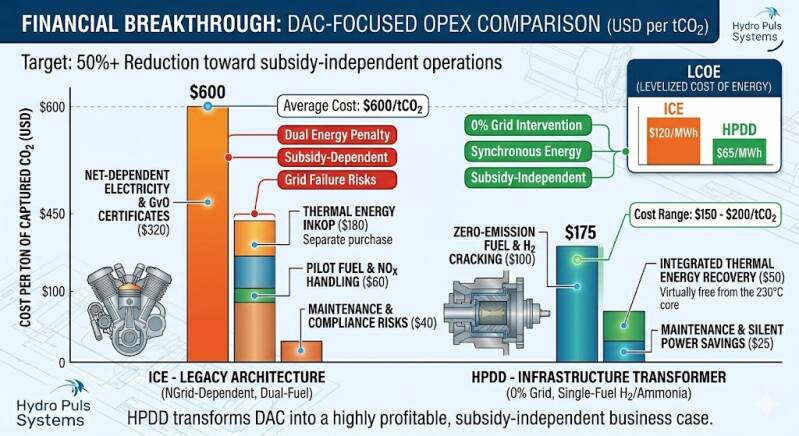
However, a financial breakdown reveals that a traditional krukas-driven engine is structurally incapable of breaking the ~$600/tCO_2 cost barrier. The limitation is not the fuel; it is the legacy mechanical architecture itself.
Here is why a traditional ICE cannot replicate the HPDD financial profile:
1. The "Dual Energy Penalty" (Thermal vs. Kinetic Split)
A conventional ICE splits its energy output inefficiently: roughly one-third becomes mechanical rotation, one-third is lost as waste heat to the cooling jackets, and one-third bleeds out of the exhaust.
- The ICE Penalty: To power a Direct Air Capture (DAC) facility, a legacy engine must run an alternator to generate electricity for the air handlers, while the high-grade thermal heat needed for filter desorption must be purchased or generated separately ($180 per ton of CO_2 in separate thermal energy inkoop).
- The HPDD Advantage: The HPDD is an infrastructure transformer. It delivers brute hydraulic fluid power and traps high-grade thermal energy within its pre-stressed core, delivering both energy vectors simultaneously from a single fuel input.
2. Mechanical Fatigue vs. High Static Voorspanning
An ICE must constantly cycle its cylinders between 1 bar (atmospheric) and peak pressures of 60 to 80 bar. This massive dynamic stress delta (pm 60 bar) causes rapid material fatigue and mechanical deformation.
- Why ICE cannot scale to 600 bar: If you attempt to run a traditional krukas engine at a 600 bar baseline, the dynamic piston slap, alternating rod stresses, and friction on the crankshaft bearings would physically tear the engine block apart within minutes.
- The HPDD Advantage: By eliminating the krukas entirely and operating under a permanent static tension of 600 bar, the HPDD core experiences a stress delta of merely 5 bar during the CVC event. Because the Inconel 718 components are in absolute material rest, maintenance and compliance risks collapse from $40 down to a negligible $25 per ton of captured CO_2.
3. The Pilot Fuel Financial Trapped Loop
Because ammonia has a slow flame velocity, a traditional ICE requires a secondary fossil-based pilot fuel (like diesel) to guarantee ignition.
- This dual-fuel requirement immediately introduces a carbon penalty, forcing the operator to purchase expensive emission compliance certificates or install complex downstream NO_x and soot-scrubbing equipment ($60 per ton handling cost).
- The HPDD uses its integrated 230°C thermal core to continuously crack 5% of the incoming ammonia into hydrogen, establishing a self-sustained autopilot ignition loop.
Conclusion: Architecture Dictates the Balance Sheet
A legacy ICE is designed to turn a wheel via alternating mechanical stress, leaking energy at every stage. The HPDD is engineered from first-principles physics to act as a stable, high-pressure thermodynamic and fluidic gateway.
You cannot fix global carbon economics with a better fuel; you must fix it with a fundamentally superior thermodynamic architecture.
The future of clean energy requires more than shifting molecules.
It requires engineering the underlying thermodynamic architecture.
The HPDD is that architecture.