

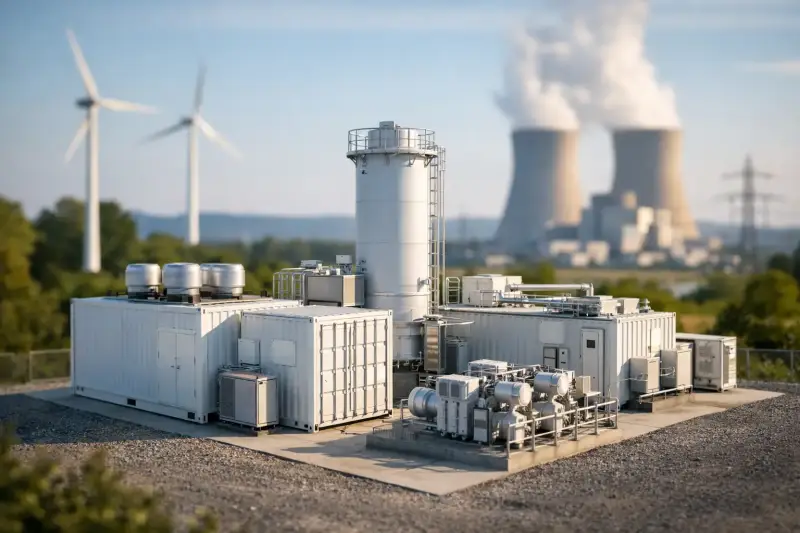
A 500 MW plant that takes seven years to permit, finance, and build solves a very different problem than a 5 MW to 50 MW system that can be deployed in phases, expanded with demand, and configured around heat, power, hydrogen-ready operation, or off-grid resilience. That is why modular power plant technology is no longer a niche engineering concept. It is becoming a serious infrastructure strategy for operators who cannot afford stranded capacity, unstable energy pricing, or long development timelines.
The appeal is not only speed. It is architectural control. A modular plant lets developers match generation to real load growth, stage capital deployment, and create application-specific energy blocks for industrial sites, data centers, greenhouses, ports, defense assets, mining operations, and regional grids. In markets where electrification pressure is rising while grid reinforcement lags, that flexibility has direct financial value.
What modular power plant technology actually changes
Traditional centralized generation has scale advantages, but it also carries structural penalties. Large plants often require oversized interconnection planning, major civil works, long supply chains, and a commercial model that assumes future demand with limited tolerance for deviation. If the load profile shifts, fuel economics change, or emissions rules tighten, the asset can lose efficiency in both thermodynamic and financial terms.
Modular power plant technology changes the design logic. Instead of one monolithic generation block, the plant is built from repeatable units that can operate independently, in parallel, or in staged sequences. That seems simple, but the implications are substantial. Redundancy improves because the failure of one module does not necessarily collapse the entire plant. Maintenance becomes more manageable because individual units can be isolated. Capacity planning becomes more precise because operators can add increments instead of overbuilding on day one.
This model also supports multi-output energy strategies. In many industrial settings, electricity is only part of the value equation. Usable heat, cooling, process steam, hydraulic work, desalination support, carbon capture integration, and fuel transition compatibility often determine project viability. A modular architecture can be designed around those outputs from the start rather than treating them as secondary recovery opportunities.
The real engineering question is not size, but operating stability
Many discussions about modular systems stay at the project-development level and miss the harder issue: whether each module can maintain high efficiency under variable real-world conditions. That is where architecture matters more than packaging.
A poor modular plant is just a cluster of conventional machines copied into a containerized format. It may be faster to deploy, but it still inherits the friction losses, part-load penalties, thermal instability, and maintenance profile of the underlying prime mover. In that case, modularity improves logistics more than performance.
A better approach is to build modules around a generation core that is inherently suited to controlled, repeatable operation. For industrial buyers, that means looking beyond nameplate output and asking deeper questions. How is combustion managed? What happens under fluctuating electrical and thermal load? How much parasitic loss is required to convert thermal energy into useful power? Can the system stay near its designed efficiency point while downstream demand moves?
Those questions determine whether modular power plant technology delivers a real step change or only a packaging upgrade.
Why fuel flexibility is becoming central to modular power plant technology
Five years ago, fuel flexibility was a strategic advantage. Increasingly, it is becoming a procurement requirement. Industrial operators and infrastructure investors are under pressure to reduce emissions without exposing operations to a single fuel pathway that may become expensive, constrained, or politically vulnerable.
That is one reason modular systems are gaining traction. They can be deployed on natural gas today, configured for CHP, and designed with a credible migration path toward hydrogen, ammonia-derived energy carriers, biogas, synthetic fuels, or hybridized operating modes. The best systems do this without forcing a full plant replacement at the point of fuel transition.
But fuel flexibility is not free. Different fuels have different flame characteristics, ignition behavior, storage needs, emissions profiles, and thermal transfer demands. A module that claims broad fuel compatibility without addressing combustion control, materials stress, and system stability should be evaluated carefully. Serious engineering teams want to see how the architecture handles those transitions, not just whether the marketing language says it can.
For this reason, next-generation developers are moving toward modular platforms that separate the energy conversion core from rigid legacy engine assumptions. Hydro Puls Systems has positioned this challenge correctly: the future plant is not simply a smaller conventional plant. It is an engineered energy platform designed to hold efficiency, maintain stable operating conditions, and deliver multiple outputs under changing load and fuel scenarios.
Where modular systems create the strongest economic case
The strongest business case for modular deployment usually appears where three conditions overlap: energy demand is mission-critical, load growth is uncertain or phased, and waste heat has real on-site value.
Greenhouse horticulture is a good example. Operators need dependable power, useful heat, and often CO2 integration strategies. A modular CHP plant can be sized to current production while leaving room for future expansion. If one module is serviced, the site keeps operating. The economics improve further when thermal output is directly monetized.
Data centers present a different pattern. Here the priority is resilience, expansion speed, and increasingly the ability to pair firm generation with emissions strategy. A modular plant can support staged capacity additions aligned with server deployment rather than forcing one oversized generation decision upfront.
Remote industry, desalination, mining, island grids, ports, and defense installations all share a related constraint: waiting for transmission reinforcement is often more expensive than building local generation. In these cases, modularity reduces schedule risk and allows capacity to track operational reality.
That said, there are cases where central plants still win. Very large, stable baseload applications with strong grid access and long planning horizons may still favor conventional utility-scale infrastructure. Modularity is not automatically superior in every scenario. Its advantage grows when uncertainty, speed, redundancy, and multi-output value matter more than pure single-site scale.
The hidden value is in integration, not just generation
Industrial buyers rarely need electricity alone. They need integrated energy systems that can support pumps, thermal loops, process equipment, district heating interfaces, storage systems, microgrids, and future carbon management requirements. This is where many projects succeed or fail.
A modular plant should be evaluated as a systems-integration platform. Can it support black-start capability? Can it be paired with thermal storage, batteries, or carbon capture equipment without destroying the economics? Can it directly serve mechanical or hydraulic work where electrical conversion would introduce unnecessary losses? Can controls coordinate multiple modules to optimize efficiency instead of simply rotating runtime hours?
These are not secondary questions. They define long-term return on capital. A module that appears inexpensive at procurement but requires complex balance-of-plant adaptation, high maintenance labor, or poor part-load performance can quickly become the more expensive asset.
For OEMs and engineering partners, this is where differentiated architecture becomes decisive. A system designed around lower friction, reduced parasitic loss, controlled thermal behavior, and direct coupling to useful work has a fundamentally different integration profile than conventional crankshaft-based machinery. That difference compounds over time through fuel savings, service intervals, thermal recovery quality, and dispatch flexibility.
What buyers should demand before backing a platform
The market is now crowded with containerized generation claims. Buyers should separate real modular power plant technology from repackaged legacy hardware by demanding proof at four levels: thermodynamic logic, mechanical architecture, validation data, and application-specific performance.
Thermodynamic logic means the efficiency claim makes sense from first principles. Mechanical architecture means the conversion pathway is not burdened by avoidable losses. Validation data means test results, operating envelopes, and load-response behavior are documented. Application-specific performance means the vendor can show how the plant behaves in your environment, not in an idealized brochure scenario.
This is particularly important for strategic investors and utilities. The right modular plant can reduce CAPEX exposure by phasing deployment, lower OPEX through improved efficiency, and reduce transition risk by preserving fuel optionality. The wrong one can multiply asset complexity under the appearance of flexibility.
The next generation of power infrastructure will not be defined only by megawatts. It will be defined by how intelligently those megawatts are packaged, controlled, expanded, and connected to real industrial value. Buyers who understand that shift will make better decisions earlier - and they will avoid locking tomorrow’s energy system into yesterday’s machine logic.
The practical question is no longer whether modularity belongs in serious power planning. It is which architecture can turn modularity into measurable performance instead of just faster installation.