HPDD Tactical Drone
Hydro Puls Direct-Drive (HPDD) Platform: Micro-Modular Airborne Hybrid Cores
🌐 Transforming Aviation Architecture: Overcoming the Drone Endurance Limit
Modern heavy-payload industrial drones and unmanned aerial vehicles (UAVs) have reached a fundamental barrier in aerospace engineering. Traditional power systems impose severe penalties on flight dynamics:
- The Lithium Battery Wall: Standard electrochemical battery packs introduce massive dead weight, suffer steep conversion efficiency losses across fluctuating high-altitude temperature ranges, and limit total flight times to a narrow 20-to-40-minute window.
- The Rotating Mechanical Fatigue Tax: Legacy small internal combustion engines suffer rapid bearing fatigue due to intense high-frequency vibrations. Additionally, heavy mechanical crankshafts and complex parasitic oil lubrication systems create significant dead-weight overhead, destroying the aircraft's net power-to-weight ratio.
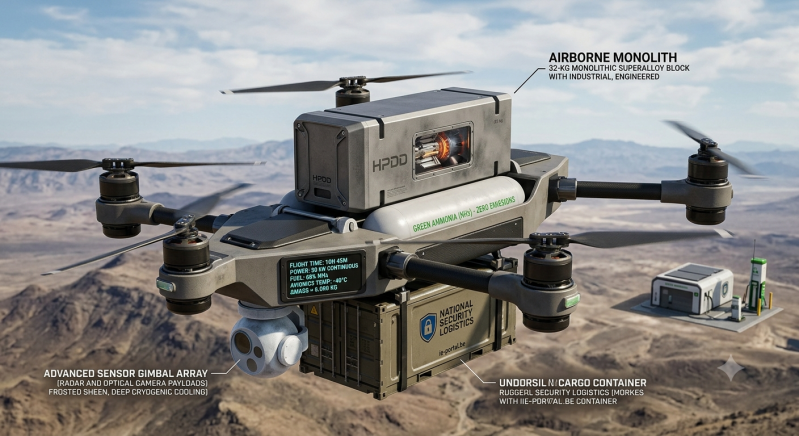
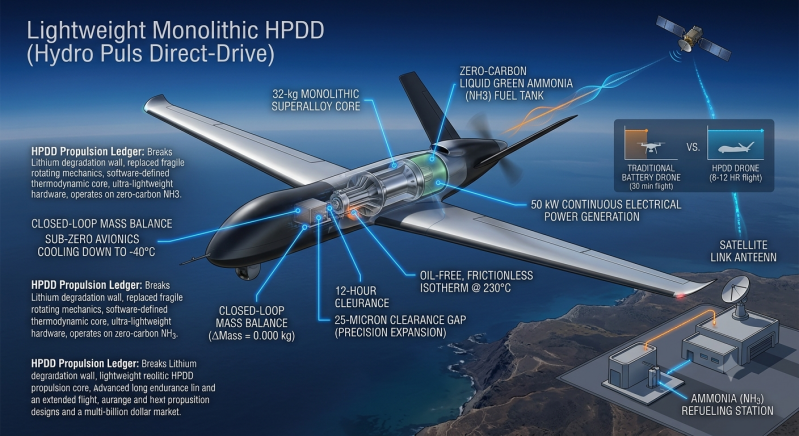
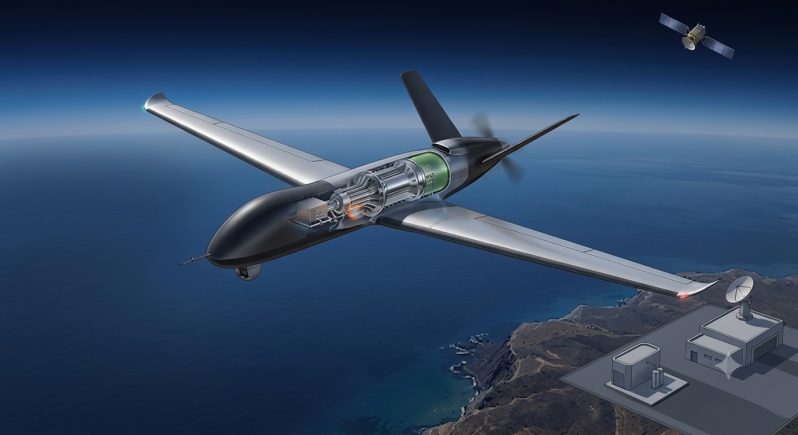
The Airborne HPDD Hybrid Power Core completely bypasses these operational restrictions. By replacing fragile, field-assembled mechanical machinery with a crankshaft-free linear engine matrix housed within a 32-kg monolithic superalloy block, Hydro Puls delivers an aerospace-grade, multi-decade alternative. Running continuously on liquid carbon-free Green Ammonia ($NH_3$), this technology shifts industrial drone assets into automated airborne resource refineries—expanding flight endurance from minutes to 8 to 12 hours of continuous flight.
📊 Core System & Design Specifications
The modular platform operates as an ultra-high-density hybrid power source under rigid engineering boundaries:
SpecificationTarget ValueCore Net Electrical Power Output 50 kW continuous onboard generation
Prime Fuel Source IntegrationCarbon-Free Liquid Green Ammonia (NH_3) direct injection
Baseline Core Engine Weight 32 kg total mass
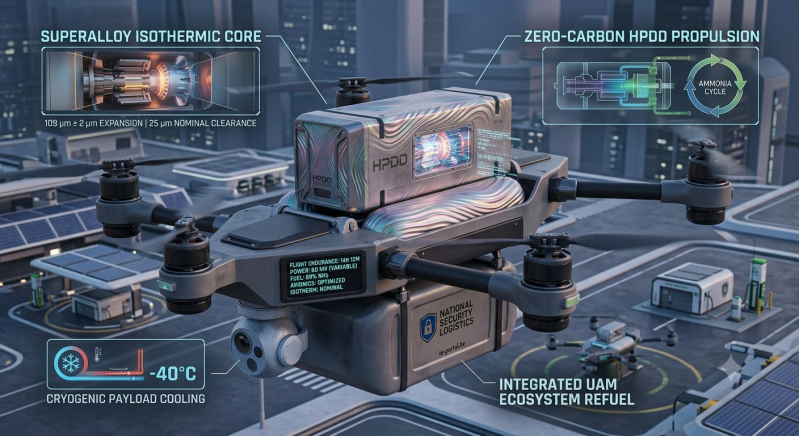
Thermal Operational Standard 25-micron frictionless fluidic nominal clearance gap locked at a strict 230C wall isotherm
Targeted Flight Endurance8 to 12 HOURS continuous flight time
Mass Balance Variance: absolute balance lock
⚙️ Step-by-Step Thermochemical Process Trace
The 50-kW airborne HPDD core operates through five synchronized thermodynamic states over each continuous 100 Hz pulse cycle window:
Phase 1: High-Pressure Non-Lubricated Linear Compression (600 BAR / 210C)
Liquid Green Ammonia is vaporized using native exhaust heat and compressed up to 600 BAR inside our micro-modular linear cylinder boring. The design deletes traditional mechanical crankshafts, connecting rods, and high-friction oil lubrication networks that jeopardize flight safety. Instead, two pairs of dual-opposed linear pistons float entirely on an electronically controlled high-pressure gas shield, completely eliminating structural friction and mechanical wear while elevating the internal gas temperature to 210C.
Phase 2: Ultra-Lean Isothermal Combustion (600 BAR / 1,000C)
The compressed ammonia-air mixture undergoes complete, ultra-lean combustion (lambda \approx 3.4) inside the combustion chamber, absorbing native high-grade endothermic exhaust enthalpy to flash the temperature up to 1,000C. To prevent uneven thermal expansion and cylinder seizing during intense high-altitude aviation maneuvers, the engine block is wrapped inside an unpressurized siloxane liquid thermal jacket, hard-locking the internal walls at a strict 230C isotherm. Under this standard, the Inconel 718 components expand identically and symmetrically by exactly 109mu, permanently preserving a flawless 25-micron frictionless fluidic clearance gap.
Phase 3: Low-Parasitic Cold Collapse & Direct Generation
The rapid linear movement of the pistons translates directly into high-density electrical energy via direct-coupled linear alternators, delivering a continuous 50 kW of clean power directly to the drone's electric rotor motors. Simultaneously, the expansion physics of our integrated De Laval loops co-generate industrial sub-zero process cooling down to $-40^\circ\text{C}$ with exactly 0.0 kW parasitic HVAC load. This thermal energy is instantly channeled to keep the drone's onboard avionics, radar tracking systems, and high-intensity optical payloads perfectly chilled during long-range flights.
🛠️ Intrinsic Risk Mitigation & Materials Metallurgy
To guarantee zero structural cracking or component degradation under relentless, continuous $24/7$ industrial workloads, the HPDD core integrates native mechanical and thermodynamic insulation parameters:
- Coaxial Fluidic Shielding: Raw fuel inputs are never allowed to establish direct wall contact through the De Laval throat. Utilizing real-time 100 kHz automated software layers, we establish a specialized coaxial fluid dynamics architecture. The superheated, high-density carrier loop forms a protective, high-velocity aerodynamic boundary sleeve around the core influx, preventing structural wear.
- Sintered Silicon Carbide & Diamond Nanograin Metallurgy: The physical throat itself is machined from ultra-dense, pressureless sintered Alpha-Silicon Carbide (-SiC) a monolithic ceramic possessing extreme structural hardness and exceptional thermal shock resistance up to 1,600C. To ensure complete wear immunity under intense acoustic decompression waves, this monolithic substrate is electroplated with an 800,000+ psi tensile strength diamond-particle micro-matrix via advanced nanograin metallurgy, rendering the throat surface chemically inert and immune to mechanical erosion.